Deduction: Difference between revisions
No edit summary |
No edit summary |
||
| (52 intermediate revisions by the same user not shown) | |||
| Line 1: | Line 1: | ||
[https://plato.stanford.edu/entries/aristotle/ Aristotle], the first logician, defined deduction as follows: | |||
A deduction is an | <blockquote>A deduction is an argument in which, certain things being laid down, something other than these necessarily comes about through them. (''Topics'' I.1 100a25-27)</blockquote> | ||
The premises are the "things laid down" and the conclusion is what comes about necessarily through them, so another way to put Aristotle's definition is to say that ''a deduction is an [[inference]] in which the premises necessitate the conclusion''. That means that the premises' being true would make the conclusion ''have to be'' true. It will be easier to see what's meant by "necessitate" or "have to be" if we look at some examples. | |||
=Example 1: "Barbara"= | |||
{{Map|https://app.reasonspace.com/arguments/916b58e1-07e7-484c-adf9-2cb8897c1eb7}} | |||
Let’s focus on the first of these examples, Argument U. Proposition 1 tells us that all birds are animals, and Proposition 2, adds that all parrots are birds, so if we were to deny Proposition 3, it would amount to our saying "All birds are animals, and here's a type of bird that isn't." We'd be caught in a contradiction. This is the sense in which Inference U necessitates Proposition 3. | |||
Notice that it is not because of anything special about the subject matter that the premises necessitate the conclusion. If we changed the argument to be about Volkswagens, cars, and Jettas, rather than birds, animals, and parrots, the premises would still necessitate the conclusion in exactly the same way. The same holds if we changed the argument to make it about musicians, matadors, and marriage counselors. In this last case, both premises would be false, but if they were true (that is, if all musicians were matadors and all matadors were marriage counselors), then the conclusion would have to be true: all musicians would ''have to'' be marriage counselors. What makes the deduction work doesn’t have to do with the subject matter of the propositions involved, but with their structure and interrelation. This is called the ''form'' of the argument. | |||
Argument V (in the map above) has the same form as Argument U. If you don’t see this immediately, try rewriting the phrase “need food” with “are things that need food” or “are food-needers”. | |||
In order to focus on the forms of deductive arguments rather than their content, Aristotle introduced the practice of using letters to stand for the subjects and predicates of the propositions, leaving behind only words like “some”, “all”, “no”, “is” and “not” (and their variants). Argument W (in the map above) uses letters in this way to display the Form of argument shared by Arguments U and V. It is one of the [[Aristotelian_Syllogisms |forms identified by Aristotle]], and it was named [[Aristotelian_Syllogisms#Barbara|Barbara]] by Medieval Philosophers who studied his logic. You can replace the capital letters S, M, and P with any terms you like, and you'll get a deductive argument. | |||
=Example 2: "Modus Tollens"= | |||
Here are three maps that illustrate another form of argument, called [[Deductions_Involving_Complex_Propositions#Modus_Tollens|modus tollens]]: | |||
{| | {{Map|https://app.reasonspace.com/arguments/9df82f8daf9f49c5b32f9a2b19a0d373}} | ||
Arguments X and Y share the same form, which is described in Argument Z. The letters "p" and "q" (in Argument Z) stand for whole propositions in the other two arguments, as shown in the table below. | |||
{| class="wikitable" | {| class="wikitable" | ||
| | |'''Argument X''' | ||
|'''Argument Y''' | |||
|'''Argument Z''' | |||
|- | |- | ||
| | |It is raining now. | ||
| | |Daddy likes coffee. | ||
|p | |||
| | |||
|- | |- | ||
| | |I feel wet. | ||
|I've seen daddy drink coffee. | |||
|q | |||
|} | |} | ||
(If you just mechanically substitute the relevant words in for the letters p and q, you won't always get grammatical sentences, so you need to edit the wording a bit. But with a little bit of practice, it's easy to see which arguments fall into this form.) | |||
The propositions in a modus tollens argument can be thought of as complex propositions. The first premise is relating two other propositions (p and q) telling you that if the first is true, then the other also is. The second premise is telling you that the second proposition (q) is not true, and the conclusion is that the first one (p) isn't true either. The premises might be false, but if they are true, then the conclusion would have to be. | |||
=The strength of a deduction= | |||
[[ | Unlike other sorts of inferences, deductive inferences do not differ from one another in strength. Either an inference is deductive, or it is not. However, there are some forms argument that may seem like deductions but are not. We can call these [[Deductive_Fallacies|deductive fallacies]]. To differentiate between the genuine deductions and the imposters, logicians call the genuine ones ''valid'', and they call any argument that isn't a deduction (but which someone might mistake for one) ''invalid''. | ||
All valid deductive arguments have equally strong inferences, but this doesn’t mean that the arguments are equally strong taken as wholes. The can differ in strength because their premises may differ in epistemic status. Thus, the two things to do in evaluating a deductive argument are to determine whether it is valid and to assess the premises. | |||
Deduction is the most studied form of argument and many valid deductive argument forms have been identified. Even without knowing these forms explicitly, one can often tell simply by asking oneself whether the premises and conclusion of an argument are related in such a manner as to preclude any scenario under which the premises would be true and the conclusion false. | |||
Since every deduction is as strong as an inference can be, no deduction can be stronger than any other. Thus, on a scale representing the strength of inferences, we must represent deduction, not as a range, but as a point on the far right. | |||
[[file:deduction.png|thumb|center|600px]] | |||
=Determining whether an inference is a (valid) deduction= | |||
To determine whether an inference is a (valid) deduction, one needs to consider whether it has a (valid) [[deductive form]]. One can memorize the forms, and try to apply them, but even without doing this, you simply ask yourself whether the premises and conclusion are so related that it is impossible for the conclusion to be false, if the premises are true. Sometimes the answer will be immediately obvious. If it's not, try to make up an argument of the same form with true premises and a false conclusion. If you can make one up, then the argument isn't a valid deduction. If you can't, then there's a good chance that it is. | |||
Even when the argument seems to have a valid deductive form like [[Barbara]] or [[Modus Tollens]], one has to check for the fallacy of [[equivocation]], since if a word appears with different meanings in different parts of an argument, the argument may not really have the form it appears to. | |||
=Are deductive arguments better than other arguments?= | |||
You might have gotten the impression from this section that deductive arguments are better than other kinds of arguments. There’s a respect in which this is true: their inferences are stronger. However, an argument is only as good as its premises, and the premises of deductions always either include universal propositions (of the "All S is P" or "No S is P") or complex propositions that asserting something about the relations between other propositions. Premises of both of these types are often difficult to know to be true. So a deduction is usually the easy part of a larger chain of arguments, in which earlier non-deductive arguments establish the premises needed for the deduced conclusion. | |||
deductions are (for the most part, at least) generalizations, all (or nearly all) of which are established by other forms of argument. Given this, is it more accurate to view deduction as the easier and more straightforward part of a process whose more difficult part is the arguments that establish the general propositions used as premises in the deductions. The primary form of argument by which these general propositions are established is [[induction]]. | |||
Latest revision as of 13:41, 22 August 2025
Aristotle, the first logician, defined deduction as follows:
A deduction is an argument in which, certain things being laid down, something other than these necessarily comes about through them. (Topics I.1 100a25-27)
The premises are the "things laid down" and the conclusion is what comes about necessarily through them, so another way to put Aristotle's definition is to say that a deduction is an inference in which the premises necessitate the conclusion. That means that the premises' being true would make the conclusion have to be true. It will be easier to see what's meant by "necessitate" or "have to be" if we look at some examples.
Example 1: "Barbara"
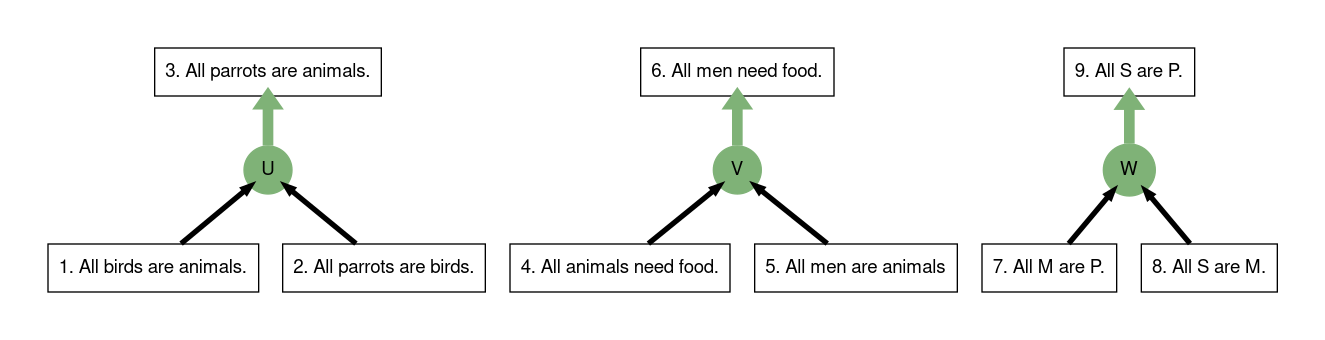
Let’s focus on the first of these examples, Argument U. Proposition 1 tells us that all birds are animals, and Proposition 2, adds that all parrots are birds, so if we were to deny Proposition 3, it would amount to our saying "All birds are animals, and here's a type of bird that isn't." We'd be caught in a contradiction. This is the sense in which Inference U necessitates Proposition 3.
Notice that it is not because of anything special about the subject matter that the premises necessitate the conclusion. If we changed the argument to be about Volkswagens, cars, and Jettas, rather than birds, animals, and parrots, the premises would still necessitate the conclusion in exactly the same way. The same holds if we changed the argument to make it about musicians, matadors, and marriage counselors. In this last case, both premises would be false, but if they were true (that is, if all musicians were matadors and all matadors were marriage counselors), then the conclusion would have to be true: all musicians would have to be marriage counselors. What makes the deduction work doesn’t have to do with the subject matter of the propositions involved, but with their structure and interrelation. This is called the form of the argument.
Argument V (in the map above) has the same form as Argument U. If you don’t see this immediately, try rewriting the phrase “need food” with “are things that need food” or “are food-needers”.
In order to focus on the forms of deductive arguments rather than their content, Aristotle introduced the practice of using letters to stand for the subjects and predicates of the propositions, leaving behind only words like “some”, “all”, “no”, “is” and “not” (and their variants). Argument W (in the map above) uses letters in this way to display the Form of argument shared by Arguments U and V. It is one of the forms identified by Aristotle, and it was named Barbara by Medieval Philosophers who studied his logic. You can replace the capital letters S, M, and P with any terms you like, and you'll get a deductive argument.
Example 2: "Modus Tollens"
Here are three maps that illustrate another form of argument, called modus tollens:

Arguments X and Y share the same form, which is described in Argument Z. The letters "p" and "q" (in Argument Z) stand for whole propositions in the other two arguments, as shown in the table below.
| Argument X | Argument Y | Argument Z |
| It is raining now. | Daddy likes coffee. | p |
| I feel wet. | I've seen daddy drink coffee. | q |
(If you just mechanically substitute the relevant words in for the letters p and q, you won't always get grammatical sentences, so you need to edit the wording a bit. But with a little bit of practice, it's easy to see which arguments fall into this form.)
The propositions in a modus tollens argument can be thought of as complex propositions. The first premise is relating two other propositions (p and q) telling you that if the first is true, then the other also is. The second premise is telling you that the second proposition (q) is not true, and the conclusion is that the first one (p) isn't true either. The premises might be false, but if they are true, then the conclusion would have to be.
The strength of a deduction
Unlike other sorts of inferences, deductive inferences do not differ from one another in strength. Either an inference is deductive, or it is not. However, there are some forms argument that may seem like deductions but are not. We can call these deductive fallacies. To differentiate between the genuine deductions and the imposters, logicians call the genuine ones valid, and they call any argument that isn't a deduction (but which someone might mistake for one) invalid.
All valid deductive arguments have equally strong inferences, but this doesn’t mean that the arguments are equally strong taken as wholes. The can differ in strength because their premises may differ in epistemic status. Thus, the two things to do in evaluating a deductive argument are to determine whether it is valid and to assess the premises.
Deduction is the most studied form of argument and many valid deductive argument forms have been identified. Even without knowing these forms explicitly, one can often tell simply by asking oneself whether the premises and conclusion of an argument are related in such a manner as to preclude any scenario under which the premises would be true and the conclusion false.
Since every deduction is as strong as an inference can be, no deduction can be stronger than any other. Thus, on a scale representing the strength of inferences, we must represent deduction, not as a range, but as a point on the far right.

Determining whether an inference is a (valid) deduction
To determine whether an inference is a (valid) deduction, one needs to consider whether it has a (valid) deductive form. One can memorize the forms, and try to apply them, but even without doing this, you simply ask yourself whether the premises and conclusion are so related that it is impossible for the conclusion to be false, if the premises are true. Sometimes the answer will be immediately obvious. If it's not, try to make up an argument of the same form with true premises and a false conclusion. If you can make one up, then the argument isn't a valid deduction. If you can't, then there's a good chance that it is.
Even when the argument seems to have a valid deductive form like Barbara or Modus Tollens, one has to check for the fallacy of equivocation, since if a word appears with different meanings in different parts of an argument, the argument may not really have the form it appears to.
Are deductive arguments better than other arguments?
You might have gotten the impression from this section that deductive arguments are better than other kinds of arguments. There’s a respect in which this is true: their inferences are stronger. However, an argument is only as good as its premises, and the premises of deductions always either include universal propositions (of the "All S is P" or "No S is P") or complex propositions that asserting something about the relations between other propositions. Premises of both of these types are often difficult to know to be true. So a deduction is usually the easy part of a larger chain of arguments, in which earlier non-deductive arguments establish the premises needed for the deduced conclusion.
deductions are (for the most part, at least) generalizations, all (or nearly all) of which are established by other forms of argument. Given this, is it more accurate to view deduction as the easier and more straightforward part of a process whose more difficult part is the arguments that establish the general propositions used as premises in the deductions. The primary form of argument by which these general propositions are established is induction.