Equivocation
Jump to navigation
Jump to search
The fallacy of equivocation is an argument which exploits the ambiguity of a term or phrase which has occurred at least twice in an argument, such that on the first occurrence it has one meaning and on the second another meaning. (Hans Hansen, SEP)
Here is an example of an equivocation:
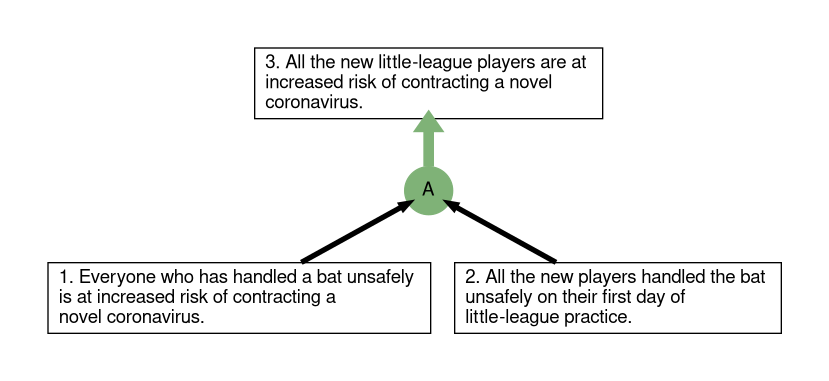
In Proposition 1, the word "bat" refers to a type of flying rodent. In Proposition 2, the same word refers to an item of baseball equipment. But Inference A, depends on the word meaning the same thing in the two premises. If the word did mean the same thing, then the inference would be a deduction (specifically an instance of the deductive form Barbara), but since the word means different things in the two premises, the argument is a non sequitur.