Arguments: Difference between revisions
Mebenstein (talk | contribs) No edit summary |
Mebenstein (talk | contribs) No edit summary |
||
| Line 223: | Line 223: | ||
{| class="wikitable" | {| class="wikitable" | ||
||{{Map|https://app.reasonspace.com/maps/6fb07cfb-d63f-49e9-b4a7-b9ea21477119}} | ||{{Map|https://app.reasonspace.com/maps/6fb07cfb-d63f-49e9-b4a7-b9ea21477119}} | ||
|{{Map|https://app.reasonspace.com/ | |{{Map|https://app.reasonspace.com/arguments/eb7e93c1-6222-4e24-beab-ffb67dafb29c}} | ||
|- | |- | ||
|Barbara | |Barbara | ||
Revision as of 11:32, 24 March 2023
When philosophers and logicians speak of "arguments," we're not talking about verbal fights—heated exchanges about who wronged whom-or about politics. These exchanges often involve *arguments* (in the relevant sense of the term), but arguments are involved also in much of our ordinary, pleasant conversation, and in the thinking, we do in the privacy of our own heads. You argue throughout the day every day and you've been doing it since you were a small child. It's one of the things you learned to do as you learned to speak. To argue is simply to give a *reason* for something. Here's an example from my two-year-old child, when he was just transitioning from diapers to underwear. At first, he wore the underwear only on the weekends (when he was home from school), but once he got proficient enough with the toilet, we started dressing him in underwear on school days too. The first time this happened he resisted. "No," he said, reaching for a diaper, "It's not the weekend anymore." He was giving it's not being the weekend as a reason for wearing a diaper today, rather than underwear. This is a case of his giving *us* a reason for something he wanted, but it's clear from observing and talking to him that he's doing this in the privacy of his own head as well: he's regarding certain things he knows to take certain actions or reach certain conclusions. For example, when I told him that it was his Grandfather's birthday, he concluded from this fact that his grandfather would probably eat cake and walk around (a replica of) the sun (as children in his Montessori school do on their birthdays).
You learned how to argue in your first years of life, as part of learning how to speak and think. During this same period, you learned how to walk and how to grasp and manipulate objects. But you learned all of these things *implicitly*—that is, without naming in words what you were doing and how. You learned many words before you knew the word “word,” and you learned how to put words together into sentences before you had the word “sentence” or words for the parts of speech (much less for the rules of grammar). You also learned how to walk, without yet knowing the word "walk," much less knowing words for the parts of your legs or for specific types of steps or for flexing and unflexing various muscles. You may have never thought much about *how* to walk, but if you’ve ever had physical therapy to recover from an injury or taken a movement class as part of learning how to dance or to act, you may have learned to analyze the act of walking into (named) component parts. Doing so gives you more control over the way you walk. When athletes train, they often learn to analyze movements they learned as a child into simpler movements, and this process gives them finer-grained control over their movements. It is likewise possible to gain greater control of your thinking by analyzing the simpler activities that make up complex thinking. In this article, we’re going to focus on "arguing" which is a central part of thinking. We will discuss how to analyze an argument into its parts, and how to use this analysis to methodically assess an argument.
Propositions
Before we discuss arguments in earnest, it will be helpful to say a bit about propositions, which are the smaller units of thought from which arguments are composed. A proposition is the sort of thought that is capable of being true or false, believed or disbelieved, and asserted or denied. Such thoughts are asserted by declarative sentences. Here are some examples:
1. Healthy grass is green.
2. O. J. Simpson killed Nicole Brown.
3. Twice two is four.
4. Twice two is five.
5. Many diseases are caused by bacteria.
6. Stalin was evil.
7. Joe Biden is the 46th President of the United States.
8. Either a Republican or a Democrat will win the 2024 Presidential election.
9. The Senate should have convicted Donald Trump in both of his impeachment trials.
10. Hillary Clinton would have been an awful president.
The proposition is not the same thing as the sentence asserting it because the same thought can be asserted by different sentences. For example, here are several different ways of asserting Proposition 3 from the list above:
3a. Twice two is four.
3b. Two times two is four.
3c. 2 x 2 = 4
3d. Deux fois deux c'est quatre.
3e. 兩次兩次是四次。
Sentences 3a and 3b are two different ways of asserting the same proposition in English. 3c is a way of asserting it in mathematical notation, 3d is a way of asserting it in French, and 3e is a way of asserting it in Chinese.
Another reason why a proposition is not the same thing as a sentence is that propositions can be asserted as parts of more complex sentences that include multiple propositions. For example, here’s a sentence that asserts both Propositions 9 and 10 from the list above: "Even though Hillary Clinton would have been an awful president, the Senate should have convicted Donald Trump at both of his impeachment trials."
Some of the propositions from the list above are uncontroversially true and others are uncontroversially false. I expect that everyone in the class will agree that Propositions 1, 3, 5 and 7 are true and that Proposition 4 is false. We will probably disagree over some of the others—with some students thinking they’re true and others thinking they’re false.
Some of you may think that some of the propositions we may disagree over aren’t really the sort of things that can be true or false at all. In particular, some of you may think this about Propositions 6, 9, and 10, because these propositions express evaluations. Some people think that evaluations aren’t the sorts of things that can be true or false. But even if you think this, you’ll have noticed that many people believe or disbelieve each of these propositions (and many other evaluations) as though they were true or false, and they make arguments to try to convince other people that these propositions are true or false. So, to understand their role in arguments you’ll have to treat them as the sort of thing that can be true or false.
The Anatomy of an Argument
As the term is used in philosophy, an argument is a set of related propositions (called premises) that is given as a reason for believing a further proposition (called the conclusion). Consider, for example, the following, simple argument:
Whoever murdered Carl had to have access to his rose garden at midnight, and the only person who did was Natalie, therefore Natalie must be the murderer.
Here the conclusion is that Natalie murdered Carl, and there are two premises: (1) that whoever murdered Carl had access to Carl’s rose garden at midnight, and (2) that only Natalie had such access.
There are a few ways in which we can represent an argument that makes its structure clearer. One popular way is called *standard form*. Here’s what the argument we have been discussing looks like in standard form:
| 1. Whoever murdered Carl had access to his rose garden at midnight.
2. Only Natalie had access to Carl’s rose garden at midnight. |
| 3. Natalie murdered Carl. |
Each proposition has been written on its own line and labeled with a number. The premises are written first, and a line is drawn to separate them from the conclusion. This line represents the inference—the mental act of moving in thought from the premises to the conclusion.
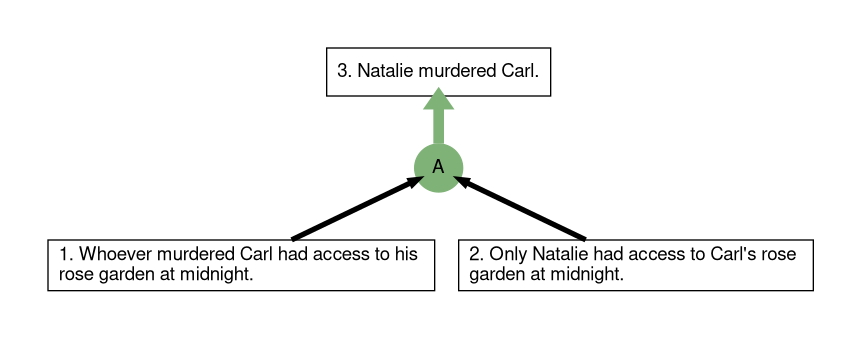
A newer way of representing the structure of arguments is called “argument mapping.” Here’s a map of the argument we’ve been discussing.
| Map 1: |
|
In the map, each proposition is written in its own box and labeled with a number. The inference is represented by a green circle that tapers to a point and labeled with a letter (we call this the *inference symbol*). Thin lines connect the inference symbol's round bottom to the boxes containing the premises, and a thicker line with an arrow at the end connects the symbol's top to the box containing the conclusion.[1]
The standard form is more compact, but (as we'll see) argument mapping enables us to visualize the relationships between multiple arguments.
Both ways of representing the argument highlight make it easy to see that Propositions 1 and 2 combine to provide a reason to believe Proposition 3. Another way we can express this point is to say that Propositions 1 and 2, taken together, are meant to help us to tell that Proposition 3 is true.
Notice that it is only when we take them *together* that Propositions 1 and 2 give us a reason to believe Proposition 3. If you knew that only Natalie had access to Carl's rose garden at midnight, then learning that whoever killed Carl must have had access to the rose garden would put you in a position to tell that Natalie was the murderer. But if you didn't know anything about who had access to the rose garden, then learning that whoever committed the murderer had access, wouldn't give you any reason to suspect Natalie. Likewise, if you already knew that the killer had to have access to the rose garden, then learning that Natalie was the only one with access would put you in a position to know that she did it. But if you didn't know anything linking the rose garden to the murder, then learning that Natalie was the only one with access to it wouldn't give you any reason to suspect her of the crime. Only when the premises are put together do they link Natalie to the crime, that's what makes these *two* premises into a *single* argument.
The map represents this relationship by having the lines from the two premises go to a single inference symbol (labeled A) from which a single arrow points to the conclusion.
Uses of Argument
If you were trying to convince someone, perhaps a jury, of Natalie’s guilt, you might present them with the argument we discussed in the last section. Or, you might formulate this argument silently to yourself in the course of trying to figure out who killed Carl. In either case, we would say that you inferred that Natalie was Carl’s murderer from the premises that the murderer had access to the rose garden at midnight and that only Natalie had such access.
We tend to think of making arguments in situations where people disagree and are trying to convince each other (or to convince some third party). This is the case when people argue in court or around a dinner table, but this is not the only use of arguments, nor is it their fundamental use. Much of what we know is based on other knowledge and inference is the process by which we reach new knowledge from old. It is only because of arguments that we know many of the things we do, and it is only by further arguments that we can come to know many of the things we would like to learn.
Let’s survey some of the areas in which much of our knowledge is due to inference. Arguments like the one concerning Carl and Natalie enable us to know who committed crimes for which there were no eyewitnesses. In the natural sciences, almost everything we know beyond the basic data (consisting of observations and measurements) is reached by inference, as is much of our knowledge in higher mathematics.[2] Our knowledge of the future is inferred from what we know about the past and present, and likewise our knowledge of the distant past (beyond the scope of our memories) is also based on argument. In some cases, we have firsthand accounts from people who claim to have observed or taken part in various historical events, but there are questions about the honesty and accuracy of these reports (especially when some contradict others), so we need arguments to determine which accounts we can rely on.
Inference is a crucial part of how you as an individual come to know the world. It’s a process that’s fallible and sometimes it results in errors—beliefs that aren’t really knowledge. When two people argue with one another—if they’re arguing honestly—they are each sharing some of the reasons they have for their beliefs. Each is trying to teach the other some of what he thinks he knows, and each can help the other identify errors in his own thinking.
Of course, people also often argue with one another dishonestly. Think of a conman who sells a bogus medicine and gives arguments to trick sick people into believing that his medicine will cure their illnesses. The conman knows that the conclusion he’s trying to convince them of is false—or, at least, he doesn’t really care if it is true. His goal is not to help them to tell what’s true, but to get them to believe a conclusion that he wants them to believe, regardless of whether it is true. It is possible to be dishonest with oneself in this same way. You may not be able to work to convince yourself of something you self-consciously know is a lie, but people often make arguments to convince themselves of things that they want to believe—or that they think they are supposed to believe—regardless of whether the things are really true. For example, someone who suspects her husband of having cheated may not want to believe it because she finds the idea too painful, or she may feel guilty for believing it because she thinks she is supposed to trust him. In either case, she may fish around for arguments to convince herself that he is faithful.
This brings me to an important point of clarification. Earlier I said that an argument is meant to give us a “reason to believe” its conclusion. When we speak of the reasons we have for performing an action, we usually have in mind either some goal that we hope to achieve by performing the action, or some obligation that we think we have for taking it. These are called pragmatic or practical reasons. In contrast, arguments give epistemic reasons, which help one to tell that a conclusion is true and thereby put one in a position to know it.
The primary use of arguments is to tell what is true. A secondary use is to persuade oneself or others that something is true. We can distinguish two forms of persuasion, which we might call "honest" and "dishonest." In honest persuasion, you articulate your own actual reasons for thinking the conclusion is true, in order to persuade someone else of it or to make it clearer in your own mind. In dishonest persuasion you come up with reasons to convince someone of something without regard for whether that thing is really true. Thus a dishonest lawyer or salesman might try to persuade someone of the innocence of his client or the quality of his wares by appealing to premises that he knows are false (or has no reason to think are true), but that he thinks his audience is likely to believe. Or he may use arguments that seem strong at first glance, but don't stand up to scrutiny. Not all sorts of dishonest persuasion stem from trying to make money or advance one's career (as these two cases do). People also argue dishonestly to impress others or to feel important themselves.
It is possible to engage in dishonest persuasion with oneself as well as with others. This often happens when someone wants to believe something (or thinks that he is supposed to believe it). Thus someone in an unhappy marriage might try to convince himself that he and his spouse are happy together, despite the growing evidence that they are not, or someone who has grown up in a family that professes certain beliefs and feels that he's supposed to believe them, might try to convince himself that they're true. We can call this dishonest reasoning with oneself, rationalizing, or BSing oneself. It is often hard to tell whether someone is being honest or dishonest in his use of arguments, and it can sometimes even be difficult to tell in one's own case. However, the essential difference between the two ways of arguing is clear: either arguments are used in an attempt to tell what's true (and to share this with others), or one using them to defend a position that one is committed to defending regardless of its actual merits. Genuine reasoning is the attempt to tell what's true, and dishonest uses of arguments are just attempts to fake (to oneself or others) that one is engaged in this process.
Relations Between Arguments
Our reasoning isn’t usually made up of single, isolated arguments, but of complex sets of interrelated arguments. And argument mapping helps us to visualize and understand these relations. In this section, we’ll consider how the argument we looked at earlier concerning Natalie might be related to other arguments. Before we do that, let’s review the simple map of that argument and get clear on how we are going to refer to each of its parts.
| Map 1 |

Each box contains a numbered proposition. We’ll refer to them as “Proposition 1,” “Proposition 2,” and “Proposition 3.” The green circle represents the act of inference, and we’ll refer to it as “Inference A.” We’ll use the phrase “Argument A” to refer to the whole argument, which includes the inference, along with its premises and the conclusion.
With this terminology under our belts, we can look at and discuss more complex maps that show relations between arguments.
One way in which arguments can be related is by sharing the same conclusion. Here’s an example:
| Map 2: |

|
Argument B has the same conclusion as Argument A. They are two distinct arguments because they give separate reasons for believing the conclusion. To see that the reasons are separate, pick one of the premises from either argument and think about what other premises you would need to combine it with before it would give you a reason to think that Natalie murdered Carl. We already discussed how Propositions 1 and 2 have to be put together before either provides a reason for *suspecting* that Natalie murdered Carl. But if you know that both of these propositions are true, you're in a position to *know* that Natalie is the murderer regardless of whether you know any of Propositions 4–6. Likewise, if you knew Propositions 4–6, they'd put you in a position to know that Natalie did it, even if you didn't know Proposition 1 or 2. But you would need to know *all three* Propositions 4, 5, and 6, for them to put you in a position to know that Natalie was guilty; no one or two of them would do it alone.[3]
Chains of Argument
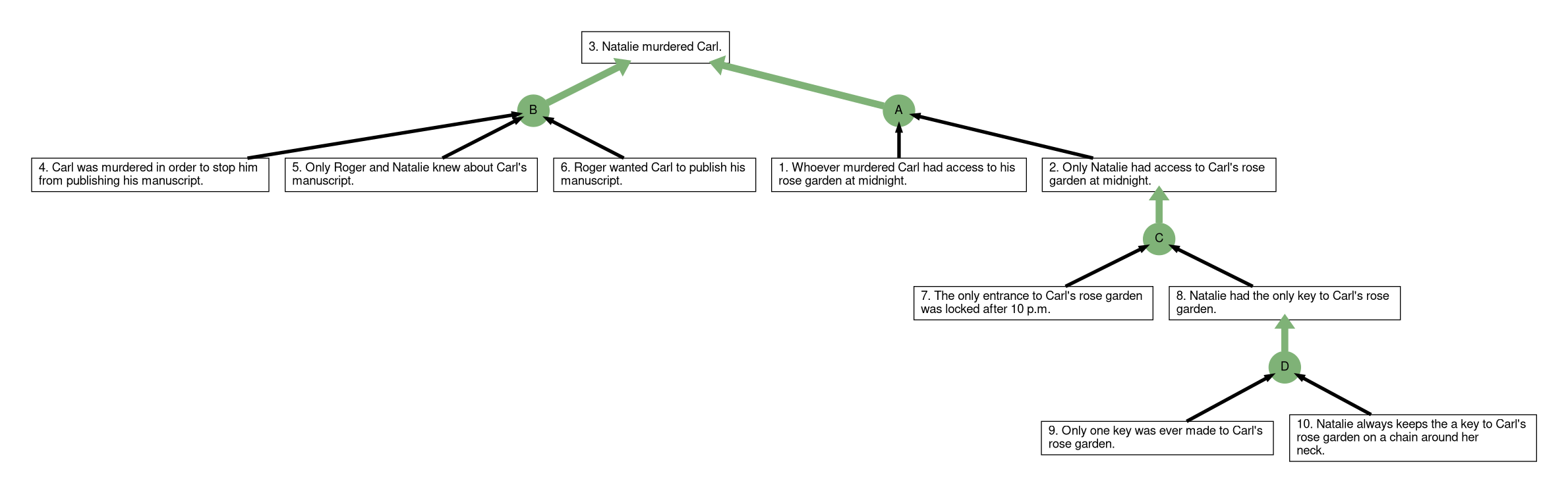
A second way arguments can be related is that a premise of one argument can be the conclusion of another, forming a chain. Here’s an example of that:
| Map 3: |
|
Notice that Argument A (from Map 1) is part of this larger map. One of its premises is now the conclusion of another argument, labeled C, and one of C's premises is a conclusion of a further argument, labeled D. So, we can think of D, C, and A as a chain of arguments, with Proposition 3 as their ultimate conclusion. (Or, to put it another way, we can think of D, C, and A as making up a three-step argument for Proposition 3. And, we can think of Propositions 2 and 8 as intermediate conclusions of this larger argument.)
Complex Maps
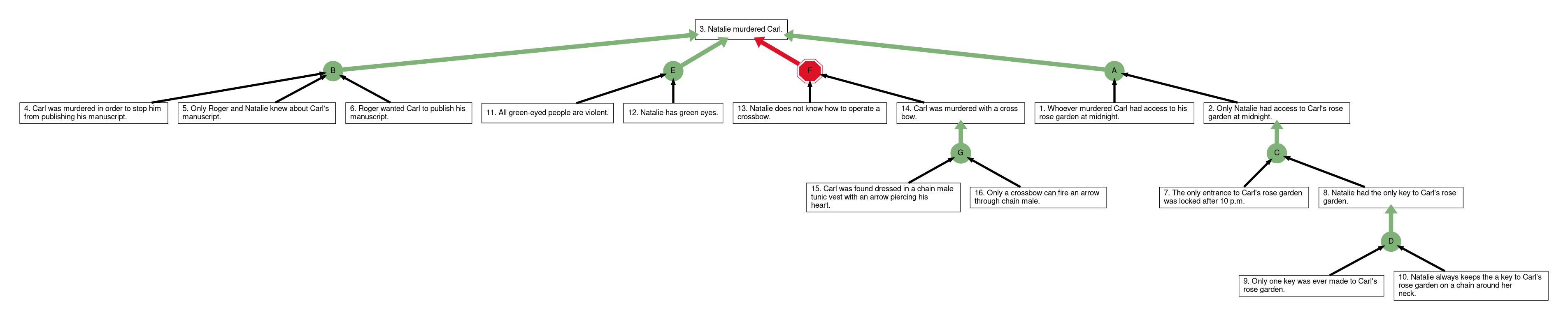
Now let’s consider a larger map that includes all the arguments we’ve looked at plus three others.
| Map 4: |
|
Argument E is a third argument for Proposition 3. I expect you’ll agree that it is a bad argument. The map shows two objections to this argument, each symbolized by a red octagon. Objections are (in effect) arguments that something is wrong with the argument they're objecting to.
Objection H objects to Proposition 11, which is a premise of Argument E. When someone objects to a premise, he is arguing that it is not a suitable premise. This could be because the premise is false (as is the case with Proposition 11), but there are other reasons why a premise might not be suitable. For example, we might not be in a position to tell whether it's true, which would make it useless as a premise. Or we might only have reason to think that it's true if we already believe the conclusion, in which case it would be a case of circular reasoning. In addition to objections to premises, there are objections to inferences. These are arguments that the inference is faulty.
Objection I objects to Inference E. To object to an inference is to argue that it's not a reasonable inference—that, even if we knew the premises to be true, the inference wouldn't give us a reason to believe the conclusion. We'll discuss the factors that make for good or bad inferences later.
Inference F is represented by a red inference symbol instead of the usual green one because it represents a counterargument. Counterarguments are arguments against conclusions, rather than for them. Counterargument F gives us a reason to think that its conclusion, Proposition 3 is false. If we wanted to treat F as a regular argument (represented by a green symbol), then its conclusion would be that “Natalie did not murder Carl.” We could write this conclusion out as a distinct proposition, in its own box, but since it is equivalent to saying that Proposition 3 is false, it’s nice to have a way to relate F to Proposition 3 on the map, so that we could see a glance that F is arguing against the very same conclusion that Arguments A, B, and E are arguing for. This is the purpose of the red counterargument symbol.
Argument G supports Proposition 14, which is a premise for Counterargument F.
The point of an argument is to help us tell what’s true. So, if we end up in a situation where we have arguments with opposite conclusions as we do in Map 4, then there must be an error somewhere. In this map, Objections H and I, indicate what's wrong with Argument E. But even if we eliminate Argument E, we have two other arguments for Proposition 3, and we have a counterargument against this same proposition. Proposition 3 cannot be both true and false, so something must be wrong either with Arguments A and B or with Counterargument F. Let’s turn now to the things that can go wrong with arguments, and why some arguments are better than others.
Why Some Arguments are Stronger than Others
Mapping an argument is a way of analyzing it—breaking it up into its parts and showing how those parts fit together into a whole. The point of analyzing an argument is that it makes it easier for us to then assess the argument. When we assess an argument, we are asking how strongly it supports the conclusion—how good a reason it gives us to think that the conclusion is true. The strongest arguments enable us to tell that their conclusions are true. In doing so, they establish the conclusions as knowledge.
If an argument supports its conclusion strongly enough to establish it as knowledge, the argument is called conclusive and is said to be a proof or to prove the conclusion. [4] These arguments are especially valuable. On the opposite extreme would be an argument that gives us no reason to believe the conclusion and so leaves us no closer to knowing it than we were before. There is no special name for such arguments, but let’s call them worthless because they don’t do any of what an argument should do.
Many arguments fall in between these two extremes. That’s because knowledge isn’t an all-or-nothing affair. There is a whole spectrum between really knowing a proposition and being entirely ignorant of it.

Consider the proposition “Natalie murdered Carl,” which was the conclusion of many of the arguments in the maps we looked at earlier. Suppose that this proposition is true and that you’re a detective investigating Carl’s murder. When you begin the case, you may have no idea who killed Carl, and no reason to suspect Natalie; indeed, you might not even know who Natalie is. So, the proposition would be at the extreme left end of the scale picture above. But as the investigation proceeds and you learn more about Carl’s life and death, at some point you encounter some evidence pointing to Natalie and you formulate the theory that she did it. At first, it might not be much evidence. We certainly wouldn’t say that you know she killed him or even that you believe it (or have reason to believe it), she may not even be your prime suspect, but she is now a suspect, so we wouldn’t say that you’re totally ignorant of her having murdered him. The proposition is now somewhere on the scale to the right of ignorance but to the left of the half-way mark.
Eventually, as you accumulate more evidence, she becomes the lead suspect. Now if you had to bet, you’d say that she did it, and you’d have good reasons to support your bet. We might say you believed she did it, but that you don’t know it yet. Eventually, you accumulate enough evidence to be certain that she did it. Now the proposition has progressed to the right-most region on the scale—you know it.
We can call a proposition's position along this continuum in the mind of a given person, the proposition's epistemic status for that person, and give names to the regions along the continuum. We call a proposition certain when we think that we know it to be true. On the other extreme, we can call a proposition unfounded if we have no reason to think it's true. We call a proposition possible (in one sense of that word) when we have reason to suspect that it might be true. And we call a proposition probable when the evidence makes it more likely to be true than not.

So in the example above, before the investigation starts you have no evidence to even suggest that Natalie may have murdered Carl. The proposition wouldn't even occur to you, but if for some reason it did, the proposition would be unfounded for you. Later when you find evidence that makes her a suspect, the proposition becomes possible, and as the evidence mounts it becomes probable and ultimately certain.
The evidence that you accumulate could be spelled out in the form of arguments, and it is these arguments that advance us along the continuum from ignorance to knowledge (or from an unfounded proposition to a certain one). An argument that’s strong enough to make its conclusion certain is a conclusive argument or proof. An argument that doesn’t give us any of the way towards certainty is worthless. But many arguments take us part of the way—they give us some reason to believe the conclusion without giving us conclusive reason. We can speak of an argument as being stronger or weaker, depending on how close it is to being conclusive.
Notice that in the scale for epistemic status, knowledge and certainty are represented by a range and not by a point. This is because, even among the things we know, we sometimes think of ourselves as being more certain of some things than we are of others. We sometimes think this even when we're not uncertain of the less certain things; and we might think of ourselves as knowing the more certain things better than we know the less certain ones. For example, I expect that you know both that Joe Biden is the 46th President of the United States and that twice two equals four. (For my part, I'm certain of both things.) But you might regard yourself as more certain that twice two is four than you are that Biden is the 46th President, because you can imagine bizarre scenarios in which you're the victim of some elaborate hoax and Biden isn't really' the President, but it's hard to imagine any scenario under which you could be mistaken that twice two is four. Some people think that there is almost nothing that they really know or can be certain of because they cannot completely rule out such hoaxes, and epistemologists think a lot about what to make of such skeptical scenarios. In ordinary reasoning however, we often take ourselves to know (or to be certain of) something without thinking that there is nothing better known (or more certain) than it. And this is what is allowed for by representing knowledge and certainty as a range rather than a point on our scales. Similarly, to say that an argument is conclusive is just to say that it’s strong enough to establish its conclusion as knowledge. It is not to say that there could not be some other argument that is even stronger.
There are two factors that contribute to the strength of an argument: the strengths of its premises and the strength of its inference. So, to assess an argument we need to assess each premise and each inference.
Strength of premises
The strongest premises are ones that we can be certain of independently of knowing the conclusion. In order for an argument to be conclusive, all of its premises must be like this. On the other extreme, if any of an argument's premises is unfounded (or if we know the premise to be false), that makes the argument worthless. An argument with premises that are possible or probable cannot prove its conclusion, but it can still offer some support for it. For example, to return to the case of Carl's murder, if we were certain that whoever murdered Carl had access to his rose garden at midnight, and it was probable that Natalie was the only person who had this access, that would make it probable that Natalie was the murderer.
This is illustrated in the assessment of our Familiar Argument A, below.
| Map 1: | ||
|
|

The scales placed in the box for Propositions 1 and 2 indicate the epistemic status of those propositions. The scale in the box for Proposition 1 has a mark in the rightmost region indicating that that proposition is certain. Proposition 2’s scale shows that the proposition is probable. And the scale for the Argument as a whole shows that it is strong enough to render the conclusion probable.
Since the case of Natalie and Carl is fictitious, there’s no way for us to actually assess the premises. The epistemic statuses in the map above are made up (as is everything else in the example). To assess an actual premise one needs to consider how strong one's reasons to believe the premise are independent of one's belief in the conclusion. This last qualification is important. It can take some reflection to recognize which of our beliefs are based on which others, so it's easy to regard as a premise something that we're only convinced of because we already believe the conclusion. This is called circular reasoning.
Strength of Inferences
The strength of an argument depends not only on the strength of its premises, but also on the strength of its inference. There are different types of inferences, and learning about the types is a great aid in assessing specific inferences. However, this section will just provide a very broad overview to give you a sense of what it means for one inference to be stronger than another, and how this can factor into the strength of an argument as a whole.
In order for an argument to support its conclusion at all, the premises need to be related to one another and to the conclusion in such a manner that, the premises being true would make the conclusion likely to be true.
Deductions
In the very strongest inferences, the premises are related to one another and to the conclusion in such a manner that one would be caught in a contradiction if one held that the premises were true, but that the conclusion was false. This is the case with Argument A concerning Natalie and Carl. Proposition 1 tells us a characteristic of Carl's murderer—namely that the murderer could access the rose garden at midnight. Proposition 2 tells us that only Natalie has this characteristic. If both propositions are true, then it has to be that Natalie is the murderer. There's no room for any alternative. Inference A is as strong as any inference could be.
Inferences like this are called deductions and are said to necessitate their conclusions.
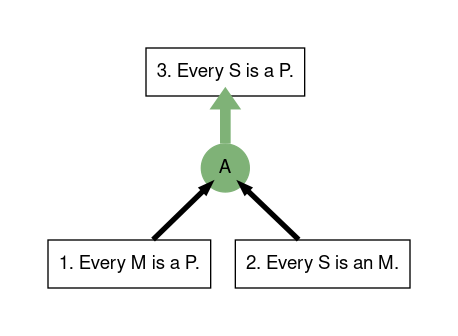
Deduction is the type of argument that has been most studied by logicians. All deductive arguments follow one of a number of forms, which one can learn and train oneself to recognize. Here are two examples of such forms:
|
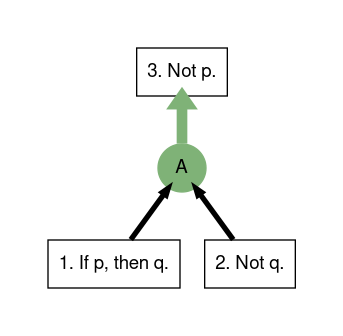
|
| Barbara | Modus Tollens |
The argument form on the left was first identified by Aristotle and was named Barbara by Medieval Philosophers who studied his logic. You can replace the capital letters S, M, and P with any terms you like, and you'll get a deductive argument.[5] The argument form on the right is called Modus Tollens. You can replace the lowercase letters "p" and "q" with any propositions you like, and (again) you'll get a deductive argument.
Even without knowing the forms of deductive argument explicitly, one can often tell simply by asking oneself whether the premises and conclusion of an argument are related in such a manner as to preclude any scenario under which the premises would be true and the conclusion false.
Since every deduction is as strong as an inference can be, no deduction can be stronger than any other. Thus, on a scale representing the strength of inferences, we must represent deduction, not as a range, but as a point on the far right.

Let's add our assessment of Inference A as a deduction into our assessment of Inference A into our map of Argument A:
| Map 1: | |
|
|

Notice that, though Inference A is a deduction, Argument A as a whole is still not conclusive. This is because Premise 2 is merely probable, rather than certain. The strength of the argument as a whole depends on the strength of all its elements, whereas the strength of the inference is independent of the strength of the premises. That’s illustrated by the following maps:
| Map 5a & 5b: | |
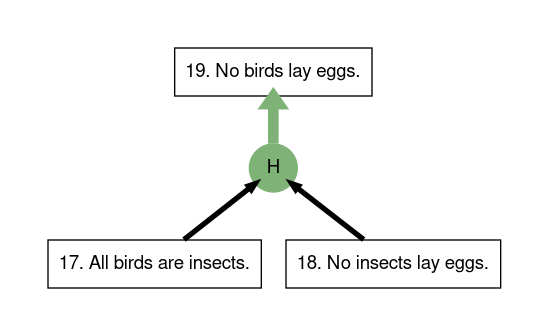
|
|
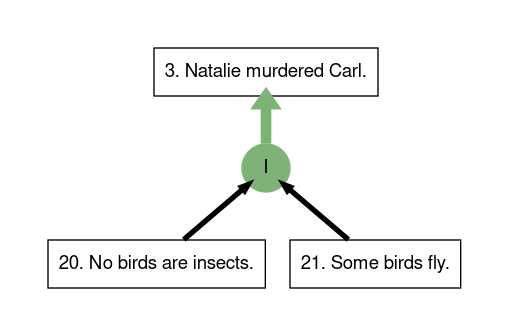
|


Here we have two arguments (H and I) that are both worthless for opposite reasons. In Argument H we have two awful premises—premises that no one has any reason to believe and that we all know to be false. But inference H is as strong as can be—it's a deduction. Propositions 17 and 18 are false, but if they were true, then Proposition 19 would have to be true also. Nonetheless, the unfounded premises make the argument as a whole worthless. As it happens the conclusion, like the premises, is obviously false. Notice that if we changed Proposition 18 to say "All insects lay eggs" and Proposition 19 to say "All birds lay eggs," the argument would then have a true conclusion and one true premise, in addition to having an inference that's as strong as can be. Nonetheless, it would still be worthless, because Proposition 17 remains unfounded (indeed obviously false), and an argument can be no stronger than its weakest part.
Both premises of Argument I are certain, but it's worthless because Inference I is so bad. There's no relation at all between the premises and the conclusion, so even if we know the premises to be true, they can't give us any reason at all to even suspect that the conclusion might be true. You can’t infer anything about Carl and Natalie from premises about birds and insects. Inferences this bad are called non-sequiturs.
Compelling Inferences
An inference does not need to be a deduction to put one in a position to know its conclusion. Consider the following argument:
| Map 6: | |
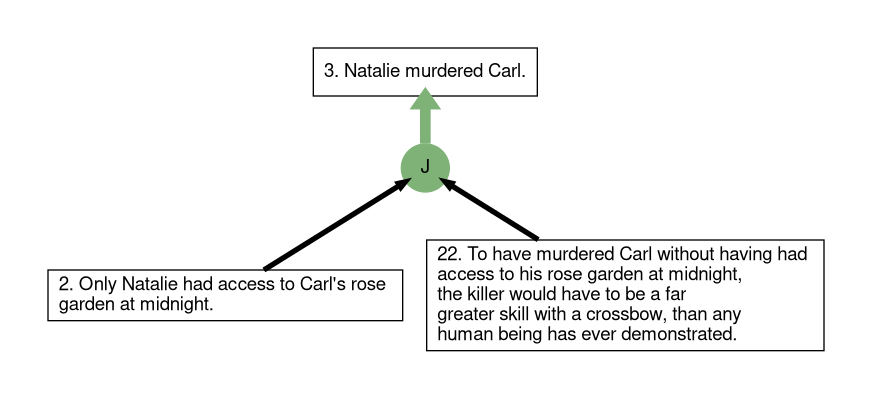
|

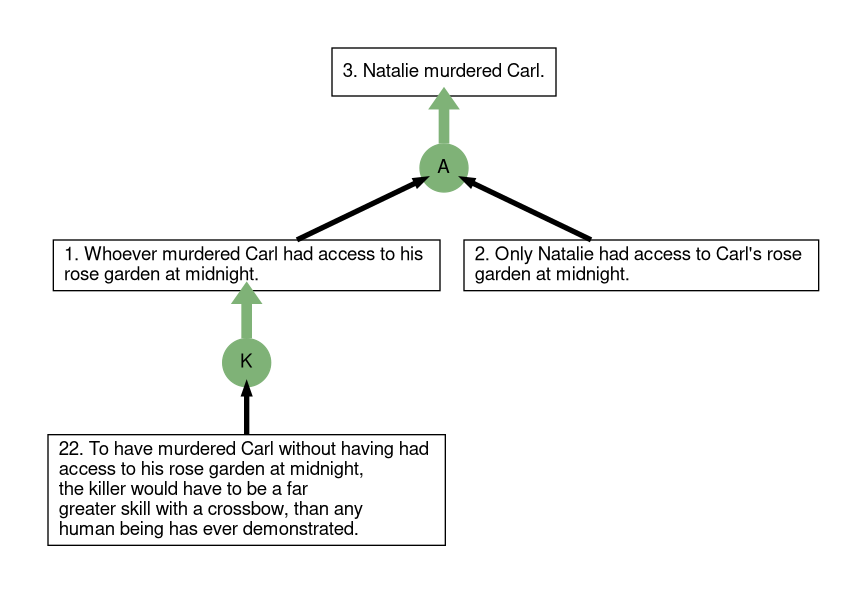
This is like Argument A, which we keep returning to, except that we've replaced Proposition 1, which said that Carl's murderer had access to his rose garden, with a premise that allows for an extremely remote possibility of someone committing the murder without having had access. Because of this, unlike Inference A, Inference J is not a deduction. But it is still a very strong inference. To judge just how strong it is we'd have to rely on some background knowledge of the situation. For example, if among Carl's associates were people who were at the cutting edge of crossbow marksmanship, we might regard it as a possibility that the murderer is someone other than Natalie who has an unprecedented level of skill with the weapon. But, in most contexts, such speculation would be unfounded. In this case, Inference J is strong enough that being certain of its premises would put us in a position to be certain of its conclusion. That's how I assessed it on the scale above.
Incidentally, instead of thinking of Proposition 22 as an alternative premise to Proposition 1 in an argument to the same conclusion, we might of Proposition 22 as part of how we know that Proposition 1 is true, as illustrated in the following map.
| Map 7: | |
|

This amounts to a different way of mapping what is in essence the same line of reasoning.
In any case, whether we focus on Argument K (in this most recent map) or on Argument J (in the map above it), the point remains the same. The inference isn't a deduction, but it's strong enough that being certain of its premises would put us in a position to be certain of its conclusion. We can call such inferences compelling.

Weaker Inferences
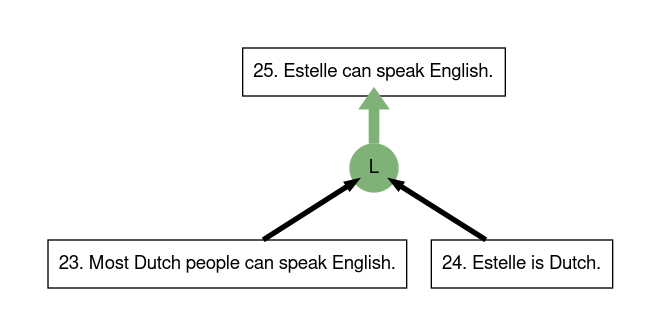
Even inferences that aren’t compelling can be useful. Consider the following argument:
| Map 8: | |
|

Inference L isn’t compelling, but it’s not bad, either. If you knew the premises to be true, this argument wouldn’t put you in a position to know the conclusion, but (unless you had other relevant knowledge of Estelle), it ought to lead you to regard it as probable that Estelle can speak English.
The Strength of an Argument as a Whole
To review then, arguments range in strength from worthless to conclusive, with conclusive arguments being the ones that are strong enough to establish their conclusions as knowledge (in other words, to make them certain). The strength of an argument is determined by the strength of its premises and of its inference. The strength of a premise is its epistemic status. The highest epistemic status is knowledge or certainty, and the lowest is that of a proposition one is either wholly ignorant of or knows to be false. We called this status "unfounded." The strength of an inference is determined by the relationship between the premises and the conclusion, and this is separate from whether the premises are true. The weakest inferences are called non-sequiturs and the strongest are called compelling.

There are two rules for assessing arguments as wholes in light of the strength of their elements:
- An argument as a whole can be no stronger than its weakest element (premise or inference).[6]
- In an argument the weaknesses compound, so if multiple elements have weaknesses, the whole argument will be weaker than the weakest part.
- ↑ All the maps in this article, are made with ReasonSpace. There are a few competing conventions for argument mapping, so you may sometimes find maps drawn or labeled a bit differently elsewhere.
- ↑ We will discuss later in the course whether any of the contents of science are known by means other than inference or observation.
- ↑ Propositions 4 and 6 taken together without Proposition 5 wouldn't even give you a reason to suspect Natalie. Knowing Propositions 4 and 5, without knowing 6, would give you a strong reason to suspect Natalie (since it would mean that she's one of only two people who could have done it), but adding Proposition 6 upgrades the argument from one that would make Natalie a suspect to one that proves that she's the murderer.
- ↑ People often call arguments that they come up with proofs if they think the arguments prove their conclusions, and sometimes these names catch on, but that doesn’t mean that the arguments really prove the conclusions. We have to assess them for ourselves to see.
- ↑ Notice that happens if you replace S with "Murderer of Carl," M with "Person with access to Carl's rose garden at midnight," and P with "Natalie," you get a very awkward way of rephrasing our now familiar argument that Natalie murdered Carl.
- ↑ There are two partial exceptions to this rule. The first is that some arguments have extra premises that don't do any work. You can make an example of such an argument by taking one of the deductive arguments above and adding a random extra premise to it. The extra premise is completely unneeded, so you might think that it's being unfounded wouldn't weaken the argument. But, precisely because the premise is unneeded, it's not really part of the argument in the first place. And representing it as part of the argument just adds an irrelevancy that (in a way) does weaken the argument by confusing it. The second exception involves additional but uncertain examples that may be added to generalizations. But these arguments are a special case, best treated elsewhere.