Arguments: Difference between revisions
| (212 intermediate revisions by 4 users not shown) | |||
| Line 1: | Line 1: | ||
The word "argument" is most often used to refer to a heated conversation in which people disagree. We speak about a couple having an argument, or about a Thanksgiving dinner that's ruined by relatives who won't stop arguing about politics. But there's another, related meaning of the word "argument," which is the more prevalent meaning in fields like philosophy, law, and rhetoric. When people are having an argument, we can speak of the ''arguments'' that each of them is making. For example consider the following brief dialogue in which Angela and Ben are arguing about abortion: | |||
<blockquote> | |||
Angela: How can you be opposed to laws banning abortion?! | |||
Ben: Easy, I respect the right to bodily autonomy! Laws against abortion severely limit pregnant women's bodily autonomy. | |||
Angela: But, abortion is ''murder'', and murder should always be illegal. | |||
</blockquote> | |||
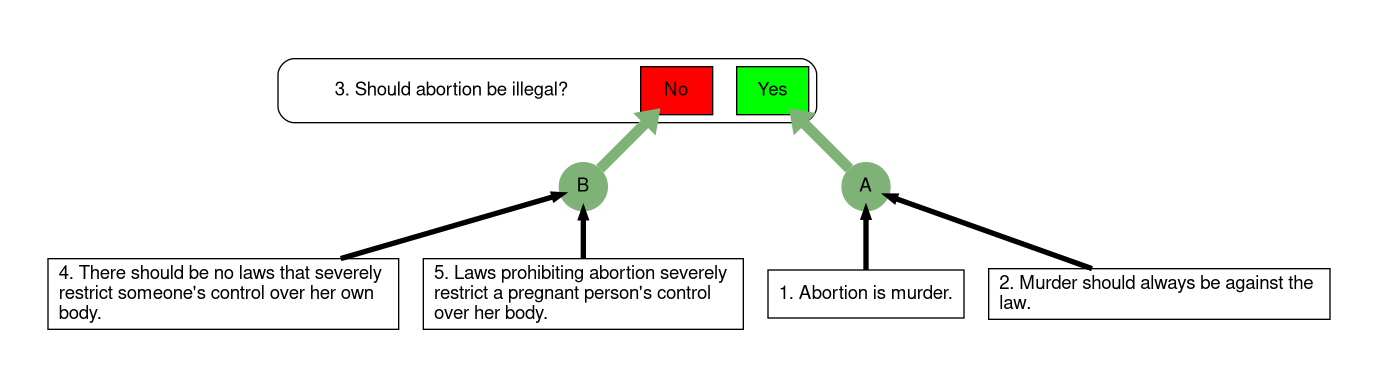
In this brief exchange, Ben and Angela each give the other a reason for accepting a different answer to the question "Should abortion be illegal?" Each of these reasons is an ''argument'' in the sense of that word in which it is used in philosophy (and allied fields). Put roughly: an argument is a reason for believing something, and it is made up of other beliefs. We can represent Ben and Angela's arguments graphically in what is called an ''argument map'': | |||
''' | {| class="wikitable" | ||
|'''Map 1: Ben and Angela's Arguments Concerning Anti-Abortion Laws''' | |||
|- | |||
|{{Map|https://app.reasonspace.com/submaps/c0211ac351954f419f23e51661d3dbd4}} | |||
|- | |||
|Ben's argument is labeled "B", and Angela's is labeled "A". | |||
|} | |||
This article is about arguments (in this sense of the word). We'll discuss what arguments are, their role in thinking, how argument maps can be used to illustrate their structure, and how we can assess arguments to determine how strong they are. | |||
=Arguments as Ways of Knowing= | |||
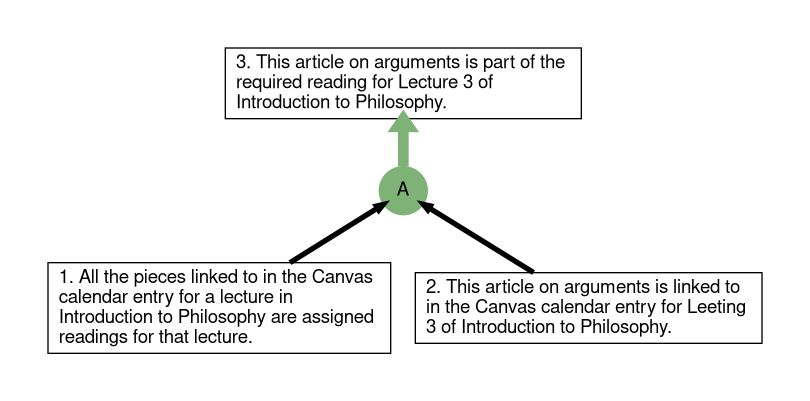
' | We most often speak about arguments in the contexts of disagreements (as in Ben and Angela's disagreement about abortion) or when people are trying to persuade one another. But arguments are made even in conversations where people do not disagree, and we form arguments in our own minds, even when there is no one around to convince of anything. Consider, for example, how you know that the article you're reading now is an assigned reading for Lecture 3 of the Introduction to Philosophy class you're taking. Most likely, you know it by means of the following argument: | ||
''' | {| class="wikitable" | ||
|'''Map 2: How you know that this article is assigned for Lecture 3''' | |||
|- | |||
|{{Map|https://app.reasonspace.com/submaps/954799ffc18046bba07a32106da18533}} | |||
|} | |||
''' | This argument isn't about convincing anyone of anything. It is simply ''how you know'' something in the first place. You know that this article is assigned for Lecture 3 ''by knowing'' two other things: that this article is linked in the calendar entry for the lecture and that everything linked in a calendar entry for a lecture is a required reading for the lecture. When you ''combine'' your knowledge of these two facts, they lead to the further knowledge that this article is assigned for the lecture. | ||
''' | On the map, each fact is depicted in a rectangle and labeled with a number. I'll refer to the contents of such boxes as propositions—a term I'll explain below. For now we can say that you in Argument A, you come to know Proposition 3 by combining your knowledge of Propositions 1 and 2. We call Propositions 1 and 2 the ''premises'' of Argument A. | ||
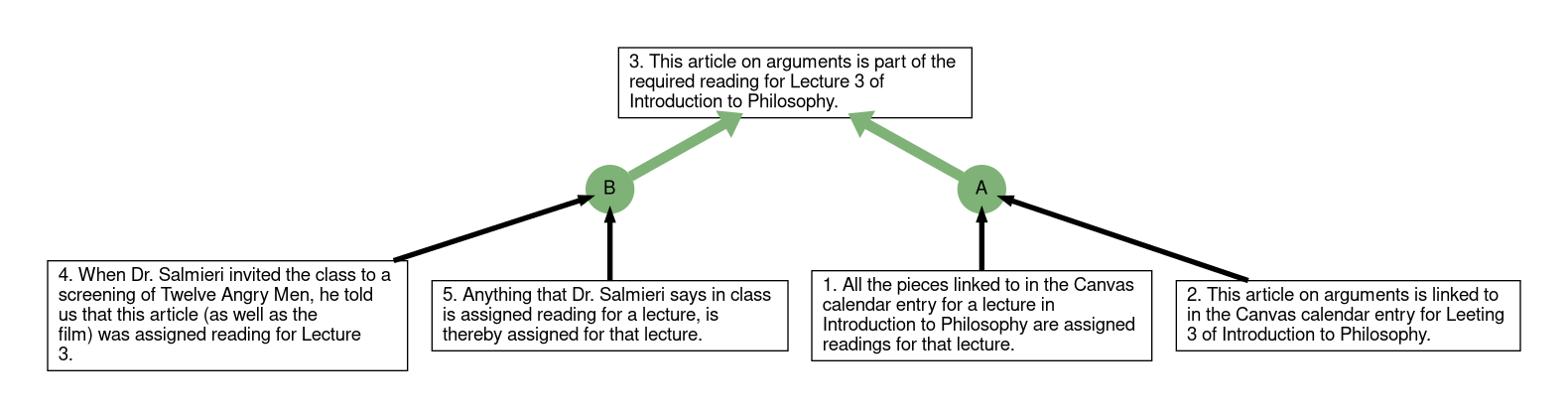
Some of you might have come to know that this reading was assigned without knowing these premises—without having looked at or thought about the calendar at all. You may have simply heard me say in class that the reading was assigned. If so, you wouldn't know Proposition 3 by Argument A, but rather by Argument B, which is pictured alongside it the map below: | |||
{| class="wikitable" | |||
|'''Map 3: Two ways in which you can know this article is assigned for Lecture 3''' | |||
|- | |||
|{{Map|https://app.reasonspace.com/arguments/760afa1e180d4baa8a0b5a760189ea66}} | |||
|} | |||
Here we see two separate arguments for Proposition 3, labeled A and B. Each argument has two premises, which combine to give you a ''way of knowing'' the same fact. Notice, that in each argument the two premises ''work together'' to enable you to know the Proposition 3. Knowing that the article is linked to in the calendar entry, wouldn't put you in a position to know that it was assigned reading, if you didn't also know that the items linked in the entries are assigned readings. And, of course, knowing that the items linked in the entries are assigned readings wouldn't put you in a position to know that this article was assigned, if you didn't also know that it was linked. So neither Proposition 1 nor Proposition 2 ''on its own'' puts you in a position to know Proposition 3. Argument A's premises only put you in a position to know Proposition 3, when ''when they're combined''. | |||
''' | |||
''' | The same goes for Argument B. Neither Proposition 4 nor Proposition 5 considered''on its own'', would put you in a position to know Proposition 3, but ''combining'' Propositions 4 and 5 does put you in a position to know it. Notice, also that it's not just ''any'' combination of premises that would put you in a position to know Proposition 3. The combination of Propositions 1 and 4 wouldn't do it, and neither would the combination of Propositions 2 and 5. Only two specific combinations of these four premises amount to ''ways of knowing'' that Proposition 3 is true. And each of these combinations is a distinct ''argument'' for the proposition. | ||
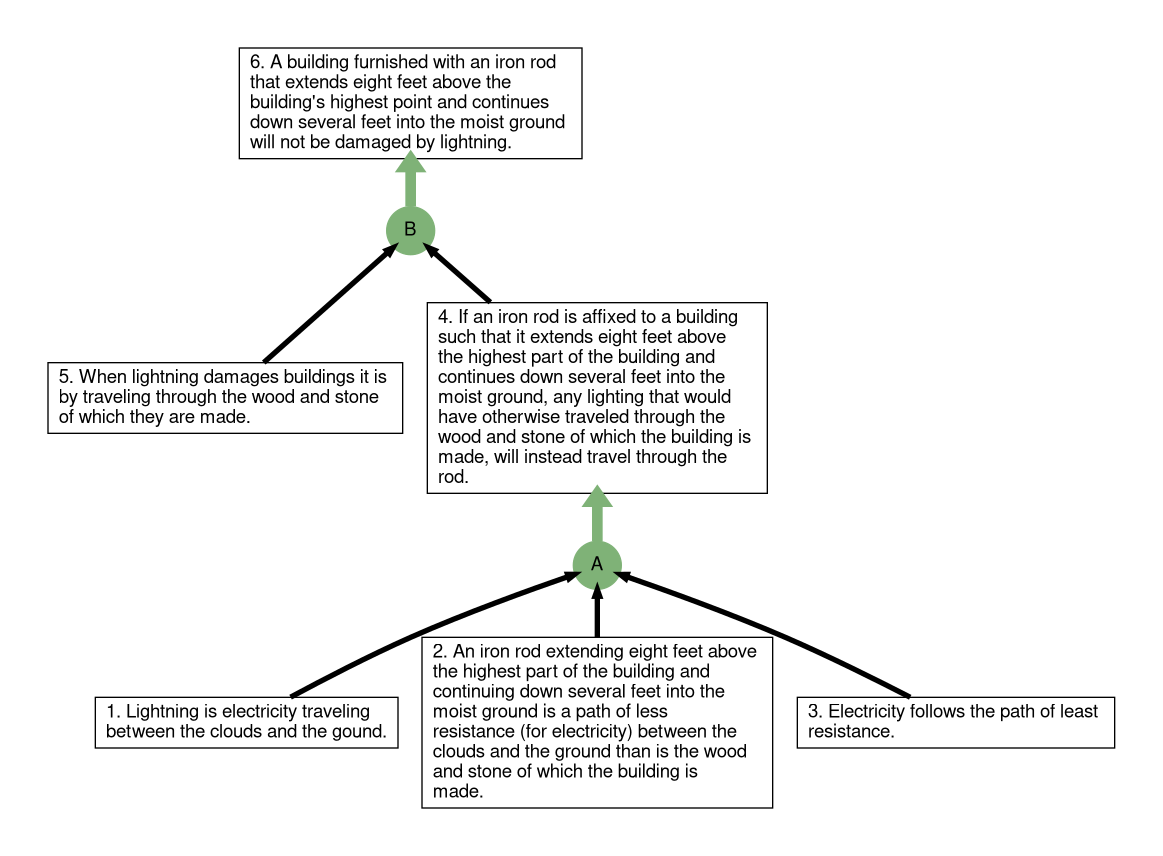
'' | In the grand scheme of things, Proposition 3 is not a particularly important piece of knowledge, and Arguments A and B aren't very impressive pieces of reasoning. But many life-saving truths were first reached by arguments. For example, one of Benjamin Franklin's claims to fame was his discovery that affixing a lightning rod to the roof of a building would prevent the building from being damaged by lightning. Here's a map of how he knew it: | ||
''' | {| class="wikitable" | ||
|'''Map 4: How Benjamin Franklin Knew His Lightning Rod Would Work''' | |||
|- | |||
| {{Map|https://app.reasonspace.com/arguments/c8675d75d9904f56ac7528ad25cbffc4}} | |||
|} | |||
The last few arguments we've discussed are ways in which someone ''knows'' something. Of course, if you knew something by means of one of these arguments, you might tell the argument to others in order to convince them of what you know. This may be what Ben and Angela are ''trying'' to do in our earlier example, in which they're arguing with one another about laws prohibiting abortion. He tells her how he thinks he knows that there should not be such laws, and she responds by telling him how she thinks that she knows that there should be. Of course, they cannot both be right, so at least one of them must not really know and the relevant argument must not really be a ''way of knowing''. There must be something wrong with at least one of their arguments. For example, one of their premises might be false. But even if one of the arguments is faulty, it is still an ''attempt at knowing''. The point of the argument is to help us ''tell'' whether laws prohibiting abortion are wrong or right. | |||
Later in this article we'll discuss how to evaluate arguments, but the first point to bear in mind when evaluating them is that they are attempts to help you to ''know'' something—to put you in a position ''to tell that it is true.'' Some arguments take us all the way there, but arguments that don't might still prove useful (by bringing us closer to knowledge than we'd otherwise be). | |||
=The Ubiquity of Argument and the Value of Logic= | |||
You argue throughout the day every day, and you've been doing it since you were a small child. It's one of the things you learned to do as you learned to speak. Here are some examples from my young son. When he was two years old and I told him that it was his Grandfather's birthday, and said "Probably Grandpa will eat cake and walk around the sun." Presumably he thinks that ''everyone'' does these things on his birthday, because he's observed that this is what happens on birthdays in his Montessori classroom. His reasoning can be represented as follows: | |||
= | {| class="wikitable" | ||
|'''Map 5: My Two-Year-Old Son's Argument about his Grandfather's Birthday''' | |||
|- | |||
| {{Map|https://app.reasonspace.com/submaps/63d6fb7560fa4971ab0f1dc72010f77c}} | |||
|} | |||
The following year in school he started grinding coffee beans as a classroom exercise and bringing the grounds home in a little baggie. One morning he told me that he'd bring some coffee grounds home for his mother, because she likes coffee. I asked if I liked coffee too and he replied: "Well, I've never seen you drink coffee, so I think that you don't like it." We might think of him as making the following argument: | |||
{| class="wikitable" | |||
|'''Map 6: My Three-Year-Old Son's Argument that I Don't Like Coffee (version 1)''' | |||
|- | |||
| {{Map|https://app.reasonspace.com/submaps/237ec69f9d9643888062964255beb79b}} | |||
|} | |||
But I don't think this map quite captures how he was thinking, because he doesn't normally assume just from the fact that he hasn't seen someone do something that the person doesn't like doing it. When people express arguments, they often leave premises unstated. We can call these "implicit premises." I think this is the argument he was actually using: | |||
{| class="wikitable" | {| class="wikitable" | ||
|''' | |'''Map 7: My Three-Year-Old Son's Argument that I Don't Like Coffee (version 2)''' | ||
|- | |- | ||
| | | {{Map|https://app.reasonspace.com/submaps/c4aaea9e1cd144948b7bf98022910813}} | ||
|} | |} | ||
The square brackets around Proposition 3, indicate that it's an implicit premise. | |||
Why did he assume that he would have seen me drink coffee, if I liked it? I don't know, but there are some good reasons he might have had for thinking this, as illustrated in this map: | |||
{| class="wikitable" | {| class="wikitable" | ||
| Map | |'''Map 8: Reconstruction of Reasons My Three-Year-Old Son has for Thinking that I Don't Like Coffee''' | ||
|- | |- | ||
| | | {{Map|https://app.reasonspace.com/submaps/41572b4f89664ecf9a335af1ffa42e89}} | ||
|} | |} | ||
I've given these examples to illustrate how commonplace arguing is, even among very young children. It's something that we all learn to do in our first years of life, as part of learning how to speak and think. During this same period, we learn how to walk and how to grasp and manipulate objects. But we learn all of these things ''implicitly''—that is, without naming in words what we are doing and how we are doing it. You learned many words before you knew the word “word,” and you learned how to put words together into sentences before you had the word “sentence” or words for the parts of speech (much less for the rules of grammar). You also learned how to walk, without yet knowing the word "walk," much less knowing words for the parts of your legs or for specific types of steps or for flexing and unflexing various muscles. You may have never thought much about ''how'' to walk, but if you’ve ever had physical therapy to recover from an injury or taken a movement class as part of learning how to dance or to act, you may have learned to analyze the act of walking into (named) component parts. Doing so gives you more control over the way you walk. When athletes train, they often learn to analyze movements they learned as a child into simpler movements, and this process gives them finer-grained control over their movements. It is likewise possible to gain greater control of your thinking by analyzing complex thought processes into the simpler components that make them up. The discipline that does this is called ''logic'', and one crucial part of it is the skill of analyzing arguments into their parts and assessing them, individually. | |||
=Anatomy of an Argument= | |||
==Propositions== | |||
Before saying anything more about arguments, it will be helpful to say a bit about propositions, which are the smaller units of thought from which arguments are built. They're the things represented by the rectangles in our argument maps. A ''proposition'' is the sort of thought that is capable of being true or false, of being believed or disbelieved, and of being asserted or denied. Such thoughts are expressed by declarative sentences. Here are some examples: | |||
<blockquote> | |||
'''1.''' Healthy grass is green. | |||
'''2.''' O. J. Simpson killed Nicole Brown. | |||
'''3.''' Twice two is four. | |||
'''4.''' Twice two is five. | |||
'''5.''' Many diseases are caused by bacteria. | |||
'''6.''' Stalin was evil. | |||
'''7.''' Joe Biden is the 46th President of the United States. | |||
'''8.''' Either Donald Trump or Kamala Harris will win the 2024 Presidential election. | |||
'''9.''' The Senate should have convicted Donald Trump in both of his impeachment trials. | |||
'''10.''' Hillary Clinton would have been an awful president. | |||
</blockquote> | |||
The proposition is not the same thing as the sentence expressing it, because the same thought can be expressed by different sentences. For example, here are several different ways of expressing Proposition 3 from the list above: | |||
<blockquote> | |||
'''3a.''' Twice two is four. | |||
'''3b.''' Two times two is four. | |||
'''3c.''' 2 x 2 = 4 | |||
'''3d.''' Deux fois deux c'est quatre. | |||
'''3e.''' 兩次兩次是四次。 | |||
</blockquote> | |||
Sentences 3a and 3b are two different ways of expressing the same proposition in English. 3c is a way of expressing it in mathematical notation, 3d is a way of expressing it in French, and 3e is a way of expressing it in Chinese. | |||
Another reason why a proposition is not the same thing as a sentence is that propositions can be expressing as parts of more complex sentences that include multiple propositions. For example, here’s a sentence expressing both Propositions 9 and 10 from the list above: "Even though Hillary Clinton would have been an awful president, the Senate should have convicted Donald Trump at both of his impeachment trials." | |||
Some of the propositions from the list above are uncontroversially true and others are uncontroversially false. I expect that everyone in the class will agree that Propositions 1, 3, 5 and 7 are true and that Proposition 4 is false. We will probably disagree over some of the others—with some students thinking they’re true and others thinking they’re false. | |||
Some of you may think that some of the propositions we may disagree over aren’t ''really'' the sort of things that can be true or false at all. In particular, some of you may think this about Propositions 6, 9, and 10, because these propositions express evaluations. Some people think that evaluations aren’t the sorts of things that can be true or false. But even if you think this, you’ll have noticed that many people ''believe'' or ''disbelieve'' each of these propositions (and many other evaluations) as though they were true or false, and they make arguments to try to convince other people that these propositions are true or false. So, to understand their role in arguments you’ll have to treat them as the sort of thing that can be true or false. | |||
==Definition of Argument and the Conventions of Argument Mapping== | |||
As the term is used in philosophy, an '''argument''' is a set of related propositions (called '''premises''') that is given as a reason for believing a further proposition (called the '''conclusion'''). Consider, for example, the following simple argument: | |||
Whoever murdered Carl had to have access to his rose garden at midnight, and the only person who did was Natalie, therefore Natalie must be the murderer. | |||
Here the conclusion is that Natalie murdered Carl, and there are two premises: (1) that whoever murdered Carl had access to Carl’s rose garden at midnight, and (2) that only Natalie had such access. | |||
There are a few ways in which we can represent an argument that makes its structure clearer. One popular way is called ''standard form''. Here’s what the argument we have been discussing looks like in standard form: | |||
{| class="wikitable" | {| class="wikitable" | ||
| | |'''1.''' Whoever murdered Carl had access to his rose garden at midnight. | ||
'''2.''' Only Natalie had access to Carl’s rose garden at midnight. | |||
|- | |- | ||
| | | '''3.''' Natalie murdered Carl. | ||
|} | |} | ||
Each proposition has been written on its own line and labeled with a number. The premises are written first, and a line is drawn to separate them from the conclusion. This line represents the '''inference'''—the mental act of moving in thought from the premises to the conclusion. | |||
In this class we'll occasionally see arguments laid out in standard form, but we'll mostly use argument maps (as we did earlier in this article). Here’s a map of the same argument with annotations, indicating what each element in the map means. | |||
{| class="wikitable" | {| class="wikitable" | ||
| Map | | '''Map 9''' | ||
|- | |- | ||
|[ | |[[file:Map_9_Annotated.png|thumb|center|700px|]] | ||
|- | |||
|[https://app.reasonspace.com/submaps/d784fd01d2ef446abe5ef5be1d22783b View this map on ReasonSpace] | |||
|} | |} | ||
In the map, each proposition is written in its own box and labeled with a number. The inference is represented by a green circle and labeled with a letter (we call this the *inference symbol*). Thin lines connect the inference symbol's round bottom to the boxes containing the premises, and a thicker line with an arrow at the end connects the symbol's top to the box containing the conclusion.<ref>All the maps in this article, are made with [http://app.reasonspace.com ReasonSpace]. There are a few competing conventions for argument mapping, so you may sometimes find maps drawn or labeled a bit differently elsewhere.</ref> | |||
The standard form is more compact, but argument mapping enables us to visualize the relationships between multiple arguments. | |||
Both ways of representing the argument highlight make it easy to see that Propositions 1 and 2 combine to provide a reason to believe Proposition 3. | |||
Notice that it is only when we take them ''together'' that Propositions 1 and 2 give us a reason to believe Proposition 3. If you knew that only Natalie had access to Carl's rose garden at midnight, then learning that whoever killed Carl must have had access to the rose garden would put you in a position to tell that Natalie was the murderer. But if you didn't know anything about who had access to the rose garden, then learning that whoever committed the murderer had access, wouldn't give you any reason to suspect Natalie. Likewise, if you already knew that the killer had to have access to the rose garden, then learning that Natalie was the only one with access would put you in a position to know that she did it. But if you didn't know anything linking the rose garden to the murder, then learning that Natalie was the only one with access to it wouldn't give you any reason to suspect her of the crime. Only when the premises are put together do they link Natalie to the crime, that's what makes these ''two'' premises into a ''single'' argument. | |||
The map represents this relationship by having the lines from the two premises go to a single inference symbol (labeled A) from which a single arrow points to the conclusion. | |||
==Relations Between Arguments in Complex Maps== | |||
With this terminology under our belts, we can look at and discuss more complex maps that show relations between arguments. | |||
One way in which arguments can be related is by sharing the same conclusion. Here’s an example: | |||
{| class="wikitable" | |||
| '''Map 10''' | |||
|- | |||
|{{Map|https://app.reasonspace.com/submaps/05c4582aace9476883878b49e3fce664}} | |||
|} | |||
Argument B has the same conclusion as Argument A. They are two distinct arguments because they give separate reasons for believing the conclusion. To see that the reasons are separate, pick one of the premises from either argument and think about what other premises you would need to combine it with before it would give you a reason to think that Natalie murdered Carl. We already discussed how Propositions 1 and 2 have to be put together before either provides a reason for ''suspecting'' that Natalie murdered Carl. But if you know that both of these propositions are true, you're in a position to ''know'' that Natalie is the murderer regardless of whether you know any of Propositions 4–6. Likewise, if you knew Propositions 4–6, they'd put you in a position to know that Natalie did it, even if you didn't know Proposition 1 or 2. But you would need to know ''all three'' Propositions 4, 5, and 6, for them to put you in a position to know that Natalie was guilty; no one or two of them would do it alone.<ref>Propositions 4 and 6 taken together without Proposition 5 wouldn't even give you a reason to suspect Natalie. Knowing Propositions 4 and 5, without knowing 6, would give you a strong reason to suspect Natalie (since it would mean that she's one of only two people who could have done it), but adding Proposition 6 upgrades the argument from one that would make Natalie a suspect to one that proves that she's the murderer.</ref> | |||
A second way arguments can be related is that a premise of one argument can be the conclusion of another, forming a chain. Here’s an example of that: | |||
{| class="wikitable" | |||
|'''Map 11''' | |||
|- | |||
|{{Map|https://app.reasonspace.com/submaps/95c077a9e8454fdfad9181e21a21ecd5}} | |||
|} | |||
Notice that Argument A (from Map 9) is part of this larger map. One of its premises is now the conclusion of another argument, labeled C, and one of C's premises is a conclusion of a further argument, labeled D. So, we can think of D, C, and A as a chain of arguments, with Proposition 3 as their ultimate conclusion. (Or, to put it another way, we can think of D, C, and A as making up a three-step argument for Proposition 3. And, we can think of Propositions 2 and 8 as intermediate conclusions of this larger argument.) | |||
=Why Some Arguments are Stronger than Others= | |||
Mapping an argument is a way of analyzing it—breaking it up into its parts and showing how those parts fit together into a whole. The point of analyzing an argument is that it makes it easier for us to then ''assess'' the argument. When we assess an argument, we are asking how strongly it supports the conclusion—how good a reason it gives us to think that the conclusion is true. The strongest arguments are ''ways of knowing'' their conclusions—or, in other words, they give us a way to ''tell that the their conclusions are true''. | |||
If an argument supports its conclusion strongly enough to establish it as knowledge, the argument is called '''conclusive''' and is said to be a '''proof''' or to '''prove''' the conclusion. <Ref>People often call arguments that they come up with proofs if they think the arguments prove their conclusions, and sometimes these names catch on, but that doesn’t mean that the arguments ''really'' prove the conclusions. We have to assess them for ourselves to see.</Ref> These arguments are especially valuable. On the opposite extreme would be an argument that gives us no reason to believe the conclusion and so leaves us no closer to knowing it than we were before. There is no special name for such arguments, but let’s call them '''fatuous''' (meaning silly and pointless) because they don’t accomplish ''any'' of what an argument should do. | |||
[[file:Strength_of_an_Argument.png|thumb|center|1000px]] | |||
[[file: | |||
Many arguments fall in between these two extremes. That’s because knowledge isn’t an all-or-nothing affair. There is a whole spectrum between really knowing a proposition and being entirely ignorant of it. | |||
[[file:Knowledge_vs_Ignorance.png|thumb|center|1000px]] | |||
Consider the proposition “Natalie murdered Carl,” which was the conclusion of many of the arguments in the maps we looked at earlier. Suppose that this proposition is true and that you’re a detective investigating Carl’s murder. When you begin the case, you may have no idea who killed Carl, and no reason to suspect Natalie; indeed, you might not even know who Natalie is. So, the proposition would be at the extreme left end of the scale pictured above. But as the investigation proceeds and you learn more about Carl’s life and death, at some point you encounter some evidence pointing to Natalie and you formulate the theory that she did it. At first, it might not be much evidence. We certainly wouldn’t say that you ''know'' she killed him or even that you ''believe'' it (or have reason to believe it), she may not even be your prime suspect, but she is now ''a'' suspect, so we wouldn’t say that you’re totally ignorant of her having murdered him. The proposition is now somewhere on the scale to the right of ignorance but to the left of the half-way mark. | |||
Eventually, as you accumulate more evidence, she becomes the lead suspect. Now if you had to bet, you’d say that she did it, and you’d have good reasons to support your bet. We might say you believed she did it, but that you don’t ''know'' it yet. Eventually, you accumulate enough evidence to be certain that she did it. Now the proposition has progressed to the right-most region on the scale—you know it. | |||
We can call a proposition's position along this continuum in the mind of a given person, the proposition's '''[[epistemic status]]''' for that person, and give names to the regions along the continuum. We call a proposition '''[[certain]]''' when we think that we ''know'' it to be true. On the other extreme, we can call a proposition '''[[unfounded]]''' if we have no reason to think it's true. We call a proposition '''[[possible]]''' (in one sense of that word) when we have reason to suspect that it might be true. And we call a proposition '''[[probable]]''' when the evidence makes it more likely to be true than not. | |||
[[file:epistemic_status.png|thumb|center|1000px]] | |||
So in the example above, before the investigation starts you have no evidence to even suggest that Natalie may have murdered Carl. The proposition wouldn't even occur to you, but if for some reason it did, the proposition would be unfounded for you. Later when you find evidence that makes her a suspect, the proposition becomes possible, and as the evidence mounts it becomes probable and ultimately certain. | |||
The evidence that you accumulate could be spelled out in the form of arguments, and it is these arguments that advance us along the continuum from ignorance to knowledge (or from an unfounded proposition to a certain one). An argument that’s strong enough to | |||
make its conclusion ''certain'' is a conclusive argument or proof. An argument that doesn’t give us ''any'' of the way towards certainty is worthless. But many arguments take us part of the way—they give us ''some'' reason to ''believe'' the conclusion without giving us conclusive reason. We can speak of an argument as being stronger or weaker, depending on how close it is to being conclusive. | |||
We | Notice that in the scale for epistemic status, knowledge and certainty are represented by a range and not by a point. This is because, even among the things we know, we sometimes think of ourselves as being ''more certain'' of some things than we are of others. We sometimes think this even when we're not ''uncertain'' of the less certain things; and we might think of ourselves as knowing the more certain things better than we know the less certain ones. For example, I expect that you know both that Joe Biden is the 46th President of the United States and that twice two equals four. (For my part, I'm certain of both things.) But you might regard yourself as ''more certain'' that twice two is four than you are that Biden is the 46th President, because you can imagine bizarre scenarios in which you're the victim of some elaborate hoax and Biden isn't ''really'' the President, but it's hard to imagine any scenario under which you could be mistaken that twice two is four. Some people think that there is almost nothing that they really ''know'' or can be ''certain'' of because they cannot completely rule out such hoaxes, and epistemologists think a lot about what to make of such [[skeptical scenarios]]. In ordinary reasoning however, we often take ourselves to ''know'' (or to be ''certain'' of) something without thinking that there is nothing better known (or more certain) than it. And this is what is allowed for by representing knowledge and certainty as a range rather than a point on our scales. Similarly, to say that an argument is conclusive is just to say that it’s strong ''enough'' to establish its conclusion as knowledge. It is not to say that there could not be some other argument that is even stronger. | ||
[[ | |||
There are two factors that contribute to the strength of an argument: the strengths of its premises and the strength of its inference. So, to assess an argument we need to assess each premise and each inference. | |||
==Strength of premises== | |||
The strongest premises are ones that we can be certain of independently of knowing the conclusion. In order for an argument to be conclusive, all of its premises must be like this. On the other extreme, if any of an argument's premises is unfounded (or if we know the premise to be false), that makes the argument worthless. An argument with premises that are ''possible'' or ''probable'' cannot prove its conclusion, but it can still offer some support for it. For example, to return to the case of Carl's murder, if we were certain that whoever murdered Carl had access to his rose garden at midnight, and it was probable that Natalie was the only person who had this access, that would make it probable that Natalie was the murderer. | |||
This is illustrated in the assessment of our Familiar Argument A, below. | |||
{| class="wikitable" | |||
| '''Map 9''' | |||
|- | |||
|{{Map|https://app.reasonspace.com/smaps/0ad59e33b3434d96865df2350e2d4d7e}} | |||
|- | |||
|[[File:Argument_A_Assessment_1.png|thumb|center|500px]] | |||
|} | |||
The scales placed in the box for Propositions 1 and 2 indicate the epistemic status of those propositions. The scale in the box for Proposition 1 has a mark in the rightmost region indicating that that proposition is certain. Proposition 2’s scale shows that the proposition is probable. And the scale for the Argument as a whole shows that it is strong enough to render the conclusion probable. | |||
Since the case of Natalie and Carl is fictitious, there’s no way for us to actually assess the premises. The epistemic statuses in the map above are made up (as is everything else in the example). To assess an actual premise one needs to consider how strong one's reasons to believe the premise are ''independent of one's belief in the conclusion''. This last qualification is important. It can take some reflection to recognize which of our beliefs are based on which others, so it's easy to regard as a premise something that we're only convinced of because we already believe the conclusion. This is called [[circular reasoning]]. | |||
==Strength of Inferences== | |||
The strength of an argument depends not only on the strength of its premises, but also on the strength of its ''inference''. There are different [[types of inferences]] which we'll discuss over the semester, and learning about the types is a great aid in assessing specific inferences. Here I'll just make a few general remarks. | |||
In order for an argument to support its conclusion at all, the premises need to be related to one another and to the conclusion in such a manner that, the premises being true would make the conclusion likely to be true. In the very strongest inferences, the premises are related to one another and to the conclusion in such a manner that one would be caught in a contradiction if one held that the premises were true, but that the conclusion was false. This is the case with many of the inferences we've looked at in this article, including Inference A (in Map 9). Proposition 1 tells us a characteristic of Carl's murderer—namely that the murderer could access the rose garden at midnight. Proposition 2 tells us that only Natalie has this characteristic. If both propositions are true, then it ''has to be'' that Natalie is the murderer. There's no room for any alternative. Inference A is ''as strong as any inference could be''. Inferences like this are called '''[[deductions]]''' and are said to ''necessitate'' their conclusions. | |||
Deduction is the type of argument that has been most studied by logicians. All deductive arguments follow one of a number of ''forms'', which one can learn and train oneself to recognize. Since every deduction is as strong as an inference can be, no deduction can be stronger than any other. Thus, on a scale representing the strength of inferences, we must represent deduction, not as a range, but as a point on the far right. | |||
[[file:deduction.png|thumb|center|600px]] | |||
Let's add our assessment of Inference A as a deduction into our assessment of Inference A into our map of Argument A: | |||
{| class="wikitable" | |||
| '''Map 9''' | |||
|- | |||
|{{Map|https://app.reasonspace.com/smaps/0ad59e33b3434d96865df2350e2d4d7e}} | |||
|- | |||
|[[File:Argument_A_Assessment_2.png|thumb|center|500px]] | |||
|} | |||
Notice that, though Inference A is a deduction, Argument A as a whole is still not conclusive. This is because Premise 2 is merely probable, rather than certain. The strength of the argument as a whole depends on the strength of ''all'' its elements, whereas the strength of the inference is independent of the strength of the premises. That’s illustrated by the following maps: | |||
{| class="wikitable" | |||
| '''Map 12''' | |||
|'''Map 13''' | |||
|- | |||
|{{Map|https://app.reasonspace.com/maps/1f4a6db8-37a3-4d02-b9b4-44749176a0b9}} | |||
|{{Map|https://app.reasonspace.com/maps/3c6b4d76-04ff-4219-8a2e-3e7b7c468e40}} | |||
|- | |||
|[[File:Argument_H_Assessment.png|thumb|center|500px]] | |||
|[[File:Argument_I_Assessment.png|thumb|center|500px]] | |||
|} | |||
: | |||
Here we have two arguments (H and I) that are both fatuous for opposite reasons. In Argument H we have two awful premises—premises that no one has any reason to believe and that we all know to be false. But ''inference'' H is as strong as can be—it's a deduction. Propositions 17 and 18 are false, but ''if they were true'', then Proposition 19 would ''have to be'' true also. Nonetheless, the unfounded premises make the argument as a whole fatuous. As it happens the conclusion, like the premises, is obviously false. Notice that if we changed Proposition 18 to say "All insects lay eggs" and Proposition 19 to say "All birds lay eggs," the argument would then have a true conclusion and one true premise, in addition to having an inference that's as strong as can be. Nonetheless, it would still be fatuous, because Proposition 17 remains unfounded (indeed obviously false), and an argument can be no stronger than its weakest part. | |||
Both premises of Argument I are certain, but the argument is fatuous because Inference I is so bad. There's no relation at all between the premises and the conclusion, so even if we know the premises to be true, they can't give us any reason at all to even suspect that the conclusion might be true. You can’t infer anything about Carl and Natalie from premises about birds and insects. Inferences this bad are called '''[[non_sequitur|non sequiturs]]'''. | |||
An inference does not need to be a deduction to put one in a position to know its conclusion. Consider the following argument: | |||
{| class="wikitable" | {| class="wikitable" | ||
| Map | | '''Map 14''' | ||
|- | |||
|{{Map|https://app.reasonspace.com/submaps/fbdcd9761a1043f8aaaf94c6a70c88bb}} | |||
|- | |- | ||
|[ | |[[File:Argument_J_Assessment.png|thumb|center|500px]] | ||
|} | |} | ||
This is like Argument A from Map 9, except that we've replaced Proposition 1, which said that Carl's murderer had access to his rose garden, with a premise that allows for an extremely remote possibility of someone committing the murder without having had access. Because of this, unlike Inference A, Inference J is not a deduction. But it is still a very strong inference. To judge just how strong it is, we'd have to rely on some background knowledge of the situation. For example, if among Carl's associates were people who were at the cutting edge of crossbow marksmanship, we might regard it as a possibility that the murderer is someone other than Natalie—someone who has an unprecedented level of skill with the weapon. But, in most contexts, such speculation would be unfounded. In this case, Inference J is strong enough that being certain of its premises would put us in a position to be certain of its conclusion. That's how I assessed it on the scale above. | |||
Incidentally, instead of thinking of Proposition 22 as an alternative premise to Proposition 1 in an argument to the same conclusion, we might think of Proposition 22 as part of how we know that Proposition 1 is true, as illustrated in the following map. | |||
[[ | {| class="wikitable" | ||
| '''Map 15''' | |||
|- | |||
|{{Map|https://app.reasonspace.com/submaps/ed74d8c90a3c418eb9435215133bdc5d}} | |||
|- | |||
|[[File:Arguments_K_and_A_Assessment.png|thumb|center|500px]] | |||
|} | |||
This amounts to a different way of mapping what is in essence the same line of reasoning. | |||
In any case, whether we focus on Argument K (in this most recent map) or on Argument J (in the map above it), the point remains the same. The inference isn't a deduction, but it's strong enough that being certain of its premises would put us in a position to be certain of its conclusion. We can call such inferences '''[[compelling]]'''. | |||
[[file:Strength_of_an_Inference.png|thumb|center|1000px]] | |||
Even inferences that aren’t compelling can be useful. Consider the following argument: | |||
{| class="wikitable" | |||
|'''Map 16''' | |||
|- | |||
|{{Map|https://app.reasonspace.com/maps/156b41a4-a850-469b-9a7c-8665f4f3c2e6}} | |||
|- | |||
|[[File:Argument_L_Assessment.png|thumb|center|500px]] | |||
|} | |||
[[ | |||
Inference L isn’t compelling, but it’s not bad, either. If you knew the premises to be true, this argument wouldn’t put you in a position to ''know'' the conclusion, but (unless you had other relevant knowledge of Estelle), it ought to lead you to regard it as ''probable'' that Estelle can speak English. | |||
==The Strength of an Argument as a Whole== | |||
To review then, arguments range in strength from fatuous to conclusive, with conclusive arguments being the ones that are strong enough to establish their conclusions as knowledge (in other words, to make them certain). The strength of an argument is determined by the strength of its premises and of its inference. The strength of a premise is its [[epistemic status]]. The highest epistemic status is knowledge or certainty, and the lowest is that of a proposition one is either wholly ignorant of or knows to be false. We called this status "unfounded." The strength of an inference is determined by the relationship between the premises and the conclusion, and this is separate from whether the premises are true. The weakest inferences are called non-sequiturs and the strongest are called compelling. | |||
[[file:Three_Scales.jpg|thumb|center|650px]] | |||
Latest revision as of 12:15, 22 August 2025
The word "argument" is most often used to refer to a heated conversation in which people disagree. We speak about a couple having an argument, or about a Thanksgiving dinner that's ruined by relatives who won't stop arguing about politics. But there's another, related meaning of the word "argument," which is the more prevalent meaning in fields like philosophy, law, and rhetoric. When people are having an argument, we can speak of the arguments that each of them is making. For example consider the following brief dialogue in which Angela and Ben are arguing about abortion:
Angela: How can you be opposed to laws banning abortion?!
Ben: Easy, I respect the right to bodily autonomy! Laws against abortion severely limit pregnant women's bodily autonomy.
Angela: But, abortion is murder, and murder should always be illegal.
In this brief exchange, Ben and Angela each give the other a reason for accepting a different answer to the question "Should abortion be illegal?" Each of these reasons is an argument in the sense of that word in which it is used in philosophy (and allied fields). Put roughly: an argument is a reason for believing something, and it is made up of other beliefs. We can represent Ben and Angela's arguments graphically in what is called an argument map:
| Map 1: Ben and Angela's Arguments Concerning Anti-Abortion Laws |
|
| Ben's argument is labeled "B", and Angela's is labeled "A". |
This article is about arguments (in this sense of the word). We'll discuss what arguments are, their role in thinking, how argument maps can be used to illustrate their structure, and how we can assess arguments to determine how strong they are.
Arguments as Ways of Knowing
We most often speak about arguments in the contexts of disagreements (as in Ben and Angela's disagreement about abortion) or when people are trying to persuade one another. But arguments are made even in conversations where people do not disagree, and we form arguments in our own minds, even when there is no one around to convince of anything. Consider, for example, how you know that the article you're reading now is an assigned reading for Lecture 3 of the Introduction to Philosophy class you're taking. Most likely, you know it by means of the following argument:
| Map 2: How you know that this article is assigned for Lecture 3 |
|
This argument isn't about convincing anyone of anything. It is simply how you know something in the first place. You know that this article is assigned for Lecture 3 by knowing two other things: that this article is linked in the calendar entry for the lecture and that everything linked in a calendar entry for a lecture is a required reading for the lecture. When you combine your knowledge of these two facts, they lead to the further knowledge that this article is assigned for the lecture.
On the map, each fact is depicted in a rectangle and labeled with a number. I'll refer to the contents of such boxes as propositions—a term I'll explain below. For now we can say that you in Argument A, you come to know Proposition 3 by combining your knowledge of Propositions 1 and 2. We call Propositions 1 and 2 the premises of Argument A.
Some of you might have come to know that this reading was assigned without knowing these premises—without having looked at or thought about the calendar at all. You may have simply heard me say in class that the reading was assigned. If so, you wouldn't know Proposition 3 by Argument A, but rather by Argument B, which is pictured alongside it the map below:
| Map 3: Two ways in which you can know this article is assigned for Lecture 3 |
|
Here we see two separate arguments for Proposition 3, labeled A and B. Each argument has two premises, which combine to give you a way of knowing the same fact. Notice, that in each argument the two premises work together to enable you to know the Proposition 3. Knowing that the article is linked to in the calendar entry, wouldn't put you in a position to know that it was assigned reading, if you didn't also know that the items linked in the entries are assigned readings. And, of course, knowing that the items linked in the entries are assigned readings wouldn't put you in a position to know that this article was assigned, if you didn't also know that it was linked. So neither Proposition 1 nor Proposition 2 on its own puts you in a position to know Proposition 3. Argument A's premises only put you in a position to know Proposition 3, when when they're combined.
The same goes for Argument B. Neither Proposition 4 nor Proposition 5 consideredon its own, would put you in a position to know Proposition 3, but combining Propositions 4 and 5 does put you in a position to know it. Notice, also that it's not just any combination of premises that would put you in a position to know Proposition 3. The combination of Propositions 1 and 4 wouldn't do it, and neither would the combination of Propositions 2 and 5. Only two specific combinations of these four premises amount to ways of knowing that Proposition 3 is true. And each of these combinations is a distinct argument for the proposition.
In the grand scheme of things, Proposition 3 is not a particularly important piece of knowledge, and Arguments A and B aren't very impressive pieces of reasoning. But many life-saving truths were first reached by arguments. For example, one of Benjamin Franklin's claims to fame was his discovery that affixing a lightning rod to the roof of a building would prevent the building from being damaged by lightning. Here's a map of how he knew it:
| Map 4: How Benjamin Franklin Knew His Lightning Rod Would Work |
|
The last few arguments we've discussed are ways in which someone knows something. Of course, if you knew something by means of one of these arguments, you might tell the argument to others in order to convince them of what you know. This may be what Ben and Angela are trying to do in our earlier example, in which they're arguing with one another about laws prohibiting abortion. He tells her how he thinks he knows that there should not be such laws, and she responds by telling him how she thinks that she knows that there should be. Of course, they cannot both be right, so at least one of them must not really know and the relevant argument must not really be a way of knowing. There must be something wrong with at least one of their arguments. For example, one of their premises might be false. But even if one of the arguments is faulty, it is still an attempt at knowing. The point of the argument is to help us tell whether laws prohibiting abortion are wrong or right.
Later in this article we'll discuss how to evaluate arguments, but the first point to bear in mind when evaluating them is that they are attempts to help you to know something—to put you in a position to tell that it is true. Some arguments take us all the way there, but arguments that don't might still prove useful (by bringing us closer to knowledge than we'd otherwise be).
The Ubiquity of Argument and the Value of Logic
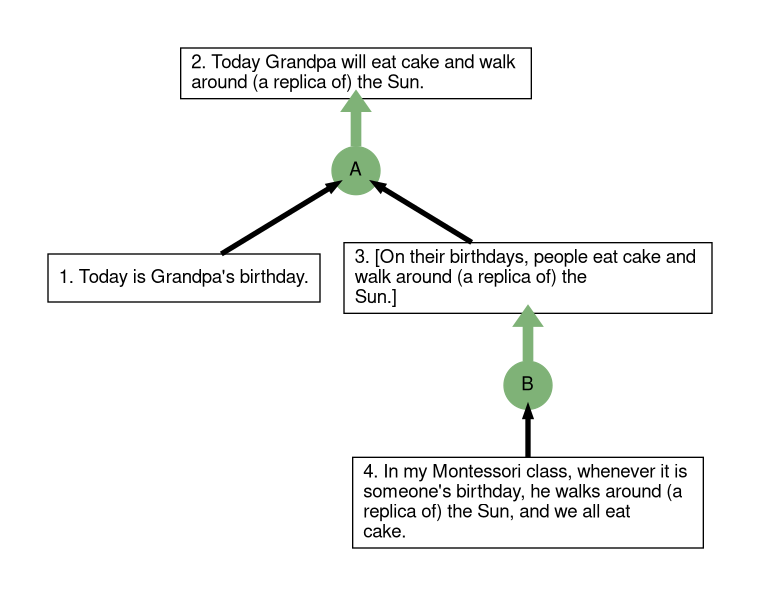
You argue throughout the day every day, and you've been doing it since you were a small child. It's one of the things you learned to do as you learned to speak. Here are some examples from my young son. When he was two years old and I told him that it was his Grandfather's birthday, and said "Probably Grandpa will eat cake and walk around the sun." Presumably he thinks that everyone does these things on his birthday, because he's observed that this is what happens on birthdays in his Montessori classroom. His reasoning can be represented as follows:
| Map 5: My Two-Year-Old Son's Argument about his Grandfather's Birthday |
|
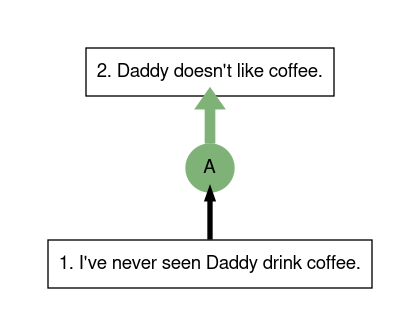
The following year in school he started grinding coffee beans as a classroom exercise and bringing the grounds home in a little baggie. One morning he told me that he'd bring some coffee grounds home for his mother, because she likes coffee. I asked if I liked coffee too and he replied: "Well, I've never seen you drink coffee, so I think that you don't like it." We might think of him as making the following argument:
| Map 6: My Three-Year-Old Son's Argument that I Don't Like Coffee (version 1) |
|
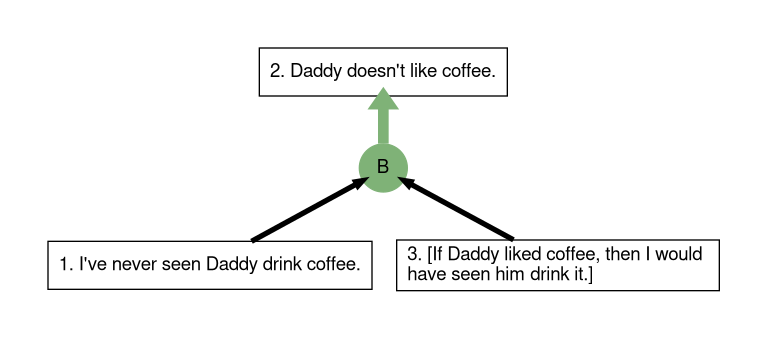
But I don't think this map quite captures how he was thinking, because he doesn't normally assume just from the fact that he hasn't seen someone do something that the person doesn't like doing it. When people express arguments, they often leave premises unstated. We can call these "implicit premises." I think this is the argument he was actually using:
| Map 7: My Three-Year-Old Son's Argument that I Don't Like Coffee (version 2) |
|
The square brackets around Proposition 3, indicate that it's an implicit premise.
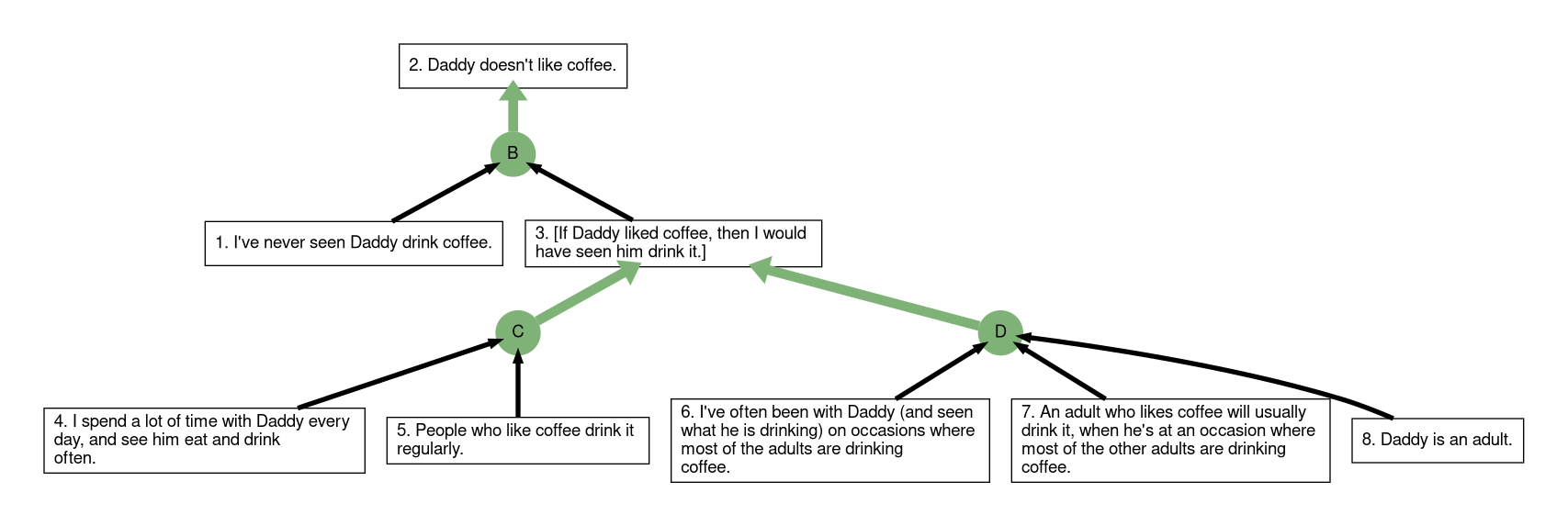
Why did he assume that he would have seen me drink coffee, if I liked it? I don't know, but there are some good reasons he might have had for thinking this, as illustrated in this map:
| Map 8: Reconstruction of Reasons My Three-Year-Old Son has for Thinking that I Don't Like Coffee |
|
I've given these examples to illustrate how commonplace arguing is, even among very young children. It's something that we all learn to do in our first years of life, as part of learning how to speak and think. During this same period, we learn how to walk and how to grasp and manipulate objects. But we learn all of these things implicitly—that is, without naming in words what we are doing and how we are doing it. You learned many words before you knew the word “word,” and you learned how to put words together into sentences before you had the word “sentence” or words for the parts of speech (much less for the rules of grammar). You also learned how to walk, without yet knowing the word "walk," much less knowing words for the parts of your legs or for specific types of steps or for flexing and unflexing various muscles. You may have never thought much about how to walk, but if you’ve ever had physical therapy to recover from an injury or taken a movement class as part of learning how to dance or to act, you may have learned to analyze the act of walking into (named) component parts. Doing so gives you more control over the way you walk. When athletes train, they often learn to analyze movements they learned as a child into simpler movements, and this process gives them finer-grained control over their movements. It is likewise possible to gain greater control of your thinking by analyzing complex thought processes into the simpler components that make them up. The discipline that does this is called logic, and one crucial part of it is the skill of analyzing arguments into their parts and assessing them, individually.
Anatomy of an Argument
Propositions
Before saying anything more about arguments, it will be helpful to say a bit about propositions, which are the smaller units of thought from which arguments are built. They're the things represented by the rectangles in our argument maps. A proposition is the sort of thought that is capable of being true or false, of being believed or disbelieved, and of being asserted or denied. Such thoughts are expressed by declarative sentences. Here are some examples:
1. Healthy grass is green.
2. O. J. Simpson killed Nicole Brown.
3. Twice two is four.
4. Twice two is five.
5. Many diseases are caused by bacteria.
6. Stalin was evil.
7. Joe Biden is the 46th President of the United States.
8. Either Donald Trump or Kamala Harris will win the 2024 Presidential election.
9. The Senate should have convicted Donald Trump in both of his impeachment trials.
10. Hillary Clinton would have been an awful president.
The proposition is not the same thing as the sentence expressing it, because the same thought can be expressed by different sentences. For example, here are several different ways of expressing Proposition 3 from the list above:
3a. Twice two is four.
3b. Two times two is four.
3c. 2 x 2 = 4
3d. Deux fois deux c'est quatre.
3e. 兩次兩次是四次。
Sentences 3a and 3b are two different ways of expressing the same proposition in English. 3c is a way of expressing it in mathematical notation, 3d is a way of expressing it in French, and 3e is a way of expressing it in Chinese.
Another reason why a proposition is not the same thing as a sentence is that propositions can be expressing as parts of more complex sentences that include multiple propositions. For example, here’s a sentence expressing both Propositions 9 and 10 from the list above: "Even though Hillary Clinton would have been an awful president, the Senate should have convicted Donald Trump at both of his impeachment trials."
Some of the propositions from the list above are uncontroversially true and others are uncontroversially false. I expect that everyone in the class will agree that Propositions 1, 3, 5 and 7 are true and that Proposition 4 is false. We will probably disagree over some of the others—with some students thinking they’re true and others thinking they’re false.
Some of you may think that some of the propositions we may disagree over aren’t really the sort of things that can be true or false at all. In particular, some of you may think this about Propositions 6, 9, and 10, because these propositions express evaluations. Some people think that evaluations aren’t the sorts of things that can be true or false. But even if you think this, you’ll have noticed that many people believe or disbelieve each of these propositions (and many other evaluations) as though they were true or false, and they make arguments to try to convince other people that these propositions are true or false. So, to understand their role in arguments you’ll have to treat them as the sort of thing that can be true or false.
Definition of Argument and the Conventions of Argument Mapping
As the term is used in philosophy, an argument is a set of related propositions (called premises) that is given as a reason for believing a further proposition (called the conclusion). Consider, for example, the following simple argument:
Whoever murdered Carl had to have access to his rose garden at midnight, and the only person who did was Natalie, therefore Natalie must be the murderer.
Here the conclusion is that Natalie murdered Carl, and there are two premises: (1) that whoever murdered Carl had access to Carl’s rose garden at midnight, and (2) that only Natalie had such access.
There are a few ways in which we can represent an argument that makes its structure clearer. One popular way is called standard form. Here’s what the argument we have been discussing looks like in standard form:
| 1. Whoever murdered Carl had access to his rose garden at midnight.
2. Only Natalie had access to Carl’s rose garden at midnight. |
| 3. Natalie murdered Carl. |
Each proposition has been written on its own line and labeled with a number. The premises are written first, and a line is drawn to separate them from the conclusion. This line represents the inference—the mental act of moving in thought from the premises to the conclusion.
In this class we'll occasionally see arguments laid out in standard form, but we'll mostly use argument maps (as we did earlier in this article). Here’s a map of the same argument with annotations, indicating what each element in the map means.
| Map 9 |
| View this map on ReasonSpace |

In the map, each proposition is written in its own box and labeled with a number. The inference is represented by a green circle and labeled with a letter (we call this the *inference symbol*). Thin lines connect the inference symbol's round bottom to the boxes containing the premises, and a thicker line with an arrow at the end connects the symbol's top to the box containing the conclusion.[1]
The standard form is more compact, but argument mapping enables us to visualize the relationships between multiple arguments.
Both ways of representing the argument highlight make it easy to see that Propositions 1 and 2 combine to provide a reason to believe Proposition 3.
Notice that it is only when we take them together that Propositions 1 and 2 give us a reason to believe Proposition 3. If you knew that only Natalie had access to Carl's rose garden at midnight, then learning that whoever killed Carl must have had access to the rose garden would put you in a position to tell that Natalie was the murderer. But if you didn't know anything about who had access to the rose garden, then learning that whoever committed the murderer had access, wouldn't give you any reason to suspect Natalie. Likewise, if you already knew that the killer had to have access to the rose garden, then learning that Natalie was the only one with access would put you in a position to know that she did it. But if you didn't know anything linking the rose garden to the murder, then learning that Natalie was the only one with access to it wouldn't give you any reason to suspect her of the crime. Only when the premises are put together do they link Natalie to the crime, that's what makes these two premises into a single argument.
The map represents this relationship by having the lines from the two premises go to a single inference symbol (labeled A) from which a single arrow points to the conclusion.
Relations Between Arguments in Complex Maps
With this terminology under our belts, we can look at and discuss more complex maps that show relations between arguments.
One way in which arguments can be related is by sharing the same conclusion. Here’s an example:
| Map 10 |

|
Argument B has the same conclusion as Argument A. They are two distinct arguments because they give separate reasons for believing the conclusion. To see that the reasons are separate, pick one of the premises from either argument and think about what other premises you would need to combine it with before it would give you a reason to think that Natalie murdered Carl. We already discussed how Propositions 1 and 2 have to be put together before either provides a reason for suspecting that Natalie murdered Carl. But if you know that both of these propositions are true, you're in a position to know that Natalie is the murderer regardless of whether you know any of Propositions 4–6. Likewise, if you knew Propositions 4–6, they'd put you in a position to know that Natalie did it, even if you didn't know Proposition 1 or 2. But you would need to know all three Propositions 4, 5, and 6, for them to put you in a position to know that Natalie was guilty; no one or two of them would do it alone.[2]
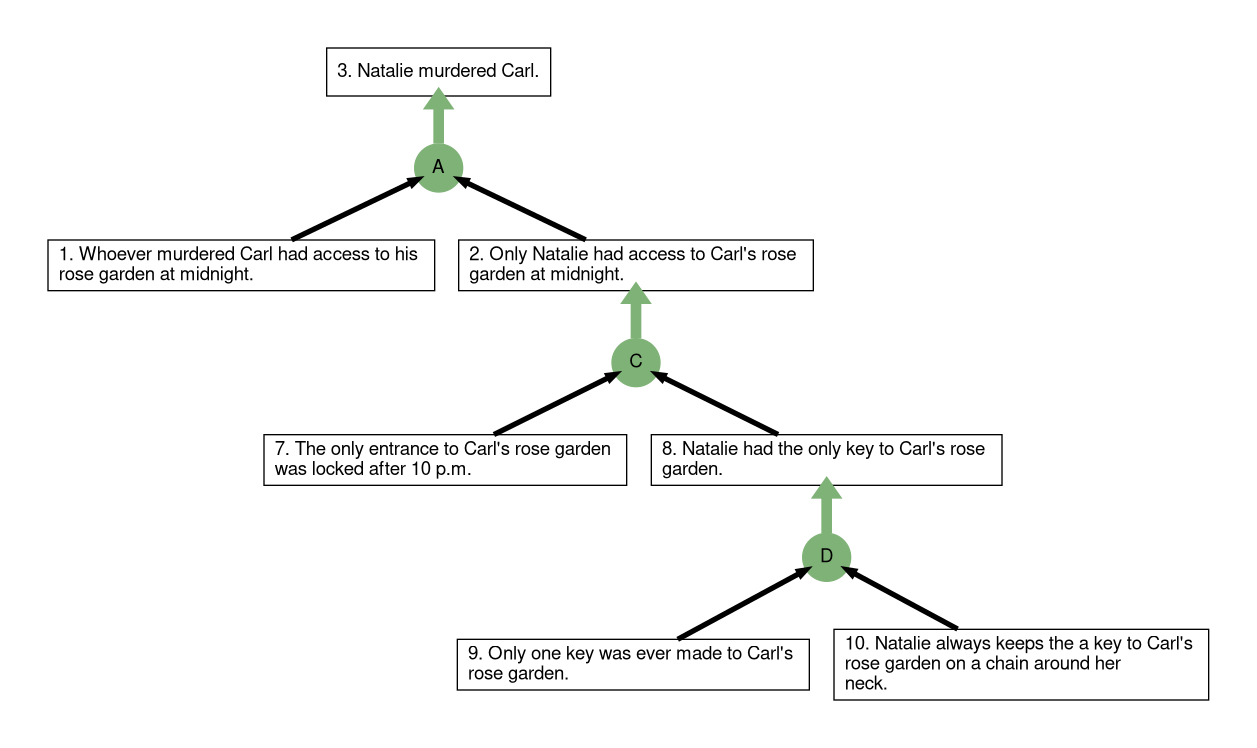
A second way arguments can be related is that a premise of one argument can be the conclusion of another, forming a chain. Here’s an example of that:
| Map 11 |
|
Notice that Argument A (from Map 9) is part of this larger map. One of its premises is now the conclusion of another argument, labeled C, and one of C's premises is a conclusion of a further argument, labeled D. So, we can think of D, C, and A as a chain of arguments, with Proposition 3 as their ultimate conclusion. (Or, to put it another way, we can think of D, C, and A as making up a three-step argument for Proposition 3. And, we can think of Propositions 2 and 8 as intermediate conclusions of this larger argument.)
Why Some Arguments are Stronger than Others
Mapping an argument is a way of analyzing it—breaking it up into its parts and showing how those parts fit together into a whole. The point of analyzing an argument is that it makes it easier for us to then assess the argument. When we assess an argument, we are asking how strongly it supports the conclusion—how good a reason it gives us to think that the conclusion is true. The strongest arguments are ways of knowing their conclusions—or, in other words, they give us a way to tell that the their conclusions are true.
If an argument supports its conclusion strongly enough to establish it as knowledge, the argument is called conclusive and is said to be a proof or to prove the conclusion. [3] These arguments are especially valuable. On the opposite extreme would be an argument that gives us no reason to believe the conclusion and so leaves us no closer to knowing it than we were before. There is no special name for such arguments, but let’s call them fatuous (meaning silly and pointless) because they don’t accomplish any of what an argument should do.

Many arguments fall in between these two extremes. That’s because knowledge isn’t an all-or-nothing affair. There is a whole spectrum between really knowing a proposition and being entirely ignorant of it.

Consider the proposition “Natalie murdered Carl,” which was the conclusion of many of the arguments in the maps we looked at earlier. Suppose that this proposition is true and that you’re a detective investigating Carl’s murder. When you begin the case, you may have no idea who killed Carl, and no reason to suspect Natalie; indeed, you might not even know who Natalie is. So, the proposition would be at the extreme left end of the scale pictured above. But as the investigation proceeds and you learn more about Carl’s life and death, at some point you encounter some evidence pointing to Natalie and you formulate the theory that she did it. At first, it might not be much evidence. We certainly wouldn’t say that you know she killed him or even that you believe it (or have reason to believe it), she may not even be your prime suspect, but she is now a suspect, so we wouldn’t say that you’re totally ignorant of her having murdered him. The proposition is now somewhere on the scale to the right of ignorance but to the left of the half-way mark.
Eventually, as you accumulate more evidence, she becomes the lead suspect. Now if you had to bet, you’d say that she did it, and you’d have good reasons to support your bet. We might say you believed she did it, but that you don’t know it yet. Eventually, you accumulate enough evidence to be certain that she did it. Now the proposition has progressed to the right-most region on the scale—you know it.
We can call a proposition's position along this continuum in the mind of a given person, the proposition's epistemic status for that person, and give names to the regions along the continuum. We call a proposition certain when we think that we know it to be true. On the other extreme, we can call a proposition unfounded if we have no reason to think it's true. We call a proposition possible (in one sense of that word) when we have reason to suspect that it might be true. And we call a proposition probable when the evidence makes it more likely to be true than not.

So in the example above, before the investigation starts you have no evidence to even suggest that Natalie may have murdered Carl. The proposition wouldn't even occur to you, but if for some reason it did, the proposition would be unfounded for you. Later when you find evidence that makes her a suspect, the proposition becomes possible, and as the evidence mounts it becomes probable and ultimately certain.
The evidence that you accumulate could be spelled out in the form of arguments, and it is these arguments that advance us along the continuum from ignorance to knowledge (or from an unfounded proposition to a certain one). An argument that’s strong enough to make its conclusion certain is a conclusive argument or proof. An argument that doesn’t give us any of the way towards certainty is worthless. But many arguments take us part of the way—they give us some reason to believe the conclusion without giving us conclusive reason. We can speak of an argument as being stronger or weaker, depending on how close it is to being conclusive.
Notice that in the scale for epistemic status, knowledge and certainty are represented by a range and not by a point. This is because, even among the things we know, we sometimes think of ourselves as being more certain of some things than we are of others. We sometimes think this even when we're not uncertain of the less certain things; and we might think of ourselves as knowing the more certain things better than we know the less certain ones. For example, I expect that you know both that Joe Biden is the 46th President of the United States and that twice two equals four. (For my part, I'm certain of both things.) But you might regard yourself as more certain that twice two is four than you are that Biden is the 46th President, because you can imagine bizarre scenarios in which you're the victim of some elaborate hoax and Biden isn't really the President, but it's hard to imagine any scenario under which you could be mistaken that twice two is four. Some people think that there is almost nothing that they really know or can be certain of because they cannot completely rule out such hoaxes, and epistemologists think a lot about what to make of such skeptical scenarios. In ordinary reasoning however, we often take ourselves to know (or to be certain of) something without thinking that there is nothing better known (or more certain) than it. And this is what is allowed for by representing knowledge and certainty as a range rather than a point on our scales. Similarly, to say that an argument is conclusive is just to say that it’s strong enough to establish its conclusion as knowledge. It is not to say that there could not be some other argument that is even stronger.
There are two factors that contribute to the strength of an argument: the strengths of its premises and the strength of its inference. So, to assess an argument we need to assess each premise and each inference.
Strength of premises
The strongest premises are ones that we can be certain of independently of knowing the conclusion. In order for an argument to be conclusive, all of its premises must be like this. On the other extreme, if any of an argument's premises is unfounded (or if we know the premise to be false), that makes the argument worthless. An argument with premises that are possible or probable cannot prove its conclusion, but it can still offer some support for it. For example, to return to the case of Carl's murder, if we were certain that whoever murdered Carl had access to his rose garden at midnight, and it was probable that Natalie was the only person who had this access, that would make it probable that Natalie was the murderer.
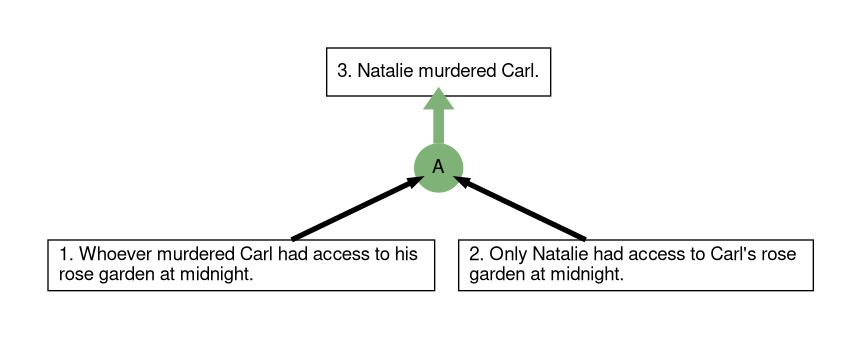
This is illustrated in the assessment of our Familiar Argument A, below.
| Map 9 |
|

The scales placed in the box for Propositions 1 and 2 indicate the epistemic status of those propositions. The scale in the box for Proposition 1 has a mark in the rightmost region indicating that that proposition is certain. Proposition 2’s scale shows that the proposition is probable. And the scale for the Argument as a whole shows that it is strong enough to render the conclusion probable.
Since the case of Natalie and Carl is fictitious, there’s no way for us to actually assess the premises. The epistemic statuses in the map above are made up (as is everything else in the example). To assess an actual premise one needs to consider how strong one's reasons to believe the premise are independent of one's belief in the conclusion. This last qualification is important. It can take some reflection to recognize which of our beliefs are based on which others, so it's easy to regard as a premise something that we're only convinced of because we already believe the conclusion. This is called circular reasoning.
Strength of Inferences
The strength of an argument depends not only on the strength of its premises, but also on the strength of its inference. There are different types of inferences which we'll discuss over the semester, and learning about the types is a great aid in assessing specific inferences. Here I'll just make a few general remarks.
In order for an argument to support its conclusion at all, the premises need to be related to one another and to the conclusion in such a manner that, the premises being true would make the conclusion likely to be true. In the very strongest inferences, the premises are related to one another and to the conclusion in such a manner that one would be caught in a contradiction if one held that the premises were true, but that the conclusion was false. This is the case with many of the inferences we've looked at in this article, including Inference A (in Map 9). Proposition 1 tells us a characteristic of Carl's murderer—namely that the murderer could access the rose garden at midnight. Proposition 2 tells us that only Natalie has this characteristic. If both propositions are true, then it has to be that Natalie is the murderer. There's no room for any alternative. Inference A is as strong as any inference could be. Inferences like this are called deductions and are said to necessitate their conclusions.
Deduction is the type of argument that has been most studied by logicians. All deductive arguments follow one of a number of forms, which one can learn and train oneself to recognize. Since every deduction is as strong as an inference can be, no deduction can be stronger than any other. Thus, on a scale representing the strength of inferences, we must represent deduction, not as a range, but as a point on the far right.

Let's add our assessment of Inference A as a deduction into our assessment of Inference A into our map of Argument A:
| Map 9 |
|
|

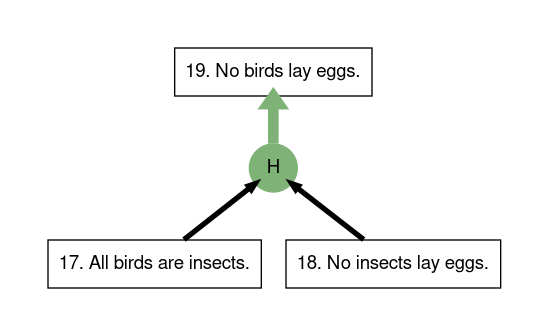
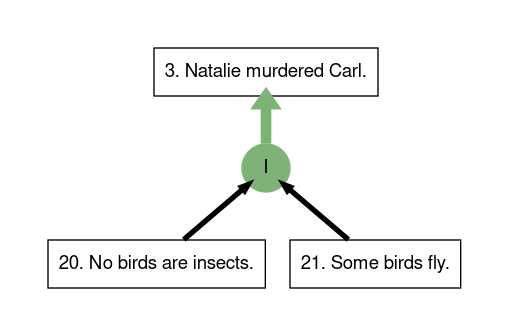
Notice that, though Inference A is a deduction, Argument A as a whole is still not conclusive. This is because Premise 2 is merely probable, rather than certain. The strength of the argument as a whole depends on the strength of all its elements, whereas the strength of the inference is independent of the strength of the premises. That’s illustrated by the following maps:
| Map 12 | Map 13 |
|
|


Here we have two arguments (H and I) that are both fatuous for opposite reasons. In Argument H we have two awful premises—premises that no one has any reason to believe and that we all know to be false. But inference H is as strong as can be—it's a deduction. Propositions 17 and 18 are false, but if they were true, then Proposition 19 would have to be true also. Nonetheless, the unfounded premises make the argument as a whole fatuous. As it happens the conclusion, like the premises, is obviously false. Notice that if we changed Proposition 18 to say "All insects lay eggs" and Proposition 19 to say "All birds lay eggs," the argument would then have a true conclusion and one true premise, in addition to having an inference that's as strong as can be. Nonetheless, it would still be fatuous, because Proposition 17 remains unfounded (indeed obviously false), and an argument can be no stronger than its weakest part.
Both premises of Argument I are certain, but the argument is fatuous because Inference I is so bad. There's no relation at all between the premises and the conclusion, so even if we know the premises to be true, they can't give us any reason at all to even suspect that the conclusion might be true. You can’t infer anything about Carl and Natalie from premises about birds and insects. Inferences this bad are called non sequiturs.
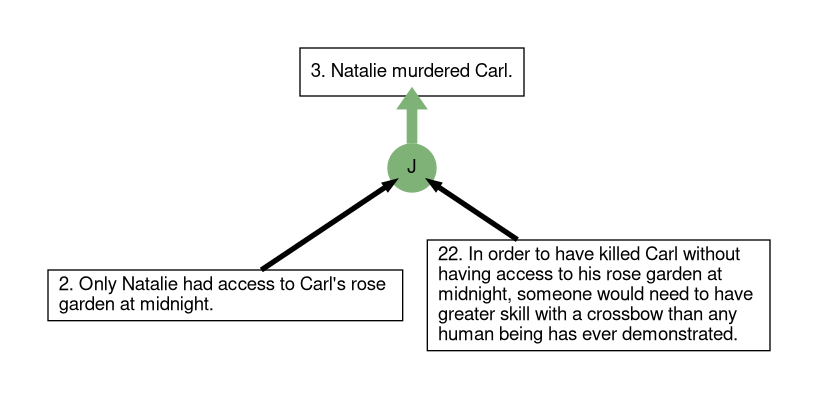
An inference does not need to be a deduction to put one in a position to know its conclusion. Consider the following argument:
| Map 14 |
|

This is like Argument A from Map 9, except that we've replaced Proposition 1, which said that Carl's murderer had access to his rose garden, with a premise that allows for an extremely remote possibility of someone committing the murder without having had access. Because of this, unlike Inference A, Inference J is not a deduction. But it is still a very strong inference. To judge just how strong it is, we'd have to rely on some background knowledge of the situation. For example, if among Carl's associates were people who were at the cutting edge of crossbow marksmanship, we might regard it as a possibility that the murderer is someone other than Natalie—someone who has an unprecedented level of skill with the weapon. But, in most contexts, such speculation would be unfounded. In this case, Inference J is strong enough that being certain of its premises would put us in a position to be certain of its conclusion. That's how I assessed it on the scale above.
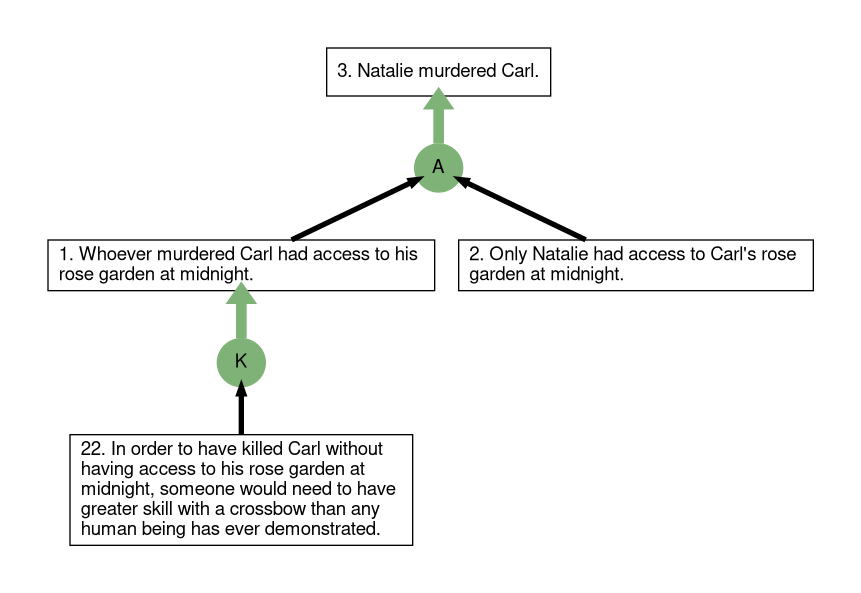
Incidentally, instead of thinking of Proposition 22 as an alternative premise to Proposition 1 in an argument to the same conclusion, we might think of Proposition 22 as part of how we know that Proposition 1 is true, as illustrated in the following map.
| Map 15 |
|

This amounts to a different way of mapping what is in essence the same line of reasoning.
In any case, whether we focus on Argument K (in this most recent map) or on Argument J (in the map above it), the point remains the same. The inference isn't a deduction, but it's strong enough that being certain of its premises would put us in a position to be certain of its conclusion. We can call such inferences compelling.

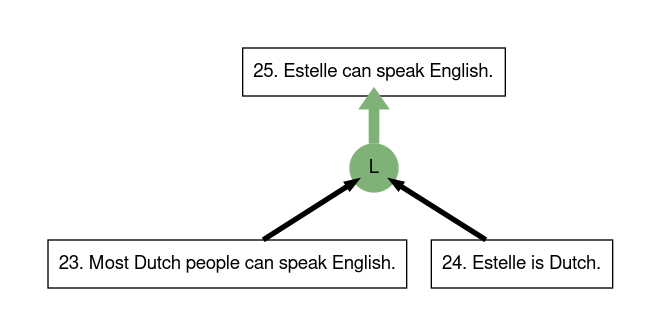
Even inferences that aren’t compelling can be useful. Consider the following argument:
| Map 16 |
|

Inference L isn’t compelling, but it’s not bad, either. If you knew the premises to be true, this argument wouldn’t put you in a position to know the conclusion, but (unless you had other relevant knowledge of Estelle), it ought to lead you to regard it as probable that Estelle can speak English.
The Strength of an Argument as a Whole
To review then, arguments range in strength from fatuous to conclusive, with conclusive arguments being the ones that are strong enough to establish their conclusions as knowledge (in other words, to make them certain). The strength of an argument is determined by the strength of its premises and of its inference. The strength of a premise is its epistemic status. The highest epistemic status is knowledge or certainty, and the lowest is that of a proposition one is either wholly ignorant of or knows to be false. We called this status "unfounded." The strength of an inference is determined by the relationship between the premises and the conclusion, and this is separate from whether the premises are true. The weakest inferences are called non-sequiturs and the strongest are called compelling.

- ↑ All the maps in this article, are made with ReasonSpace. There are a few competing conventions for argument mapping, so you may sometimes find maps drawn or labeled a bit differently elsewhere.
- ↑ Propositions 4 and 6 taken together without Proposition 5 wouldn't even give you a reason to suspect Natalie. Knowing Propositions 4 and 5, without knowing 6, would give you a strong reason to suspect Natalie (since it would mean that she's one of only two people who could have done it), but adding Proposition 6 upgrades the argument from one that would make Natalie a suspect to one that proves that she's the murderer.
- ↑ People often call arguments that they come up with proofs if they think the arguments prove their conclusions, and sometimes these names catch on, but that doesn’t mean that the arguments really prove the conclusions. We have to assess them for ourselves to see.