Inference to the Best Explanation
Introduction to the Concept or Inference to the Best Explanation
When you look at a patch of ground and see regularly spaced shoe-shaped impressions in the pattern that we call “foot-prints”, you immediately infer that someone walked there. What argument are you using? Perhaps this one:
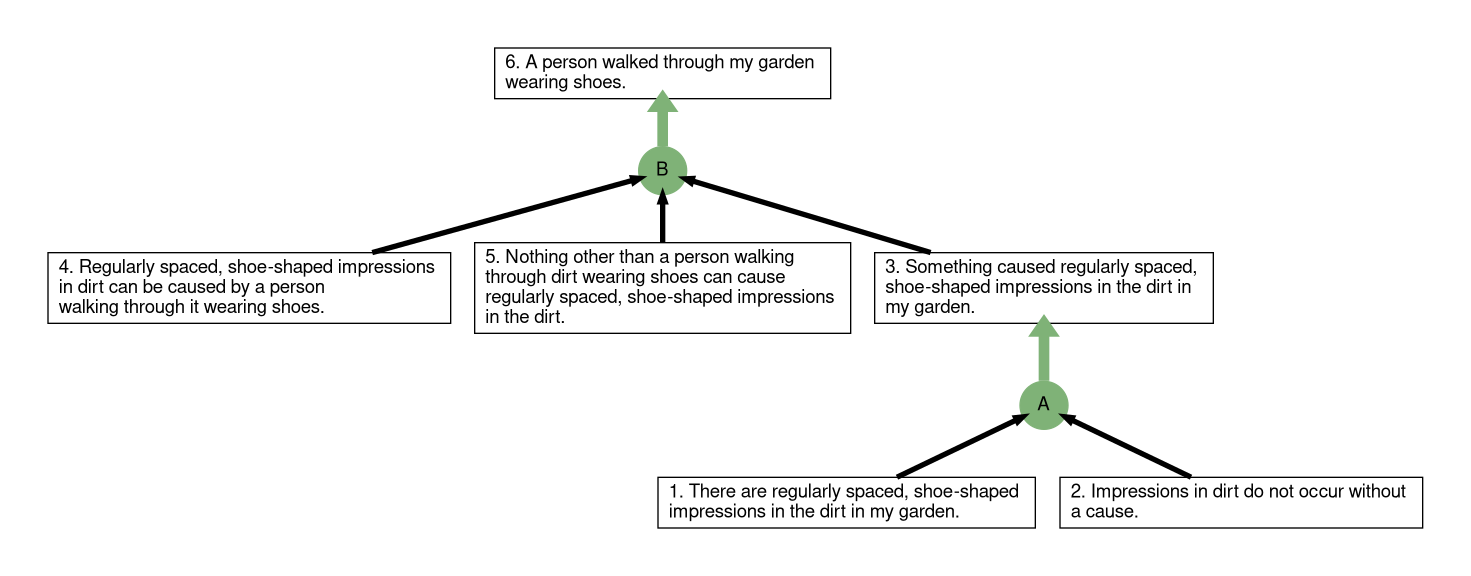
This is a valid deductive argument, but Proposition 5 is false. There are other things that could cause such a pattern of impressions in dirt. For example, a single large stamp with a footprint-like pattern on it could have been pressed into the dirt, or the pattern could have been made by a robot or specially trained chimpanzee walking upright with shoes on. You can probably come up with some other similarly outlandish ways in which such a pattern in dirt could be created. But even though there are things other than a walking person that could cause impressions of the relevant sort, it is clear that, in most circumstances at least, the best explanation of the footprints would be that someone walked by. Because of this, it is eminently reasonable inn almost all circumstances to conclude from seeing such a pattern that a person walked by; indeed, unless one had some special evidence to the contrary, it would be irrational not to draw this conclusion. However, the inference taking place is not a deduction; it is an “inference to the best explanation”. If we wanted to lay out the argument it would be as follows:
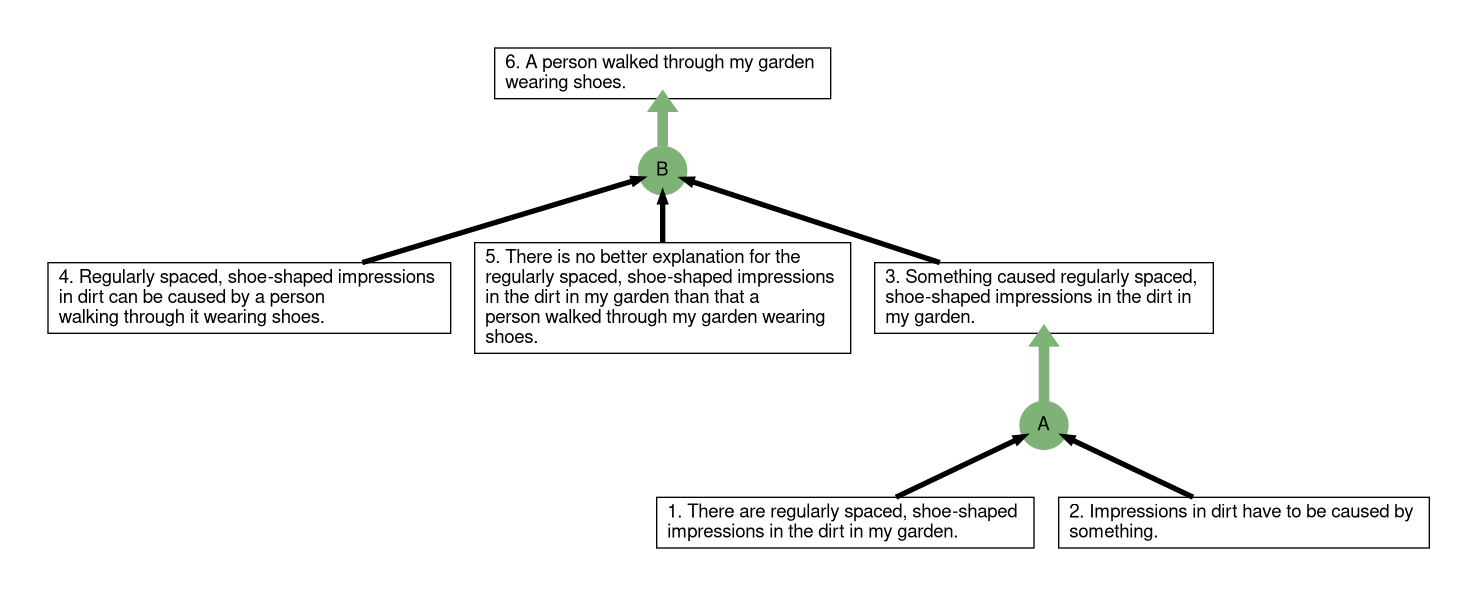
Inference to the best explanation is constantly used in the sciences, in solving crimes, and in other contexts. In such inferences, one concludes that a certain proposition is true because it would explain a known effect better than any alternative explanation. Recall that an explanation explains an effect by citing causes. An inference to the best explanation concludes that a certain putative cause exists, because it would explain a known effect.
The structure of an inference to the best explanation
Such an argument depends on knowing (or having excellent reason to believe) several things: (1) that the effect in question exists, (2) that it is an effect (that is, something which is caused by something else), (3) what sorts of things could cause the effect, (4) which of these causes explains the effect best. Notice how these four correspond to the premises in the argument above. We can restate the form of argument involved as follows:
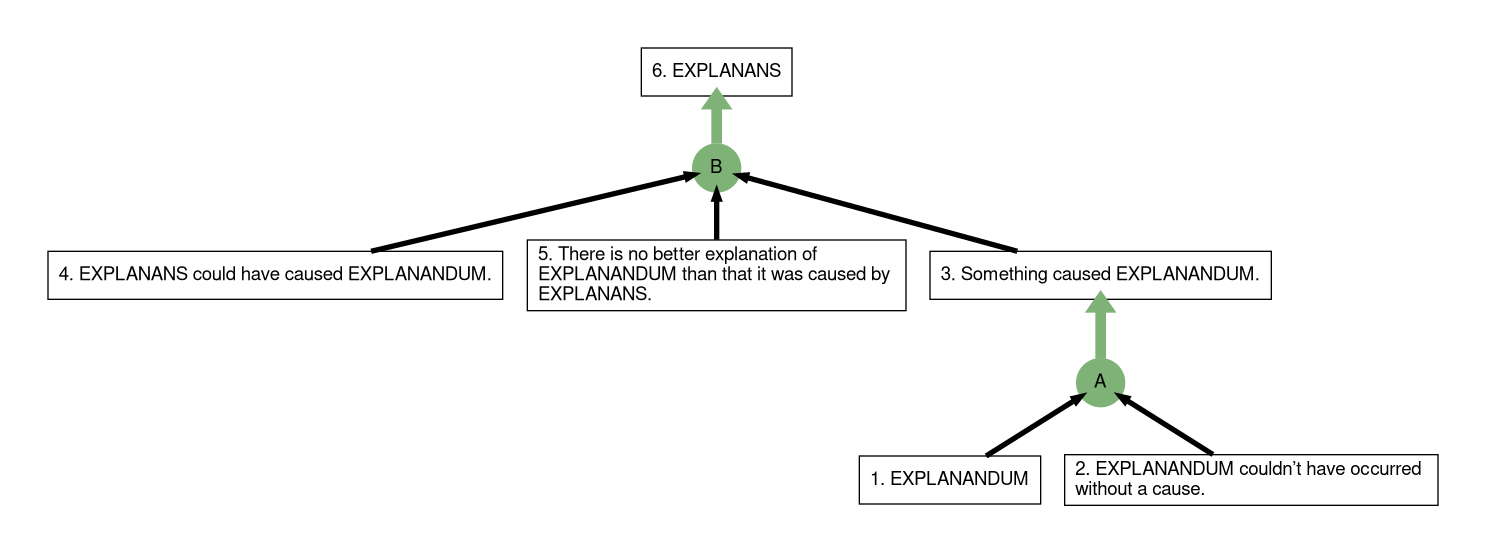
The Latin word “explanandum” means “thing to be explained” and the word “explanans” means “thing that explains.” So if we just replace these (capitalized) words in the map above with the thing we want to explain, and with our theory of what explains it, we’ll get a map of an inference to the best explanation.
If all the premises of such an argument are certain, then the degree of support the argument provides for the conclusion is proportionate to how much better the explanation in question is than whatever alternative explanations may be available. In the example of the footprints, the alternative explanations are all quite poor, so the conclusion is either certain or nearly so. But in a case where there were several decent explanations, the conclusion would only be probable, or merely possible, depending on how good the other explanations were. For example, think of a murder which any of three people could have committed. The murder is the effect, and there are three explanations corresponding to the three suspects—let’s call them Ed, Fran, and George. Suppose that the best of these three explanations is that Fran did it (perhaps she had a stronger motive than either of the others), but that this explanation was only slightly better. If so, then argument would only make the proposition that Fran committed the murder possible, because though it is more likely that she’s the murderer than it is that Ed is or that George is, it is still more likely that the murderer is one of these two men than that it is Fran. Indeed, Fran is probably innocent. This shows that, to assess an inference to the best explanation we need to know not only that the explanation in question is the best one, we need to know how much better it is than competing alternatives. Also, we should keep in mind that the competing alternatives here aren’t limited to explanations we’ve already come up with; they include others that might not yet have occurred to us.
This raises two big questions: (1) How do we know when we’ve come up with all the relevant explanations to consider? (2) What makes some explanations better than others?
Let’s take up this second question first.
Why some explanations are better than others
What makes some explanations better than others in the first place? There are at least three factors: (i) the degree of detail in which the effect is explained; (ii) how much independent reason there is to believe that the cause exists and is operative in the relevant context; and (iii) how well the statement of the cause is circumscribed.
(i) Degree of detail with which the effect is explained.
Let’s begin with the first of these factors and consider it in connection with a variant of our footprint example. While on a hike, you come across what we would normally describe as animal tracks. These are the effect that you want to explain. Notice that in describing them as animal tracks, we’re already explaining them as effects of an animal, so for now don’t think of them as animal tracks but as a certain pattern of impressions in the ground. Notice that there are different levels of detail at which this pattern can be described. At the one extreme, they could be described simply as impressions in the ground. A more detailed description would include the approximate size of the impressions and their foot-like shape, and it would indicate pattern in which the impressions occur—for example, it might say that they occur at regular intervals along two roughly parallel lines, and that the impressions are staggered somewhat, so that the impressions in the left line are slightly ahead of those in the right. A still more detailed description would specify the shape, size and pattern more precisely, including such details as whether there are toe marks and how many, the precise shape of each part of each the impression, how deep the impressions are, just how far apart, how exactly each impression is oriented relative to the others, etc. The description could be more or less detailed depending on how many of these aspects of the impression it described and the degree of specificity with which it described each—for example, whether numerical measurements are given, and, if so, with what degree of precision. (There are entire books on documenting animal tracks and some people make this their life’s work.) The upshot of the preceding is that we can describe the effect at different levels of detail. The relevance of this to assessing explanations is that, all other factors being equal, one explanation of an effect is better than another if it can explain the effect in greater detail. So, consider several different explanations that someone might give for the animal tracks:
(A) The impressions were made by one or more entities pressing into the ground.
(B) The impressions were made by a walking animal.
(C) The impressions were made by a charging elephant.
(D) The impressions were made by a relatively small animal with four toes.
(E) The impressions were made by a canine.
(F) The impressions were made by a fox.
(G) The impressions were made by an adult female kit fox moving at top speed.
Explanation (A) does explain why there are impressions in the ground, but it does so only at the most generalized level. It explains why there are impressions without explaining any of the details of these impressions. This may be the best explanation someone could give if all he knew about the effect was that there were impressions in the ground, but in the example, we know a lot more about the effect than that. Explanation (B) is a better explanation because it explains a lot more about the impressions. Our knowledge of animals, feet, and walking allows us to figure out what sort of impressions would be caused by an animal walking, and since the impressions we see on the ground are of this sort, this explanation explains the effect in more detail than the previous one. Explanation (C) gives further details of the cause, from which we could infer further details that would have to be true of the effect. The tracks made by a charging elephant would quite large and deep. Let’s suppose that this is not so of the tracks we are looking at. If so, (C) will be ruled out entirely as an explanation, because the effect to be explained couldn’t have been produced by the specified cause. Like (C), Explanation (D) gives us details about what kind of animal caused the tracks and, again, we know more or less what sort of tracks an animal of the sort specified would make. Let’s suppose that in this case, the tracks we observe are of the right sort to have been caused by a relatively small four-toed animal. If so, then this is the best of the explanations so far, because it explains the effect accurately and in greater detail than any of the others. In fact, this is probably the best explanation that a layperson would be in a position to give. Someone who knows a little more about the feet of different animals and how they walk would be able to give an explanation like (E) or (F) which would explain further details of the tracks, and an experienced woodsman could explain subtler details of the tracks with an explanation like (G).
In this example, all of the explanations other than (C) are consistent with one another. Animal feet are things that press into the ground; small, four-toed animals are animals; canines are small and four-toed, foxes are canines, female kit foxes are foxes, and running at top speed is one of the ways in which female kit foxes move. Thus, though one explanation is better than the others in that it is more detailed, all the explanations can be simultaneously true. There are cases, however, in which two competing explanations that are both consistent with what is known about an effect, but cannot both be true. In some such cases, one explanation explains the effect in greater detail. For example, suppose that you already knew that the animal tracks were caused either by a jack rabbit or a fox (perhaps because you know that these are the only two sorts of animals in the area of the right approximate size) and that you know next to nothing about jackrabbits’ feet but enough about foxes’ to know that they would make tracks of roughly the shape observed. In this situation, the explanation that the tracks were made by a fox would explain the tracks in greater detail than the explanation that they were made by a jackrabbit.
ii. How much independent reason do we have to believe that the cause cited in the explanation exists and is operative in the relevant context
Let’s move on now to the second factor that makes some explanations better than others. The more independent reason we have to believe that the cause specified by an explanation exists and is operative in the relevant context, the better the explanation is. For example, suppose that you’re looking at a photograph taken in Alaska of a set of large tracks through the snow. Two explanations for the tracks occur to you: (A) “They were caused by a polar bear”, (B) “It’s the abominable snow man!” Clearly (A) is a far better explanation than (B), because you know that polar bears exist and live in Alaska, whereas the idea that there’s an abominable snow man is unfounded (or, at any rate, it has a much lower status than the idea that there are polar bears).
Now consider a case in which you know that both of the causes you’re considering as explains of an effect really do exist: You’re standing on a dude ranch in Texas and you hear hoof beats behind you. Here are two explanations for the sound: (A) “A horse is approaching”, (B) “A zebra is approaching”. You know that both horses and zebras exist, but (A) is still the better explanation, because in addition to knowing that horses exist, you know that horses are comparatively common in North America, especially on dude ranches, whereas zebras are rare. This is what I mean by saying you have independent reason to believe that “the cause is operative in the relevant context”—you not only know that horses exist and cause effects like hoof beats, you know that you’re in the sort of situation in which there are likely to be horses causing these effects.
I chose this particular example because there’s a saying in medicine: “When you hear hoof beats, think horses, not zebras.” Diagnosing a patient is an example of inference to the best explanation: the patient comes to the doctor with symptoms, and the doctor needs to infer their cause. Young doctors fresh out of medical school often make the mistake of inferring that the patient has some exotic disease, even though the symptoms can be explained by a much more common condition. The exotic diseases, which are jokingly called “zebras,” are bad explanations because, other than the fact that they could cause the patient’s symptoms, there is no reason to expect to encounter them in (for example) a clinic in an American suburb, and the symptoms can be explained by other conditions (“horses”) that there is independent reason to expect to encounter when working in such a clinic.
It is worth noting, however, that sometimes the best explanation of something we observe is unusual or even unprecedented. There are animals whose very existence was first inferred from their tracks (or, in some cases, fossilized remains of tracks), and the existence of certain microbes were inferred because they explained many the details of how certain diseases (especially typhus) spread much better than any competing theories.
iii. How well has the statement of the cause been circumscribed?
The third factor that makes some explanations better than others is how well the statement of the cause is circumscribed. To get a sense of what this means, suppose that, after inferring from a set of footprints that a man walked by, we went on to infer from the size, shape, and arrangement of the footprints something about the man’s weight, shoe size, and gate. So far, so good, but then suppose we went on further to describe his taste in literature, his hat-size and his mother’s maiden name. Now our explanation of the footprints would be as follows: “They were made by a 200-pound man, walking briskly in size 11½ Bruno Magli Moc-Toe Oxfords, who adores Dostoevsky, has a hat-size of 7½, and whose mother’s maiden name was Schwartz.” The extra details given in the last three clauses make the explanation worse than it would otherwise be, because they don’t explain anything about the footprints.[1] At best such superfluous details in an explanation are distracting irrelevancies; but, in the context of an inference to the best explanation, they are worse than this. In this kind of argument, the reason we have for believing in the existence of the cause is that it would explain the effect. Therefore, the argument only gives us reasons to believe in those features of the proposed cause that play a role in explaining the effect. Thus, if having a hat-size of 7 ½ explains nothing about the footprints, then the argument can give us no reason to believe that a man with this hat-size walked past, though it does give us a reason to believe that a man walked past.
How can we ensure that we’ve considered all the possible explanations?
If we are to be reasonable in concluding that that something is true because it provides the best explanation of some phenomenon, it is not good enough for it to be the best explanation out of the few we happen to have already thought of and considered. It has to be the best explanation available—that is, we need to have reason to think that no better explanation could be produced. In order to know this, we need to have some sense of the whole range of ways in phenomenon could be explained, so that we can compare the explanation we're considering to all of these alternatives, rather than to the few that happen to have occurred (or been proposed) to us. How do we determine what this range of explanations is? There's no simple formula for it, but two points that we have already encountered help.
First, in evaluating explanations, we should always be considering more general explanations as alternatives. So, for example, if we're considering "Natalie murdered Carl" as an explanation of Carl's death, we should also consider the more general explanation "Carl was murdered." If we're going to go beyond this more general explanation to say that Natalie in particular murdered him, we'll need specific evidence pointing to her, over and above the general evidence that he was murdered. Moving up to more general explanations, helps us to better see the range of explanations available. If we're only focused on explanations as specific as "Natalie murdered Carl," we will have as many such explanations to consider as there are possible murderers, but if we zoom out to the more general explanation that Carl was murdered, then we will only have to contrast it with a few other similarly broad explanations of how he died, such as "due to natural causes," "due to an accident," or "due to suicide." If we are able rule these alternatives out at this very general level (without worrying separately about every sort of natural cause or accident), then once we've narrowed down the murder suspects to Natalie, we can be confident that the explanation that she murdered Carl give the best explanation available of his death.
Second, recall that in order to get an inference to the best explanation started, we need to know that the phenomenon we are trying to explain is something that needs an explanation in the first place—that it is not something that can happen without a cause. In general our knowledge of what sorts of things require causes comes with knowledge about the sorts of things that can serve as causes. For example, part of knowing that people do not just die, is knowing the sorts of things that can cause us to die: sickness, accidents, murder, etc. Similarly (to return to an earlier example), part of knowing that impressions in the ground are the sort of things that have causes, is knowing in broad outline the sorts of things that can cause them. So in thinking about whether you've considered the range of available explanations, reflect on how you know in the first place that something had to explain cause the phenomenon in question.
Summing up how to assess claims to have the best explanation of a phenomenon.
Let’s sum up by reviewing some of the things we need to consider when evaluating an inference to the best explanation: (1) Do we know that the effect being explained exists at all? (Or, more generally, what is the epistemic status of the proposition that it exists?) (2) Do we know that it is an effect (something that was caused by something else)? (3) Do we know enough about this kind of effect to speculate about teh range of things that might cause it and to evaluate alternative explanations? (4) Would the cause proposed in the explanation explain the effect? (5) In how much detail does it explain it? (6) Do we have any independent reason to believe that this cause exists and is operative in this context? (7) Is the explanation properly circumscribed, or does it include features that don’t contribute to explaining the effect? (8) What other causes could explain the effect? (9) Is the proposed explanation really better than all of these explanations? (10) How much better is it?
- ↑ Perhaps you can imagine a situation in which these details would explain something—for example, if the footprints were leading from the site of a Schwartz family reunion to the site of a seminar on Crime and Punishment, and a 7½ hat was found next to them. But let’s assume that we are not dealing with this sort of situation.