Deductive Fallacies
There are some forms or argument that look like deductions, but which are not. Here are the three most common invalid argument forms (or “deductive fallacies”) that are easily mistaken for deductions:
Undistributed Middle
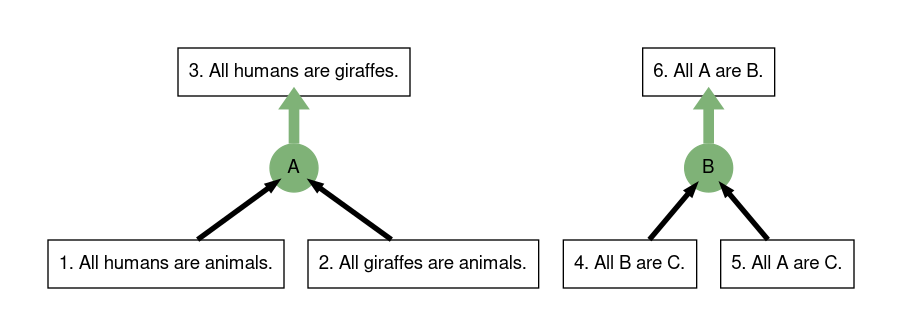
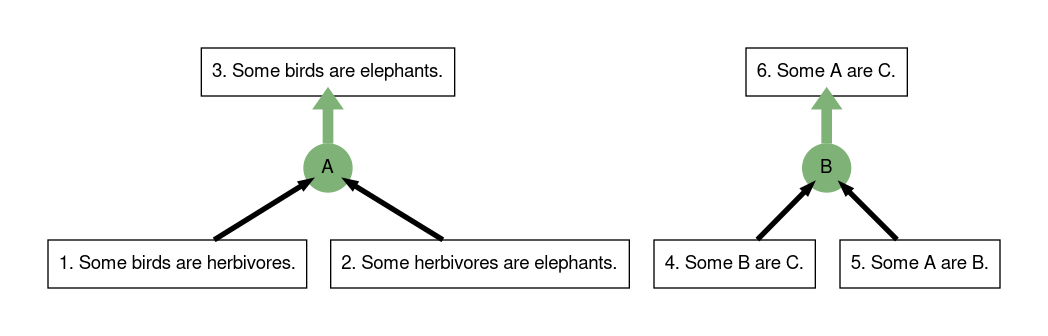
In Aristotelian syllogisms, the middle term (the one that is present in both premises) must be distributed that is, is must be said to apply to all or to none of one of the other terms. The fallacy of undistributed middle is committed when one has an argument that looks like an Aristotelian syllogism, except that the middle term is not distributed. Here's are some examples:
Affirming the Consequent
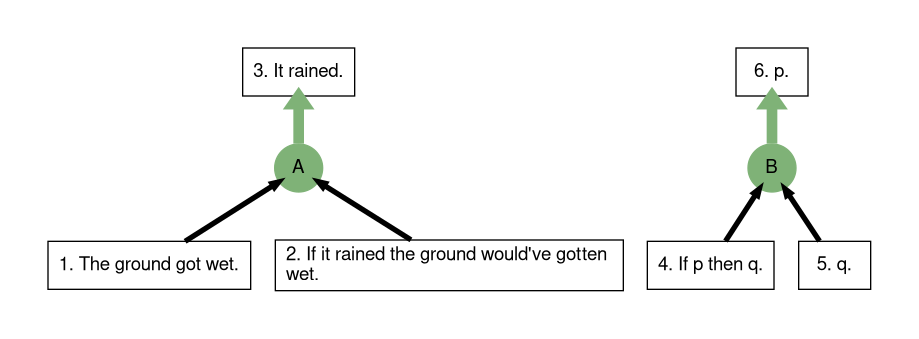
Proposition 1 in the map above tells is that if it rained the ground would be wet, but it does not tell us that the ground would not be wet unless it rained. Perhaps there are other conditions in which the ground would also be wet (for example, if someone had sprayed it with a hose), so adding Proposition 2 (which tells us that the ground did get wet) doesn't put us in a position to know that it rained (rather than having gotten wet in some other manner, such as by having been sprayed by a hose).
Denying the Antecedent
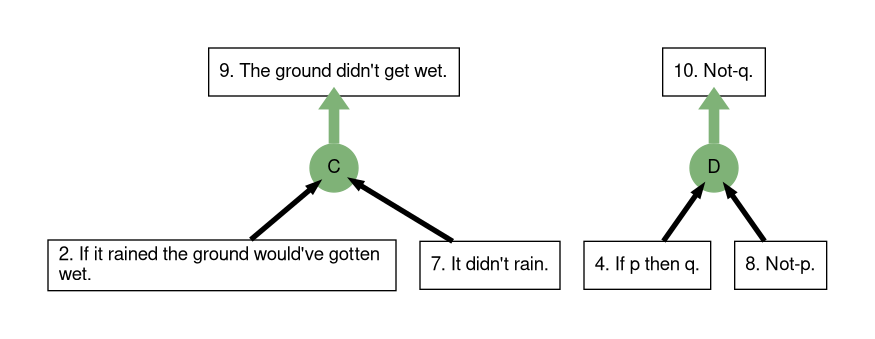
Proposition 1 in the map above tells is that if it rained the ground would be wet, but it does not tell us that the ground would not be wet unless it rained. Perhaps there are other conditions in which the ground would also be wet (for example, if someone had sprayed it with a hose), so adding Proposition 7 (which tells us that it did not rain) does not put us in a position to know that the ground is not wet.