Objections
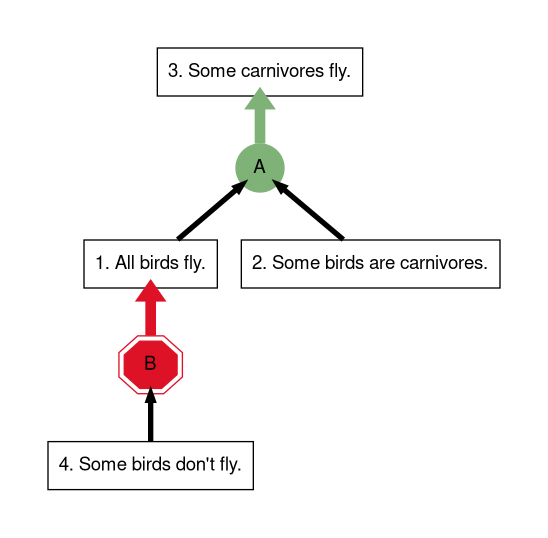
An objection is an argument that there is a weakness in another argument. An objection can be aimed at a premise or an inference. In ReasonSpace objections are represented by red octagons.
Objections to premises
An objection to a premise is an argument that the premise is unfounded and therefore is of no value in establishing any further conclusion. The objection can show this either by showing that the premise is false, or else by showing that we are in no position to know (or have any reason to believe) that it is true.
Here is an example of a map with an objection to a premise on the grounds that it is untrue:
Objections to inferences
An objection to an inference is an argument that the inference is a non-sequitur, or (failing that) that it is not very strong. This means that it aims to show that even if one knew the premises of the inference to be true, the premises wouldn't give one a reason to think that the conclusion is true. Often such objections work by identifying the inference as a known fallacy.
Assessing arguments with objections in ReasonSpace
Objections in ReasonSpace are represented as arguments with one or more propositions leading into the red hexagon, which represents the objecting inference. To assess an objection, first assess each of its premises as you would assess any other proposition. Then assess the objecting inference. To assess this inference, assume (for the sake of argument) that all of its premises are true, and then consider how damaging this would be to the proposition or inference being objected to. If the objection's premises being true would thoroughly undermine the item being objected to (showing that the premise us unfounded or the inference a non sequitur), then assess the objecting inference in the right-most region of the scale. If the premises' being true wouldn't at all undermine the item being objected to, then assess the objecting inference in the leftmost region of the scale (as a non sequitur). If the premises' being true would be damaging, but not fatal to the item being objected to, then assess the objecting inference somewhere in the middle two regions of the scale (depending on just how damaging you think it is).
Assessing an objection will add a limit to how highly you can assess the item objected to. This limit will appear as a red shaded area at the right of the assessment scale of the relevant item.