Deductive Fallacies: Difference between revisions
Jump to navigation
Jump to search
No edit summary |
|||
| Line 1: | Line 1: | ||
There are some forms or argument that look like [[deductions]], but which are not. Here are the three most common invalid argument forms (or “deductive fallacies”): | There are some forms or argument that look like [[deductions]], but which are not. Here are the three most common invalid argument forms (or “deductive fallacies”) that are easily mistaken for deductions: | ||
=Undistributed Middle= | =Undistributed Middle= | ||
| Line 10: | Line 10: | ||
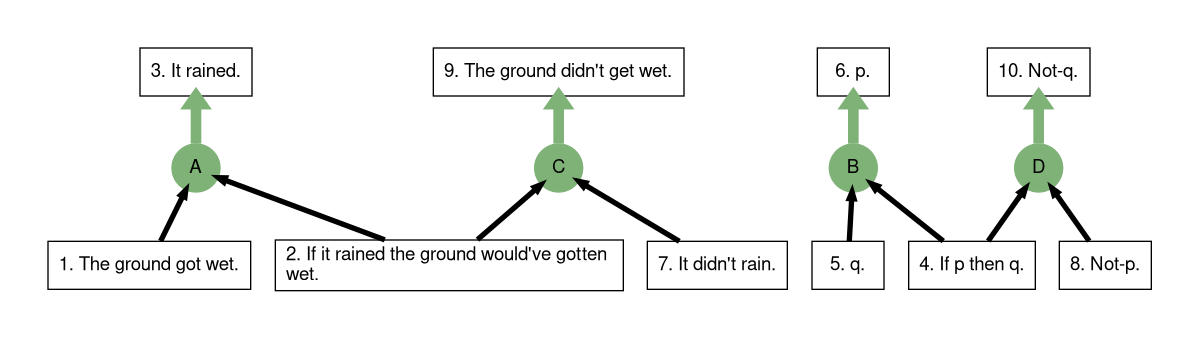
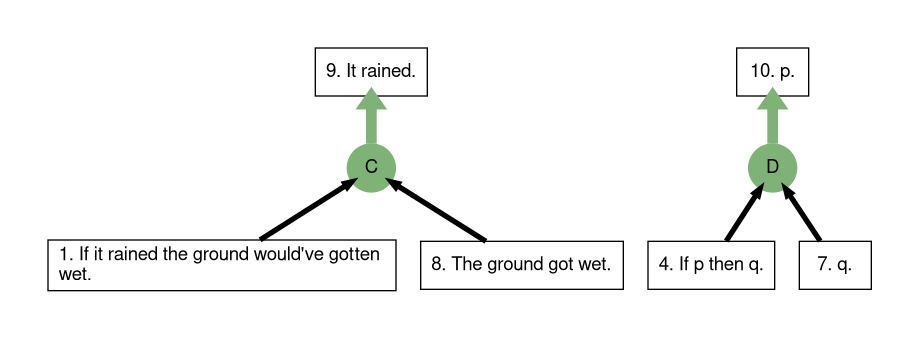
=Affirming the Consequent= | |||
{ | {{Map|https://app.reasonspace.com/smaps/3ff089e85e8d4edf9facb8e314e8cff3}} | ||
| | |||
=Denying the Antecedent= | |||
{{Map|https://app.reasonspace.com/arguments/89a7c8ca-66a7-4c50-9252-d43c3b163143}} | |||
{ | |||
| | |||
Revision as of 14:19, 2 September 2024
There are some forms or argument that look like deductions, but which are not. Here are the three most common invalid argument forms (or “deductive fallacies”) that are easily mistaken for deductions:
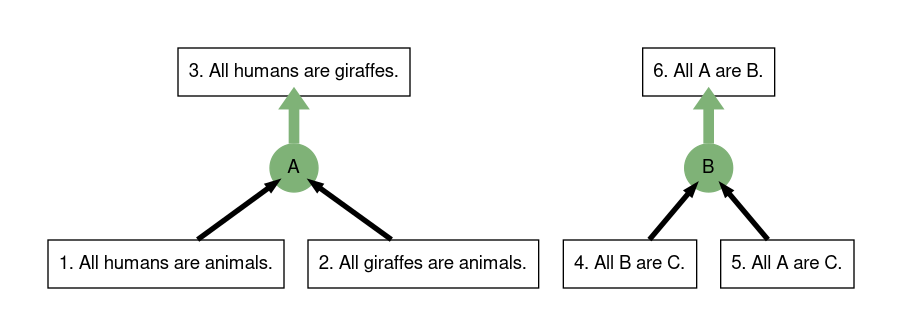
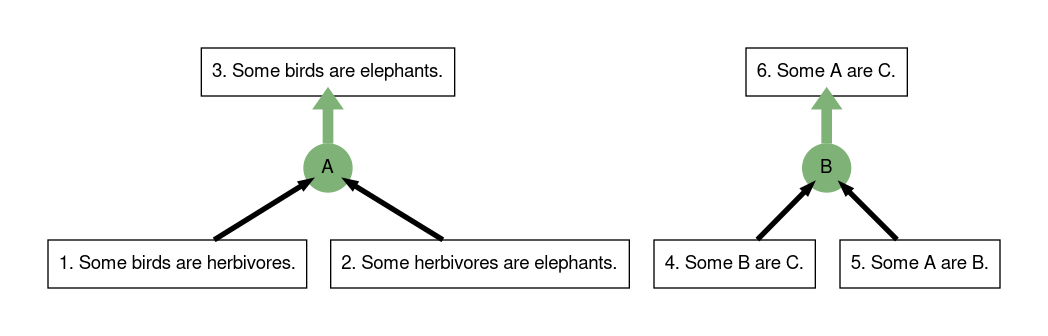
Undistributed Middle
In Aristotelian syllogisms, the middle term (the one that is present in both premises) must be distributed that is, is must be said to apply to all or to none of one of the other terms. The fallacy of undistributed middle is committed when one has an argument that looks like an Aristotelian syllogism, except that the middle term is not distributed. Here's are some examples:
Affirming the Consequent
Denying the Antecedent