Deductions Involving Complex Propositions: Difference between revisions
(Created page with "Some deductions involve ''complex propositions''. A complex proposition is a proposition that is made from simpler propositions combined with connectives like "and," "or," and "if... then." When discussing the form of such propositions, we use lowercase letters to represent the simple propositions. In this article we will cover arguments involving ''conditionals'' (complex propositions joined by "if... then..." and ''disjunctions'' (complex propositions joined by "or...") |
No edit summary |
||
| Line 5: | Line 5: | ||
In this article we will cover arguments involving ''conditionals'' (complex propositions joined by "if... then..." and ''disjunctions'' (complex propositions joined by "or"). | In this article we will cover arguments involving ''conditionals'' (complex propositions joined by "if... then..." and ''disjunctions'' (complex propositions joined by "or"). | ||
= | =Deductions Involving Conditionals= | ||
In a conditional, the proposition following the "if" is called the "antecedent" and the one following the "then" is called the consequent. | In a conditional, the proposition following the "if" is called the "antecedent" and the one following the "then" is called the consequent. | ||
| Line 24: | Line 24: | ||
Modus Tollens should not be confused with the fallacy of [[denying the antecedent]]. | Modus Tollens should not be confused with the fallacy of [[denying the antecedent]]. | ||
==Conditional Sylogism== | |||
A conditional syllogism is a two-premise deductive argument in which each premise is a conditional, the consequent of one these conditionals is the antecedent of the other, and the conclusion is a third conditional with the remaining anticeedent as its anticeedent and the remaining consequent as its consequent. | |||
{{Map|https://app.reasonspace.com/smaps/88b51968ded24d69b8a8d88e4f03ca53}} | |||
Revision as of 13:47, 2 September 2024
Some deductions involve complex propositions. A complex proposition is a proposition that is made from simpler propositions combined with connectives like "and," "or," and "if... then."
When discussing the form of such propositions, we use lowercase letters to represent the simple propositions.
In this article we will cover arguments involving conditionals (complex propositions joined by "if... then..." and disjunctions (complex propositions joined by "or").
Deductions Involving Conditionals
In a conditional, the proposition following the "if" is called the "antecedent" and the one following the "then" is called the consequent.
Modus Ponens
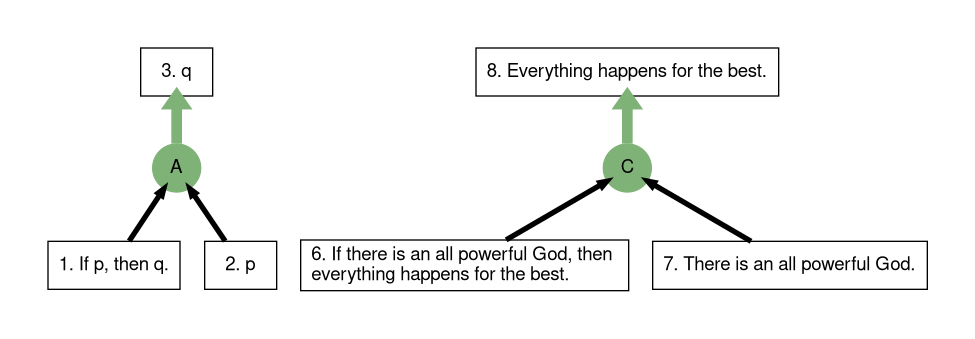
Modus Ponens (or "affirming the antecedent") is a two-premise deduction of which one premise is a conditional, the other is the antecedent of the conditional, and the conclusion is the consequent of the same conditional.
 .
.
Modus ponens should not be confused with the fallacy of affirming the consequent.
Modus Tollens
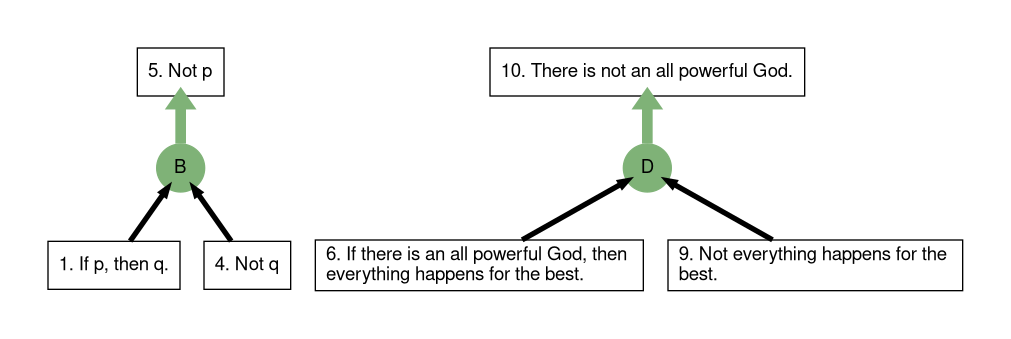
Modus Tollens (or "denying the consequent") is a two-premise deduction of which one premise is a conditional, the other is the denial of the consequent, and the conclusion is the denial of the antecedent.
Modus Tollens should not be confused with the fallacy of denying the antecedent.
Conditional Sylogism
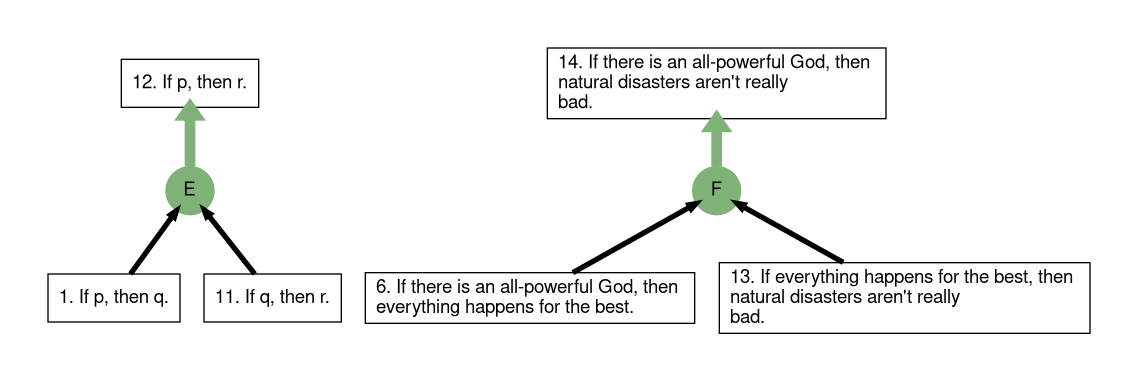
A conditional syllogism is a two-premise deductive argument in which each premise is a conditional, the consequent of one these conditionals is the antecedent of the other, and the conclusion is a third conditional with the remaining anticeedent as its anticeedent and the remaining consequent as its consequent.