Immediate Inferences: Difference between revisions
Jump to navigation
Jump to search
(Created page with "An immediate inference is an inference in which a single premise necessitates a conclusion. There are a few such forms of inference, listed below: =Converse= {{Map|https://app.reasonspace.com/smaps/9796b938f3fa4db2a4fb6648eef7e792}} =Obverse= {{Map|https://app.reasonspace.com/smaps/f648051cf96848c39c9ffc6442fba1a6}} =Contrapositive= {{Map|https://app.reasonspace.com/smaps/ae96763894f14dd9845acef41fa5f018}}") |
|||
| Line 2: | Line 2: | ||
=Converse= | =Converse= | ||
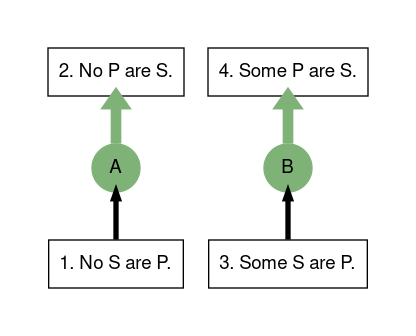
In a universal negative (No S are P) or particular affirmative (Some S are P) proposition, you can reverse the two terms, and deduce another proposition of the same form (as shown below). | |||
{{Map|https://app.reasonspace.com/smaps/9796b938f3fa4db2a4fb6648eef7e792}} | {{Map|https://app.reasonspace.com/smaps/9796b938f3fa4db2a4fb6648eef7e792}} | ||
Revision as of 10:57, 2 September 2024
An immediate inference is an inference in which a single premise necessitates a conclusion. There are a few such forms of inference, listed below:
Converse
In a universal negative (No S are P) or particular affirmative (Some S are P) proposition, you can reverse the two terms, and deduce another proposition of the same form (as shown below).
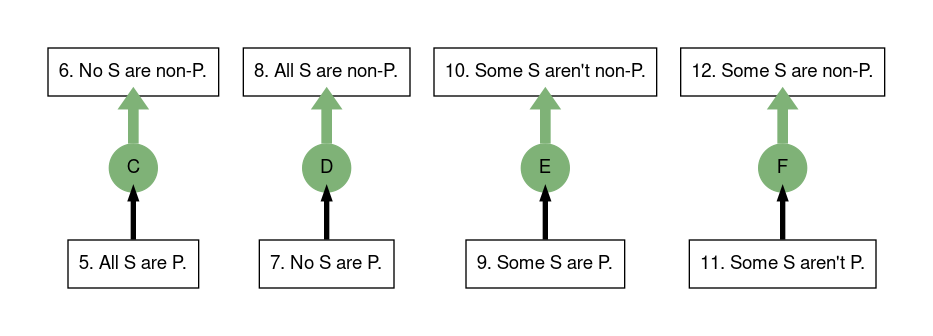
Obverse
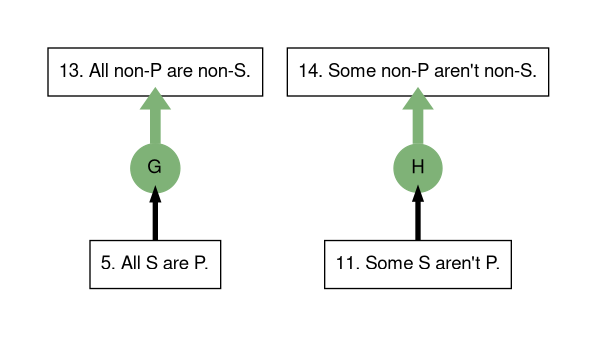
Contrapositive