Single Culprit Fallacy: Difference between revisions
Jump to navigation
Jump to search
No edit summary |
No edit summary |
||
| Line 3: | Line 3: | ||
{{Map|https://app.reasonspace.com/arguments/4efb15d472cb439d919b18d63f3bfe1e}} | {{Map|https://app.reasonspace.com/arguments/4efb15d472cb439d919b18d63f3bfe1e}} | ||
[https:// | Proposition 1 is clearly true. For a crime to be committed someone must commit it, and we call that person a criminal. Proposition 2 is also true. [https://www.austintexas.gov/sites/default/files/files/Police/Reports/Crime_and_Traffic/2020%20Crime%20and%20Traffic%20Report%20Final.pdf |According to the Austin Police Department], tens of thousands of crimes (of one sort or another) occur in the city every year. Moreover, the premises are related to one another such that we could deduce ''some'' conclusion from them, but the Inference A is clearly a [[non sequitur]]: the premises give us ''no reason'' to believe Proposition 3. | ||
Revision as of 18:07, 2 September 2024
Consider the following argument.
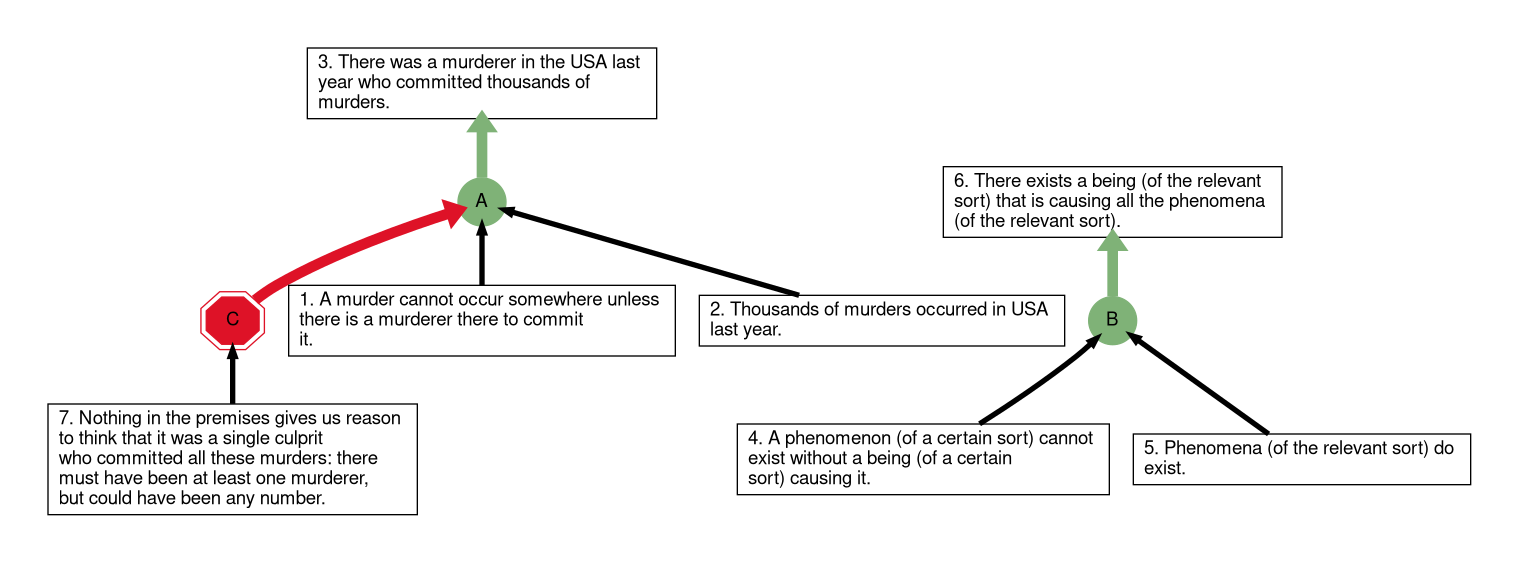
Proposition 1 is clearly true. For a crime to be committed someone must commit it, and we call that person a criminal. Proposition 2 is also true. |According to the Austin Police Department, tens of thousands of crimes (of one sort or another) occur in the city every year. Moreover, the premises are related to one another such that we could deduce some conclusion from them, but the Inference A is clearly a non sequitur: the premises give us no reason to believe Proposition 3.