Epistemic status: Difference between revisions
| (16 intermediate revisions by 3 users not shown) | |||
| Line 2: | Line 2: | ||
In evaluating arguments, it is necessary to determine the epistemic status of each premise—where it falls along the scale running from ignorance to knowledge. | In evaluating arguments, it is necessary to determine the epistemic status of each premise—where it falls along the scale running from ignorance to knowledge. | ||
In some unusual cases, we might be able to specify this to such a fine degree of resolution that we can assign a number to it, and different scales have been devised for assigning such numbers. In most cases, however, this is not possible, and we distinguish epistemic statuses more coarsely using terms like “unfounded”, “possible”, “probable”, and “certain”. In order to get clearer on epistemic status, we will need to discuss each of these terms. | |||
=Between Knowledge and Ignorance= | |||
To get a sense of the continuum between knowing something and being wholly ignorant of it, it helps to consider some examples. Let’s start with the following scenario: While walking across the quad one day at 8:00am, you see someone at a distance whom you almost recognize as your acquaintance Bob, but you lose sight of him before you can be sure. If you had gotten a better look at the man and recognized him as Bob, then you would know that Bob was on the quad at 8:00am. As things stand, however, you do not know it. Still, you are not in the same position with respect to the proposition “Bob was on the quad at 8:00am” as you would be if you hadn’t seen what you did. Your experience on the quad gives you some ''reason'' to believe the proposition, without making you ''certain'' of it. | |||
Notice that you might go on to use this proposition in arguments. Suppose, for example, that a bank robbery was committed in Dallas at 8:03 and Bob was suspected of being behind the wheel of the getaway car. If you knew that Bob was on the quad at 8:00, you could be certain, via the following argument, that these allegations are false. | |||
{{Map|https://app.reasonspace.com/arguments/6676e764-6cfb-4f6c-af5a-830115c9852e}} | |||
As things stand, however, you do not know Proposition 2, and so you do not know the conclusion, Proposition 3. But, because you have some reason to believe Proposition 2, you have some reason to believe the conclusion as well. Perhaps, then, you should go to the police and make a statement. If you do, how much weight should the police give to your testimony? Let’s consider some of the questions that they might ask you (and that you could ask of yourself): | |||
<blockquote> For how long did you see him? At what distance? How good was the visibility? Did you focus on him, or was he in the periphery of your vision? How familiar are you with Bob’s appearance in the first place? Is it based on vision alone that you think you recognized him, or did you hear his voice as well, or smell that unusual cologne that he’s always wearing?" </blockquote> | |||
In addition to these questions, you might also consider how distinctive Bob’s appearance is: is he someone who is easily recognized in a crowd, or someone who can easily be mistaken for someone else? Notice that for each of these questions there is a range of possible answers, and that how sure you could be that Bob was on the quad depends on where along that range your answer falls. | |||
Another way in which you might have some reason to believe something without being certain of it is by remembering it vaguely. This would be the case with someone who did see Bob on the quad recently and recognized him but couldn’t recall with certainty ''when'' the encounter occurred. To get a sense of the considerations that are relevant to determining the epistemic status for this person of the proposition that Bob was on the quad at 8:00am, we could make up a list of questions similar to those that we considered above for the case of seeing Bob on the quad. A third way that one might come to have an intermediate epistemic status with respect to a proposition is by inferring it from earlier propositions. In the example we’ve just been considering, your conclusion that Bob couldn’t have been behind the wheel of the getaway car has such a status because it is inferred from uncertain premises. But there are inferences in which, even if the premises are certain, the conclusion cannot be inferred with certainty. Later, when we consider some of these types of arguments in greater detail, we will get a sense of the factors that would lead to the conclusions being nearer to or further from certainty. | |||
=Certainty= | =Certainty= | ||
Let’s start with '''certainty'''. We’ve been using this word a lot in the last few paragraphs, in a way that makes it seem to be nearly synonymous with “knowledge”. Understanding the relation between these two concepts will help us to understand epistemic status better. To be ''certain'' of a proposition is to ''regard it as knowledge'', as opposed to regarding it as doubtful. When you are certain of something you act on it and draw inferences from it confidently, whereas when you are uncertain you are more tentative, always keeping in mind the possibility that the proposition is false and planning for that contingency. In this sense, people are sometimes certain of things unreasonably. | Let’s start with '''certainty'''. We’ve been using this word a lot in the last few paragraphs, in a way that makes it seem to be nearly synonymous with “knowledge”. Understanding the relation between these two concepts will help us to understand epistemic status better. To be ''certain'' of a proposition is to ''regard it as knowledge'', as opposed to regarding it as doubtful. When you are certain of something you act on it and draw inferences from it confidently, whereas when you are uncertain you are more tentative, always keeping in mind the possibility that the proposition is false and planning for that contingency. In this sense, people are sometimes certain of things unreasonably. A fervent racist, for example, might not hesitate to act on his belief. However, when we speak of certainty as an epistemic status, we are referring not to the way a person actually does regard the proposition but to the way it is ''reasonable'' for him to regard it. We might call this ''rational certainty'' or ''objective certainty'' (as opposed to subjective certainty). In any case, this is how I am going to use the word “certain” going forward. | ||
There are some disputes among epistemologists about the relationship between certainty and knowledge. However, the following is comparatively uncontroversial: ''the beliefs that a person is entitled to classify as knowledge and those that he is entitled to classify as certain are the same''. The difference between classifying them as certain and classifying them as knowledge is that, in classifying them as certain, he is contrasting them specifically with beliefs that have a lower epistemic status and is focusing on the fact that he is in a position to act on these beliefs and to draw inferences on these beliefs without hesitation.<Ref>Among the disputed issues are whether it is possible to be certain of something that one doesn’t actually know and whether it is possible to know something without being certain of it.</Ref> | There are some disputes among epistemologists about the relationship between certainty and knowledge. However, the following is comparatively uncontroversial: ''the beliefs that a person is entitled to classify as knowledge and those that he is entitled to classify as certain are the same''. The difference between classifying them as certain and classifying them as knowledge is that, in classifying them as certain, he is contrasting them specifically with beliefs that have a lower epistemic status and is focusing on the fact that he is in a position to act on these beliefs and to draw inferences on these beliefs without hesitation.<Ref>Among the disputed issues are whether it is possible to be certain of something that one doesn’t actually know and whether it is possible to know something without being certain of it.</Ref> | ||
In thinking about the different epistemic statuses, it is often helpful to consider how they come up in the criminal justice process, when police officers, judges, and juries often need to weigh evidence, and | In thinking about the different epistemic statuses, it is often helpful to consider how they come up in the criminal justice process, when police officers, judges, and juries often need to weigh evidence, and specify how sure they are of various propositions. The concept of “certainty” is central to criminal trials, where the jury is instructed to return a guilty verdict only if they are certain that the defendant is guilty—only, to use a familiar phrase, if his guilt has been established “beyond a reasonable doubt.” In general, we can think of certainty as the state we are in with respect to a proposition when there is no reasonable doubt about it. Thus, the proposition that Bob was on the quad is not certain because there is a reasonable doubt about it: you didn’t get a good enough look at the person in question to eliminate the possibility that it was someone else who vaguely resembled Bob. Whereas, if you had seen Bob clearly and heard and recognized his voice, these doubts would have been assuaged, and you could be certain that Bob was on the quad. | ||
Of course, there are still doubts that someone might raise here, based on such farfetched scenarios as Bob impersonators, holograms, or hallucinogens; but most of us, in most contexts, would consider such doubts ''unreasonable'', and certainly they would be ruled out as unreasonable in court (unless there was some specific evidence for them in a certain situation). As you might imagine, there is room for argument about what sorts of doubts are reasonable in what contexts and about when we have certainty. Indeed, some philosophers think that there is very little about which we can be genuinely certain—that there is very little that we really know—while others think that we know a great deal. We will have occasion to discuss this debate later. For now, let’s put this issue aside and proceed on the assumption that we can be certain of such things as that the people we see in front of us are really there. This is an assumption that we all do make in our daily lives. | Of course, there are still doubts that someone might raise here, based on such farfetched scenarios as Bob impersonators, holograms, or hallucinogens; but most of us, in most contexts, would consider such doubts ''unreasonable'', and certainly they would be ruled out as unreasonable in court (unless there was some specific evidence for them in a certain situation). As you might imagine, there is room for argument about what sorts of doubts are reasonable in what contexts and about when we have certainty. Indeed, some philosophers think that there is very little about which we can be genuinely certain—that there is very little that we really know—while others think that we know a great deal. We will have occasion to discuss this debate later. For now, let’s put this issue aside and proceed on the assumption that we can be certain of such things as that the people we see in front of us are really there. This is an assumption that we all do make in our daily lives. | ||
| Line 17: | Line 33: | ||
=Probability= | =Probability= | ||
If a proposition fails to be certain, it may still be '''probable'''. A proposition is probable if the evidence is strong enough that it is more likely to be true than not, so that it is reasonable to assume it provisionally, while still making allowances for the possibility that it is false. For example, suppose that on your way to class you and one of your classmates, who you don’t know well, both stopped at an ATM to make a withdrawal and you happened to see his receipt and notice that the balance was $602.47. Half an hour later, during the class, it would be probable that this was still his balance. Since you have been with him in the intervening time, you would know that he hasn’t made any further withdrawals or deposits or used a debit card. But you could not be certain of the balance, since you do not know whether anyone else has access to the account, or whether any previous transactions posted to the account during this period; and you know that these sorts of events regularly happen with bank accounts. Still, because thirty minutes is so short a time, the odds are against any of these things having happened in this period, so it is more likely than not that the balance has remained the same. | If a proposition fails to be certain, it may still be '''probable'''. A proposition is probable if the evidence is strong enough that it is more likely to be true than not, so that it is reasonable to assume it provisionally, while still making allowances for the possibility that it is false. For example, suppose that on your way to class you and one of your classmates, who you don’t know well, both stopped at an ATM to make a withdrawal and you happened to see his receipt and notice that the balance was $602.47. Half an hour later, during the class, it would be probable that this was still his balance. Since you have been with him in the intervening time, you would know that he hasn’t made any further withdrawals or deposits or used a debit card. But you could not be certain of the balance, since you do not know whether anyone else has access to the account, or whether any previous transactions were posted to the account during this period; and you know that these sorts of events regularly happen with bank accounts. Still, because thirty minutes is so short a time, the odds are against any of these things having happened in this period, so it is more likely than not that the balance has remained the same. | ||
I discussed earlier how juries are instructed to convict in criminal cases only when they are certain that the defendant is guilty. In civil cases (that is, lawsuits) there is a less rigorous standard and only probability is required. In legal terms, a jury should find for the plaintiff and order the defendant to pay damages if “the preponderance of the evidence” favors the plaintiff’s case. This means: if the plaintiff’s case is more likely to be true than false, given all the evidence presented.<ref> It is worth reflecting on the reason for this difference between criminal and civil law. In a criminal case, what is being decided is whether a person deserves to be punished, and it would be a grave injustice to punish him for a crime he didn’t commit, so it is important to be certain that he is guilty. In a civil case, however, what is being disputed is which of two parties should have to bear a certain cost. For example, I might sue you for $1,000 to repair my car, claiming that you caused the damages. In this case, the court needs to decide between forcing you to pay the money and leaving me to pay it. And, if the preponderance of the evidence favors the conclusion that you caused the damage, then even if the jurors had some reasonable doubts, it would be unjust of them to leave me to pay for the damage that you probably caused.</ref> | I discussed earlier how juries are instructed to convict in criminal cases only when they are certain that the defendant is guilty. In civil cases (that is, lawsuits) there is a less rigorous standard and only probability is required. In legal terms, a jury should find for the plaintiff and order the defendant to pay damages if “the preponderance of the evidence” favors the plaintiff’s case. This means: if the plaintiff’s case is more likely to be true than false, given all the evidence presented.<ref> It is worth reflecting on the reason for this difference between criminal and civil law. In a criminal case, what is being decided is whether a person deserves to be punished, and it would be a grave injustice to punish him for a crime he didn’t commit, so it is important to be certain that he is guilty. In a civil case, however, what is being disputed is which of the two parties should have to bear a certain cost. For example, I might sue you for $1,000 to repair my car, claiming that you caused the damages. In this case, the court needs to decide between forcing you to pay the money and leaving me to pay it. And, if the preponderance of the evidence favors the conclusion that you caused the damage, then even if the jurors had some reasonable doubts, it would be unjust of them to leave me to pay for the damage that you probably caused.</ref> | ||
=Possibility= | =Possibility= | ||
A proposition that is not probable may still qualify as '''possible'''. To call a proposition “possible” in the relevant sense is to say that there is ''some reason'' to believe it | A proposition that is not probable may still qualify as '''possible'''. To call a proposition “possible” in the relevant sense is to say that there is ''some reason'' to believe it and that it is, therefore, reasonable to regard it as something that “might be” true and to consider it in our thinking. Thus, in the example above concerning Bob, it is at least possible that he was on the quad at 8:00am (even if it turns out that it is not probable). He ''might'' have been there. | ||
Perhaps you’re thinking that “anything is possible” and that you would be in a position to say that Bob “might have been on the quad” even if you hadn’t had the experience of seeing someone who you thought you recognized as him there. There is a sense of the word “possible” in which you could say that it was possible that Bob was on the quad, even if you hadn’t had the experience, but there is another sense of the word in which this would be false. And it is this sense—let’s call it ''epistemic possibility'' that is relevant for our present purposes. | Perhaps you’re thinking that “anything is possible” and that you would be in a position to say that Bob “might have been on the quad” even if you hadn’t had the experience of seeing someone who you thought you recognized as him there. There is a sense of the word “possible” in which you could say that it was possible that Bob was on the quad, even if you hadn’t had the experience, but there is another sense of the word in which this would be false. And it is this sense—let’s call it ''epistemic possibility'' that is relevant for our present purposes. | ||
To see this, imagine calling the police to tell them of the possibility that Bob was on the quad at 8:00am, three minutes before the robbery in | To see this, imagine calling the police to tell them of the possibility that Bob was on the quad at 8:00am, three minutes before the robbery in Dallas. They would ask you ''why'' you thought it was possible, and they would not react favorably if you responded that “anything’s possible”. They would have quite a different response, however, if you told them about your experience of thinking you recognized him. (Indeed, this report could prove quite useful to them. If Bob has been claiming that he was on the quad at that time, your report could make this alibi considerably more credible.) | ||
There are other contexts in which we can see the idea of epistemic possibility at work in the law. We are all familiar with the idea of a “suspect”—that is, of a person whom the police think ''might'' have committed a certain crime, and whom they set to work investigating. There may be a number of suspects for a given crime but notice that the police don’t regard ''everyone'' as a suspect, nor do they consider everyone who had the opportunity and ability to commit it a suspect, unless there are only a few such people. | There are other contexts in which we can see the idea of epistemic possibility at work in the law. We are all familiar with the idea of a “suspect”—that is, of a person whom the police think ''might'' have committed a certain crime, and whom they set to work investigating. There may be a number of suspects for a given crime but notice that the police don’t regard ''everyone'' as a suspect, nor do they consider everyone who had the opportunity and ability to commit it a suspect, unless there are only a few such people. In general, the police need some specific reason to suspect someone of a crime, and likewise, we need some specific reason to suspect a proposition of being true—that is, to classify it as “possible”. | ||
=Unfounded Propositions= | =Unfounded Propositions= | ||
Epistemically possible propositions are to be contrasted with '''unfounded''' ones. A proposition is unfounded when there is no reason to believe it. This is the status of things that you make up out of thin air—for example, that there are monsters under your bed, that your roommate committed a murder five years ago, or that his second cousin once lived in | Epistemically possible propositions are to be contrasted with '''unfounded''' ones. A proposition is unfounded when there is no reason to believe it. This is the status of things that you make up out of thin air—for example, that there are monsters under your bed, that your roommate committed a murder five years ago, or that his second cousin once lived in Dallas. Some of these propositions are more far-fetched than others—there are no such things as monsters, and very few people commit murders, but many people live in Dallas. However, all these propositions have in common that you have ''no reason'' to think they are true, or even to consider them, and the proper course of action is to dismiss them out of hand. | ||
Because we have no reason to believe them, unfounded premises can offer ''no support whatsoever'' to any conclusions that we might infer from them. Thus, | Because we have no reason to believe them, unfounded premises can offer ''no support whatsoever'' to any conclusions that we might infer from them. Thus, unfoundedness is the lowest epistemic status. | ||
In some cases, we not only have no reason to believe that a proposition is true, we actually have reason to believe that it is false. This happens when the proposition contradicts something that we know (or have reason to believe) to be true. For example, if you knew | In some cases, we not only have no reason to believe that a proposition is true, we actually have reason to believe that it is false. This happens when the proposition contradicts something that we know (or have reason to believe) to be true. For example, if you knew that your roommate only had one second cousin and that she spent her whole life in Wyoming, you would know that the proposition that she lives in Dallas was false—or, to put it more simply, you would know that she did not live in Dallas. (By the same token, if it were ''probable'' that she had spent her whole life in Wyoming, it would be probable that she didn’t live in Dallas.) In certain respects, propositions that are certainly or probably false can be thought of as having an even lower status than that of unfounded propositions. However, as far as their value as premises is concerned, an unfounded premise is no better than one that is certainly false: neither gives us any reason at all to believe any conclusion. | ||
=The Continuum= | =The Continuum= | ||
[[File:Epistemic_status_explanations.png|thumb|right|700px]] | [[File:Epistemic_status_explanations.png|thumb|right|700px]] | ||
Thus, we can think of the continuum of epistemic statuses as running from unfounded to certain, with the “possible” and “probable” denoting ranges in between. Of course, among the propositions which are possible, some will be nearer to being probable than others, and, within the probable propositions, some will be nearer than others to being certain. To capture this, we often use the words “probable” and “certain” in a comparative (rather than absolute) sense and say that one proposition is “more probable” or “more certain” than another. This should not be taken to imply that either proposition is probable or certain. For example, when two propositions are merely possible, one may nevertheless be more probable than the other. A proposition is probable in the absolute (rather than comparative) sense when it is more probable that it is true than that it is false—or, as we put it earlier when the preponderance of the evidence favors it. And a proposition is certain (in the absolute rather than the comparative sense), when it is no longer epistemically possible that it is false (that is, when it has been established beyond a reasonable doubt. | Thus, we can think of the continuum of epistemic statuses as running from unfounded to certain, with the “possible” and “probable” denoting ranges in between. Of course, among the propositions which are possible, some will be nearer to being probable than others, and, within the probable propositions, some will be nearer than others to being certain. To capture this, we often use the words “probable” and “certain” in a comparative (rather than absolute) sense and say that one proposition is “more probable” or “more certain” than another. This should not be taken to imply that either proposition is probable or certain. For example, when two propositions are merely possible, one may nevertheless be more probable than the other. A proposition is probable in the absolute (rather than comparative) sense when it is more probable that it is true than that it is false—or, as we put it earlier when the preponderance of the evidence favors it. And a proposition is certain (in the absolute rather than the comparative sense), when it is no longer epistemically possible that it is false (that is, when it has been established beyond a reasonable doubt). | ||
We often assert propositions tentatively, indicating that they are probable rather than certain, by qualifying them with adverb “probably” (for example, “Bob was probably on the quad”), and we usually assert possibilities by saying that they “may” or “might be” the case (“Bob may have been on the quad”). | We often assert propositions tentatively, indicating that they are probable rather than certain, by qualifying them with the adverb “probably” (for example, “Bob was probably on the quad”), and we usually assert possibilities by saying that they “may” or “might be” the case (“Bob may have been on the quad”). | ||
Additionally, the fact that a conclusion can be inferred from false premises does not give us any reason to believe that the conclusion is also false. In fact, you can take any true proposition and make up arguments that infer it from false premises. Here’s an example: | Additionally, the fact that a conclusion can be inferred from false premises does not give us any reason to believe that the conclusion is also false. In fact, you can take any true proposition and make up arguments that infer it from false premises. Here’s an example: | ||
{{Map|https://app.reasonspace.com/arguments/af530bd519ab4020927aa2b1fb8217ea}} | |||
Since the premises are false this argument doesn’t give us any reason to believe that pigs are mammals, but it certainly doesn’t show that they’re ''not'' mammals! | Since the premises are false this argument doesn’t give us any reason to believe that pigs are mammals, but it certainly doesn’t show that they’re ''not'' mammals! | ||
=Epistemic Status as Relative to | =Epistemic Status as Objective Relative to a Subject= | ||
To be known is to be known to ''someone'', and different people know different things. | To be known is to be known to ''someone'', and different people know different things. If you're assessing an argument to figure out whether it puts you in a position to tell that its conclusion is true, what matters about the premises is whether ''you'' know them. But if you're giving an argument to someone else to help them tell that the conclusion is true, it won't do you any good to use premises that you're certain of if the other person has no way to tell that they're true. An argument is a reason for ''someone'' to believe its conclusion, and how strong the argument is for that someone will depend on the epistemic status the premises have for that someone. Let's call the someone "the subject." | ||
We must take care, however, not to confuse a proposition’s epistemic status for an | The epistemic status of a proposition is relative to a subject, in the sense that the same proposition will have different statuses for different subjects. Consider the proposition "Lightning just struck the bell tower." This would be ''certain'' for a subject who saw the lightning strike the tower, and ''unfounded'' for another subject who has no idea that a lightning storm is even taking place. And it might be ''possible'' for a third subject who saw lightning strike in the area, but doesn't know what building it hit. | ||
But even though the proposition has different epistemic statuses relative to these different subjects, its status is not ''subjective'' in the sense of being determined by the subject's feelings or opinions. | |||
We must take care, however, not to confuse a proposition’s epistemic status for an a subject with how firmly the subject believes it. By the firmness of a belief, I mean how steadfast the person is in holding it. We can think of this as how easy it would be to talk someone out of the belief. The stronger a proposition’s epistemic status is, the more steadfast it is reasonable to be in believing it. It would be unreasonable of someone to get talked out of something he knows to be true. (Indeed, if he was talked out of it, we would probably conclude that he didn’t really ''know'' it in the first place.) However, people can sometimes be quite firm in beliefs that have a very low epistemic status. One example would be a fervent racist who, despite all the evidence to the contrary, persists in the belief that the members of other races are inferior to members of his own. Another example would be a self-deceived husband who clings to the belief that his wife is faithful to him, despite strong evidence that she is having an affair. | |||
One way to formulate the distinction between firmness of belief and epistemic status is to say that the former is ''subjective'' and the latter ''objective''. Something is subjective if it is determined by someone’s feelings or opinions. It is objective if it is determined by the facts. Though different people know different things, whether a particular person knows something or not is not determined simply by whether he ''thinks'' or ''feels like'' he knows it, since many people think they know things that they don’t. Nor is something’s epistemic status for someone a matter of his feelings or opinions about it. The epistemic status of a proposition for a given person is determined by facts about such things as the observations he has made and the arguments he has. | One way to formulate the distinction between firmness of belief and epistemic status is to say that the former is ''subjective'' and the latter ''objective''. Something is subjective if it is determined by someone’s feelings or opinions. It is objective if it is determined by the facts. Though different people know different things, whether a particular person knows something or not is not determined simply by whether he ''thinks'' or ''feels like'' he knows it, since many people think they know things that they don’t. Nor is something’s epistemic status for someone a matter of his feelings or opinions about it. The epistemic status of a proposition for a given person is determined by facts about such things as the observations he has made and the arguments he has. | ||
When evaluating arguments for certain purposes, is important to consider the (subjective) firmness of an audience’s beliefs. The more firmly the audience believes the premises of an argument, the more persuasive it will find the argument. So, if we were interested in arguments primarily for the purposes of persuading other people, we would have to evaluate the premises with an eye to how firmly the audience believes them. This is how we might proceed in a rhetoric class or if we were considering whether to use an argument in an advertisement or a political campaign. However, this is not why we are interested in arguments in this class. We are interested in arguments because inference is a crucial ''means of knowledge''. From this point of view, what makes an argument good is not that | When evaluating arguments for certain purposes, is important to consider the (subjective) firmness of an audience’s beliefs. The more firmly the audience believes the premises of an argument, the more persuasive it will find the argument. So, if we were interested in arguments primarily for the purposes of persuading other people, we would have to evaluate the premises with an eye to how firmly the audience believes them. This is how we might proceed in a rhetoric class or if we were considering whether to use an argument in an advertisement or a political campaign. However, this is not why we are interested in arguments in this class. We are interested in arguments because inference is a crucial ''means of knowledge''. From this point of view, what makes an argument good is not that it persuades anyone of anything, but that it puts the audience in a position to know that the conclusion is true (or else brings the audience close to such a position). Therefore, what is relevant to us when assessing premises is not how strongly the audience believes them, but what their epistemic status is for the audience. | ||
And the audience we are primarily interested in is ourselves. After all, we are studying arguments because we want to assess the arguments on which our own beliefs are based and to reach new knowledge. Therefore, when assessing the premises of the arguments we consider in this class, you should be focused on the epistemic status of these premises ''for you''. Do you know the premises to be true? Are you entirely ignorant as to whether they’re true? Or does your state with respect to them fall somewhere along the continuum between knowledge and ignorance? If so, where along that continuum? | |||
One thing to keep in mind when assessing propositions, is that you can't be sure of something if you don't understand it. If someone makes a claim using a lot of impressive technical terminology that you don't understand, then you're not in a position to know that the claim is true. You're not even in a position to think that its possibly or probably true, if you don't understand at all what the claim means. So in assessing it, you'd have to mark it as unfounded. In doing so, you're not necessarily saying that the person making the claim is mistaken or that he did something wrong. You're just saying that ''you'' are not in a position to treat the claim as knowledge or even as a hypothesis: given your state of knowledge, you're unable to use this proposition as a grounds to reach any further conclusions. | |||
Latest revision as of 13:35, 22 August 2025

In evaluating arguments, it is necessary to determine the epistemic status of each premise—where it falls along the scale running from ignorance to knowledge.
In some unusual cases, we might be able to specify this to such a fine degree of resolution that we can assign a number to it, and different scales have been devised for assigning such numbers. In most cases, however, this is not possible, and we distinguish epistemic statuses more coarsely using terms like “unfounded”, “possible”, “probable”, and “certain”. In order to get clearer on epistemic status, we will need to discuss each of these terms.
Between Knowledge and Ignorance
To get a sense of the continuum between knowing something and being wholly ignorant of it, it helps to consider some examples. Let’s start with the following scenario: While walking across the quad one day at 8:00am, you see someone at a distance whom you almost recognize as your acquaintance Bob, but you lose sight of him before you can be sure. If you had gotten a better look at the man and recognized him as Bob, then you would know that Bob was on the quad at 8:00am. As things stand, however, you do not know it. Still, you are not in the same position with respect to the proposition “Bob was on the quad at 8:00am” as you would be if you hadn’t seen what you did. Your experience on the quad gives you some reason to believe the proposition, without making you certain of it.
Notice that you might go on to use this proposition in arguments. Suppose, for example, that a bank robbery was committed in Dallas at 8:03 and Bob was suspected of being behind the wheel of the getaway car. If you knew that Bob was on the quad at 8:00, you could be certain, via the following argument, that these allegations are false.
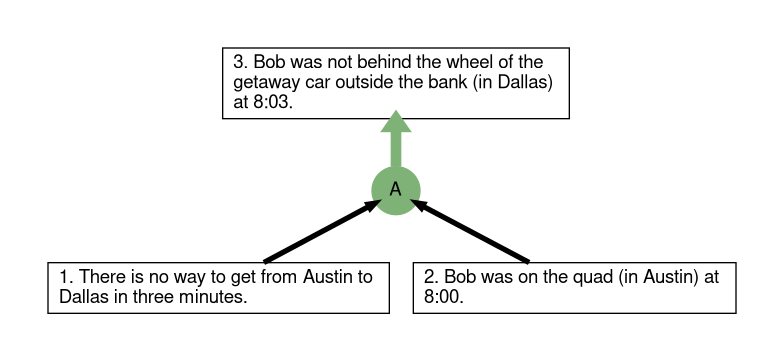
As things stand, however, you do not know Proposition 2, and so you do not know the conclusion, Proposition 3. But, because you have some reason to believe Proposition 2, you have some reason to believe the conclusion as well. Perhaps, then, you should go to the police and make a statement. If you do, how much weight should the police give to your testimony? Let’s consider some of the questions that they might ask you (and that you could ask of yourself):
For how long did you see him? At what distance? How good was the visibility? Did you focus on him, or was he in the periphery of your vision? How familiar are you with Bob’s appearance in the first place? Is it based on vision alone that you think you recognized him, or did you hear his voice as well, or smell that unusual cologne that he’s always wearing?"
In addition to these questions, you might also consider how distinctive Bob’s appearance is: is he someone who is easily recognized in a crowd, or someone who can easily be mistaken for someone else? Notice that for each of these questions there is a range of possible answers, and that how sure you could be that Bob was on the quad depends on where along that range your answer falls.
Another way in which you might have some reason to believe something without being certain of it is by remembering it vaguely. This would be the case with someone who did see Bob on the quad recently and recognized him but couldn’t recall with certainty when the encounter occurred. To get a sense of the considerations that are relevant to determining the epistemic status for this person of the proposition that Bob was on the quad at 8:00am, we could make up a list of questions similar to those that we considered above for the case of seeing Bob on the quad. A third way that one might come to have an intermediate epistemic status with respect to a proposition is by inferring it from earlier propositions. In the example we’ve just been considering, your conclusion that Bob couldn’t have been behind the wheel of the getaway car has such a status because it is inferred from uncertain premises. But there are inferences in which, even if the premises are certain, the conclusion cannot be inferred with certainty. Later, when we consider some of these types of arguments in greater detail, we will get a sense of the factors that would lead to the conclusions being nearer to or further from certainty.
Certainty
Let’s start with certainty. We’ve been using this word a lot in the last few paragraphs, in a way that makes it seem to be nearly synonymous with “knowledge”. Understanding the relation between these two concepts will help us to understand epistemic status better. To be certain of a proposition is to regard it as knowledge, as opposed to regarding it as doubtful. When you are certain of something you act on it and draw inferences from it confidently, whereas when you are uncertain you are more tentative, always keeping in mind the possibility that the proposition is false and planning for that contingency. In this sense, people are sometimes certain of things unreasonably. A fervent racist, for example, might not hesitate to act on his belief. However, when we speak of certainty as an epistemic status, we are referring not to the way a person actually does regard the proposition but to the way it is reasonable for him to regard it. We might call this rational certainty or objective certainty (as opposed to subjective certainty). In any case, this is how I am going to use the word “certain” going forward.
There are some disputes among epistemologists about the relationship between certainty and knowledge. However, the following is comparatively uncontroversial: the beliefs that a person is entitled to classify as knowledge and those that he is entitled to classify as certain are the same. The difference between classifying them as certain and classifying them as knowledge is that, in classifying them as certain, he is contrasting them specifically with beliefs that have a lower epistemic status and is focusing on the fact that he is in a position to act on these beliefs and to draw inferences on these beliefs without hesitation.[1]
In thinking about the different epistemic statuses, it is often helpful to consider how they come up in the criminal justice process, when police officers, judges, and juries often need to weigh evidence, and specify how sure they are of various propositions. The concept of “certainty” is central to criminal trials, where the jury is instructed to return a guilty verdict only if they are certain that the defendant is guilty—only, to use a familiar phrase, if his guilt has been established “beyond a reasonable doubt.” In general, we can think of certainty as the state we are in with respect to a proposition when there is no reasonable doubt about it. Thus, the proposition that Bob was on the quad is not certain because there is a reasonable doubt about it: you didn’t get a good enough look at the person in question to eliminate the possibility that it was someone else who vaguely resembled Bob. Whereas, if you had seen Bob clearly and heard and recognized his voice, these doubts would have been assuaged, and you could be certain that Bob was on the quad.
Of course, there are still doubts that someone might raise here, based on such farfetched scenarios as Bob impersonators, holograms, or hallucinogens; but most of us, in most contexts, would consider such doubts unreasonable, and certainly they would be ruled out as unreasonable in court (unless there was some specific evidence for them in a certain situation). As you might imagine, there is room for argument about what sorts of doubts are reasonable in what contexts and about when we have certainty. Indeed, some philosophers think that there is very little about which we can be genuinely certain—that there is very little that we really know—while others think that we know a great deal. We will have occasion to discuss this debate later. For now, let’s put this issue aside and proceed on the assumption that we can be certain of such things as that the people we see in front of us are really there. This is an assumption that we all do make in our daily lives.
Probability
If a proposition fails to be certain, it may still be probable. A proposition is probable if the evidence is strong enough that it is more likely to be true than not, so that it is reasonable to assume it provisionally, while still making allowances for the possibility that it is false. For example, suppose that on your way to class you and one of your classmates, who you don’t know well, both stopped at an ATM to make a withdrawal and you happened to see his receipt and notice that the balance was $602.47. Half an hour later, during the class, it would be probable that this was still his balance. Since you have been with him in the intervening time, you would know that he hasn’t made any further withdrawals or deposits or used a debit card. But you could not be certain of the balance, since you do not know whether anyone else has access to the account, or whether any previous transactions were posted to the account during this period; and you know that these sorts of events regularly happen with bank accounts. Still, because thirty minutes is so short a time, the odds are against any of these things having happened in this period, so it is more likely than not that the balance has remained the same.
I discussed earlier how juries are instructed to convict in criminal cases only when they are certain that the defendant is guilty. In civil cases (that is, lawsuits) there is a less rigorous standard and only probability is required. In legal terms, a jury should find for the plaintiff and order the defendant to pay damages if “the preponderance of the evidence” favors the plaintiff’s case. This means: if the plaintiff’s case is more likely to be true than false, given all the evidence presented.[2]
Possibility
A proposition that is not probable may still qualify as possible. To call a proposition “possible” in the relevant sense is to say that there is some reason to believe it and that it is, therefore, reasonable to regard it as something that “might be” true and to consider it in our thinking. Thus, in the example above concerning Bob, it is at least possible that he was on the quad at 8:00am (even if it turns out that it is not probable). He might have been there.
Perhaps you’re thinking that “anything is possible” and that you would be in a position to say that Bob “might have been on the quad” even if you hadn’t had the experience of seeing someone who you thought you recognized as him there. There is a sense of the word “possible” in which you could say that it was possible that Bob was on the quad, even if you hadn’t had the experience, but there is another sense of the word in which this would be false. And it is this sense—let’s call it epistemic possibility that is relevant for our present purposes.
To see this, imagine calling the police to tell them of the possibility that Bob was on the quad at 8:00am, three minutes before the robbery in Dallas. They would ask you why you thought it was possible, and they would not react favorably if you responded that “anything’s possible”. They would have quite a different response, however, if you told them about your experience of thinking you recognized him. (Indeed, this report could prove quite useful to them. If Bob has been claiming that he was on the quad at that time, your report could make this alibi considerably more credible.)
There are other contexts in which we can see the idea of epistemic possibility at work in the law. We are all familiar with the idea of a “suspect”—that is, of a person whom the police think might have committed a certain crime, and whom they set to work investigating. There may be a number of suspects for a given crime but notice that the police don’t regard everyone as a suspect, nor do they consider everyone who had the opportunity and ability to commit it a suspect, unless there are only a few such people. In general, the police need some specific reason to suspect someone of a crime, and likewise, we need some specific reason to suspect a proposition of being true—that is, to classify it as “possible”.
Unfounded Propositions
Epistemically possible propositions are to be contrasted with unfounded ones. A proposition is unfounded when there is no reason to believe it. This is the status of things that you make up out of thin air—for example, that there are monsters under your bed, that your roommate committed a murder five years ago, or that his second cousin once lived in Dallas. Some of these propositions are more far-fetched than others—there are no such things as monsters, and very few people commit murders, but many people live in Dallas. However, all these propositions have in common that you have no reason to think they are true, or even to consider them, and the proper course of action is to dismiss them out of hand.
Because we have no reason to believe them, unfounded premises can offer no support whatsoever to any conclusions that we might infer from them. Thus, unfoundedness is the lowest epistemic status.
In some cases, we not only have no reason to believe that a proposition is true, we actually have reason to believe that it is false. This happens when the proposition contradicts something that we know (or have reason to believe) to be true. For example, if you knew that your roommate only had one second cousin and that she spent her whole life in Wyoming, you would know that the proposition that she lives in Dallas was false—or, to put it more simply, you would know that she did not live in Dallas. (By the same token, if it were probable that she had spent her whole life in Wyoming, it would be probable that she didn’t live in Dallas.) In certain respects, propositions that are certainly or probably false can be thought of as having an even lower status than that of unfounded propositions. However, as far as their value as premises is concerned, an unfounded premise is no better than one that is certainly false: neither gives us any reason at all to believe any conclusion.
The Continuum

Thus, we can think of the continuum of epistemic statuses as running from unfounded to certain, with the “possible” and “probable” denoting ranges in between. Of course, among the propositions which are possible, some will be nearer to being probable than others, and, within the probable propositions, some will be nearer than others to being certain. To capture this, we often use the words “probable” and “certain” in a comparative (rather than absolute) sense and say that one proposition is “more probable” or “more certain” than another. This should not be taken to imply that either proposition is probable or certain. For example, when two propositions are merely possible, one may nevertheless be more probable than the other. A proposition is probable in the absolute (rather than comparative) sense when it is more probable that it is true than that it is false—or, as we put it earlier when the preponderance of the evidence favors it. And a proposition is certain (in the absolute rather than the comparative sense), when it is no longer epistemically possible that it is false (that is, when it has been established beyond a reasonable doubt).
We often assert propositions tentatively, indicating that they are probable rather than certain, by qualifying them with the adverb “probably” (for example, “Bob was probably on the quad”), and we usually assert possibilities by saying that they “may” or “might be” the case (“Bob may have been on the quad”).
Additionally, the fact that a conclusion can be inferred from false premises does not give us any reason to believe that the conclusion is also false. In fact, you can take any true proposition and make up arguments that infer it from false premises. Here’s an example:
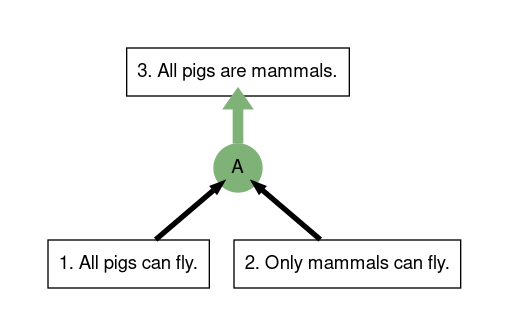
Since the premises are false this argument doesn’t give us any reason to believe that pigs are mammals, but it certainly doesn’t show that they’re not mammals!
Epistemic Status as Objective Relative to a Subject
To be known is to be known to someone, and different people know different things. If you're assessing an argument to figure out whether it puts you in a position to tell that its conclusion is true, what matters about the premises is whether you know them. But if you're giving an argument to someone else to help them tell that the conclusion is true, it won't do you any good to use premises that you're certain of if the other person has no way to tell that they're true. An argument is a reason for someone to believe its conclusion, and how strong the argument is for that someone will depend on the epistemic status the premises have for that someone. Let's call the someone "the subject."
The epistemic status of a proposition is relative to a subject, in the sense that the same proposition will have different statuses for different subjects. Consider the proposition "Lightning just struck the bell tower." This would be certain for a subject who saw the lightning strike the tower, and unfounded for another subject who has no idea that a lightning storm is even taking place. And it might be possible for a third subject who saw lightning strike in the area, but doesn't know what building it hit.
But even though the proposition has different epistemic statuses relative to these different subjects, its status is not subjective in the sense of being determined by the subject's feelings or opinions.
We must take care, however, not to confuse a proposition’s epistemic status for an a subject with how firmly the subject believes it. By the firmness of a belief, I mean how steadfast the person is in holding it. We can think of this as how easy it would be to talk someone out of the belief. The stronger a proposition’s epistemic status is, the more steadfast it is reasonable to be in believing it. It would be unreasonable of someone to get talked out of something he knows to be true. (Indeed, if he was talked out of it, we would probably conclude that he didn’t really know it in the first place.) However, people can sometimes be quite firm in beliefs that have a very low epistemic status. One example would be a fervent racist who, despite all the evidence to the contrary, persists in the belief that the members of other races are inferior to members of his own. Another example would be a self-deceived husband who clings to the belief that his wife is faithful to him, despite strong evidence that she is having an affair.
One way to formulate the distinction between firmness of belief and epistemic status is to say that the former is subjective and the latter objective. Something is subjective if it is determined by someone’s feelings or opinions. It is objective if it is determined by the facts. Though different people know different things, whether a particular person knows something or not is not determined simply by whether he thinks or feels like he knows it, since many people think they know things that they don’t. Nor is something’s epistemic status for someone a matter of his feelings or opinions about it. The epistemic status of a proposition for a given person is determined by facts about such things as the observations he has made and the arguments he has.
When evaluating arguments for certain purposes, is important to consider the (subjective) firmness of an audience’s beliefs. The more firmly the audience believes the premises of an argument, the more persuasive it will find the argument. So, if we were interested in arguments primarily for the purposes of persuading other people, we would have to evaluate the premises with an eye to how firmly the audience believes them. This is how we might proceed in a rhetoric class or if we were considering whether to use an argument in an advertisement or a political campaign. However, this is not why we are interested in arguments in this class. We are interested in arguments because inference is a crucial means of knowledge. From this point of view, what makes an argument good is not that it persuades anyone of anything, but that it puts the audience in a position to know that the conclusion is true (or else brings the audience close to such a position). Therefore, what is relevant to us when assessing premises is not how strongly the audience believes them, but what their epistemic status is for the audience.
And the audience we are primarily interested in is ourselves. After all, we are studying arguments because we want to assess the arguments on which our own beliefs are based and to reach new knowledge. Therefore, when assessing the premises of the arguments we consider in this class, you should be focused on the epistemic status of these premises for you. Do you know the premises to be true? Are you entirely ignorant as to whether they’re true? Or does your state with respect to them fall somewhere along the continuum between knowledge and ignorance? If so, where along that continuum?
One thing to keep in mind when assessing propositions, is that you can't be sure of something if you don't understand it. If someone makes a claim using a lot of impressive technical terminology that you don't understand, then you're not in a position to know that the claim is true. You're not even in a position to think that its possibly or probably true, if you don't understand at all what the claim means. So in assessing it, you'd have to mark it as unfounded. In doing so, you're not necessarily saying that the person making the claim is mistaken or that he did something wrong. You're just saying that you are not in a position to treat the claim as knowledge or even as a hypothesis: given your state of knowledge, you're unable to use this proposition as a grounds to reach any further conclusions.
- ↑ Among the disputed issues are whether it is possible to be certain of something that one doesn’t actually know and whether it is possible to know something without being certain of it.
- ↑ It is worth reflecting on the reason for this difference between criminal and civil law. In a criminal case, what is being decided is whether a person deserves to be punished, and it would be a grave injustice to punish him for a crime he didn’t commit, so it is important to be certain that he is guilty. In a civil case, however, what is being disputed is which of the two parties should have to bear a certain cost. For example, I might sue you for $1,000 to repair my car, claiming that you caused the damages. In this case, the court needs to decide between forcing you to pay the money and leaving me to pay it. And, if the preponderance of the evidence favors the conclusion that you caused the damage, then even if the jurors had some reasonable doubts, it would be unjust of them to leave me to pay for the damage that you probably caused.