Objections: Difference between revisions
No edit summary |
|||
| Line 38: | Line 38: | ||
considering how damaging the objection would be to the premise or inference objected to, | considering how damaging the objection would be to the premise or inference objected to, _if all of the objection's premises were certain_. | ||
Objections are assessed like other arguments. One assesses each of the objection's premises | Objections are assessed like other arguments. One assesses each of the objection's premises | ||
Revision as of 11:07, 22 August 2025
An objection is an argument that articulates a reason for rejecting another argument. It does this by objecting to one of the argument's premises or inferences. The objection as formulating as an argument a reason for giving the relevant premise or inference a low assessment.
In ReasonSpace an objection is represented by a red octagon with a red arrow pointing from it to the premise or inference that is being objected to. Each objection will have at least one premise, connected to it by black arrow (in the same way premises are connected to other arguments).
Objections to premises
An objection to a premise is an argument that the premise is unfounded (or otherwise week) and therefore is of no (or little) value in establishing any further conclusion. The objection can show this either by showing that the premise is false, or else by showing that we are in no position to know (or have any reason to believe) that it is true.
Here is an example of a map of an argument with an objection that one of the premises is false.
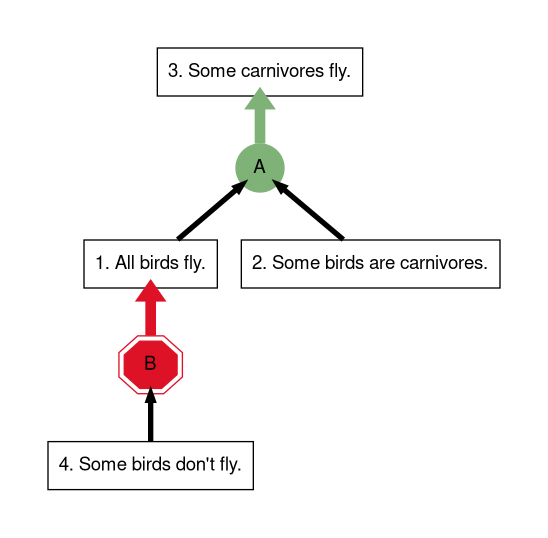
Of course, Proposition 4 is just the opposite of Proposition 1, so someone who believed this argument is likely to just reject Proposition 4 and be unmoved by this objection. So a more convicting form of the objection might give more of an argument against Proposition 4, rather than just asserting the opposite. Here's an example.
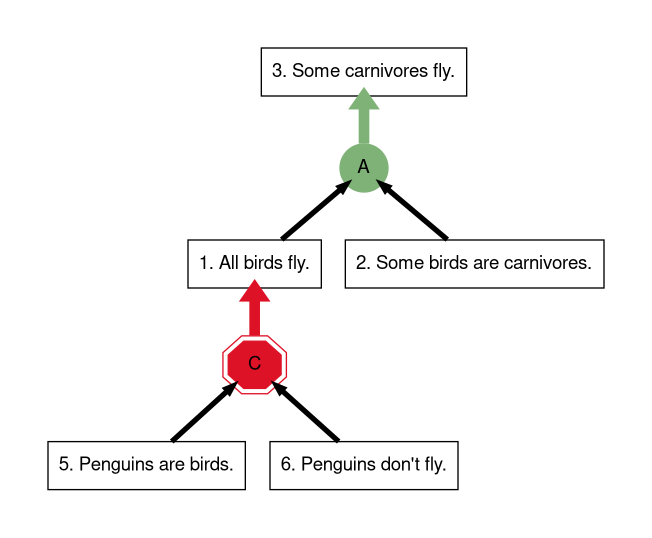
In these examples we argued that a premise is false. But a proposition doesn't have to be false to be unfounded or week. We just have to not be in a position to know that it's true. Here's a map that objects to a premise on these grounds.
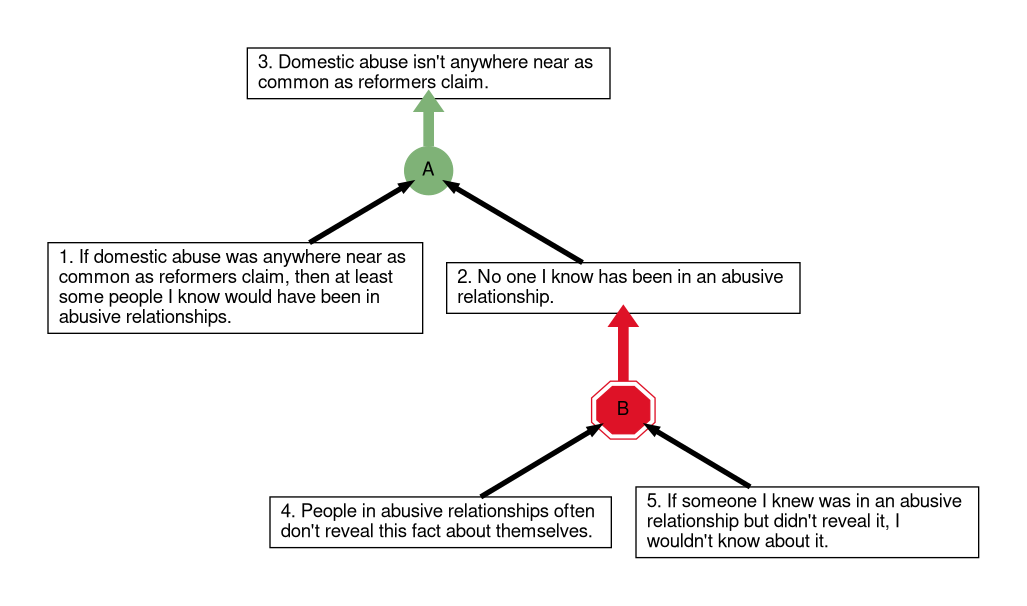
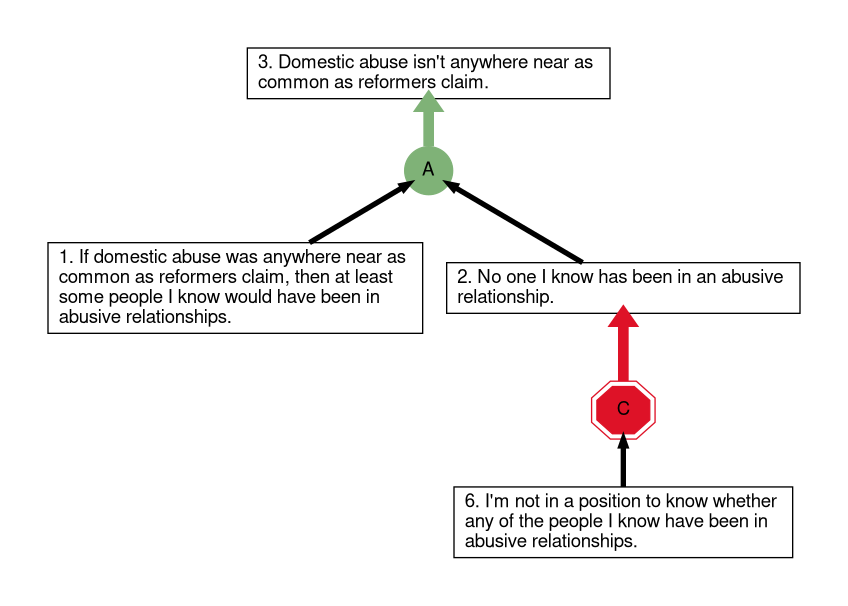
Objection B gives an argument that Proposition 2 is unknown. We could also have an objection that atterts this more directly, as in the map below:
Objections to inferences
An objection to an inference is an argument that the inference is a non-sequitur, or (failing that) that it is not very strong. This means that it aims to show that even if one knew the premises of the inference to be true, the premises wouldn't give one a reason to think that the conclusion is true. Often such objections work by identifying the inference as a known fallacy. Here are two examples:
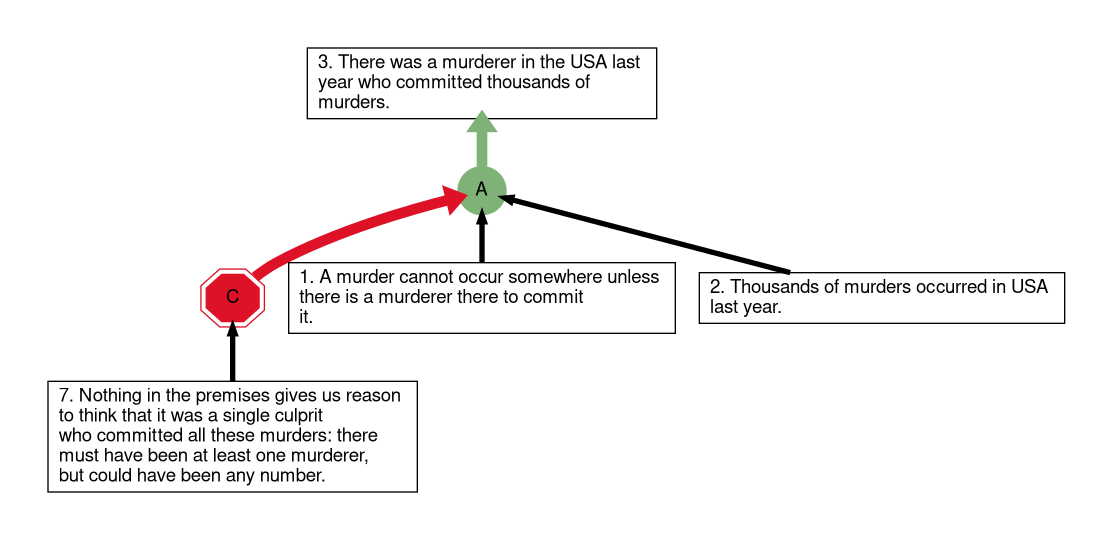
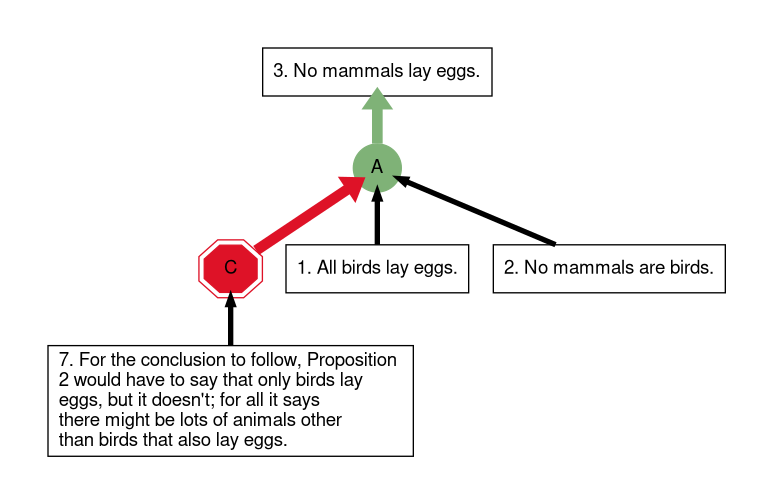
Assessing objections in ReasonSpace
To assess an objection, you have to assess all of the objections premises and the objecting inference (represented by the red octagon). You assess the premises, as you would assess any other premise, by determining its [epistemic status]. You assess the objecting inference considering how damaging the objection would be to the premise or inference objected 'if all of the objection's premises were certain'.
considering how damaging the objection would be to the premise or inference objected to, _if all of the objection's premises were certain_.
Objections are assessed like other arguments. One assesses each of the objection's premises
Objections in ReasonSpace are represented as arguments with one or more propositions leading into the red hexagon, which represents the objecting inference. To assess an objection, first assess each of its premises as you would assess any other proposition. Then assess the objecting inference. To assess this inference, assume (for the sake of argument) that all of its premises are true, and then consider how damaging this would be to the proposition or inference being objected to. If the objection's premises being true would thoroughly undermine the item being objected to (showing that the premise us unfounded or the inference a non sequitur), then assess the objecting inference in the right-most region of the scale. If the premises' being true wouldn't at all undermine the item being objected to, then assess the objecting inference in the leftmost region of the scale (as a non sequitur). If the premises' being true would be damaging, but not fatal to the item being objected to, then assess the objecting inference somewhere in the middle two regions of the scale (depending on just how damaging you think it is).
Assessing an objection will add a limit to how highly you can assess the item objected to. This limit will appear as a red shaded area at the right of the assessment scale of the relevant item.