Single Culprit Fallacy: Difference between revisions
No edit summary |
No edit summary |
||
| (5 intermediate revisions by the same user not shown) | |||
| Line 1: | Line 1: | ||
Consider the following argument. | Consider the following argument. | ||
{{Map|https://app.reasonspace.com/ | {{Map|https://app.reasonspace.com/submaps/755f10640666473c9cc7830bba28708a}} | ||
[https://app.reasonspace.com/ | Proposition 1 is clearly true. Proposition 2 is also true. There are in fact tens of thousands of murders in the US on an average year. Moreover, the premises are related to one another such that we could deduce ''some'' conclusion from them, but the Inference A is clearly a [[non sequitur]]: the premises give us ''no reason'' to believe Proposition 3. | ||
From the premises we can conclude that there was at least one murderer in the USA last year. But we can't deduce that there was any ''single murderer'' that committed ''all the murders.'' The premises don't give us any information about how many of the murders were committed by the same person. For all they say, every murder might have been committed by a different murderer. And, going by our background knowledge of criminology, this is a lot more likely than that there was some single serial killer responsible for all the murders. More likely than either of these alternatives is that there were many murderers, and that some of them committed multiple murders. Any judgment we make about how many murderers there probably were is going to depend on such background knowledge, nothing in the premises suggests one way or another, and the premises certainly don't give us any reason to think that the murders were all committed by any one person. | |||
This argument commits what we can call the ''single culprit fallacy''. Let's describe it more generally. One premise tells us that a phenomenon of a certain sort (e.g. murder) cannot exist without a being of a certain sort (e.g. a murderer) to cause it. The second premise tells us that phenomena of that sort do exist. Then the conclusion says that there is a being of the relevant sort that causes ''all'' of the relevant phenomena. | |||
{{Map|https://app.reasonspace.com/submaps/0ae85bfffc494680afab416d645fd08f}} | |||
We could conclude from the premises that ''at least one'' being of the relevant sort exists, but not that there's a ''single'' such being causing ''all'' of the relevant phenomena. That's a [[non sequitur]]. To reach any conclusion about how many such beings there are, and about which of the phenomena are caused by the same being (and which by other beings of the same type) we'd need more information than is included in these premises. | |||
Latest revision as of 18:16, 10 August 2025
Consider the following argument.
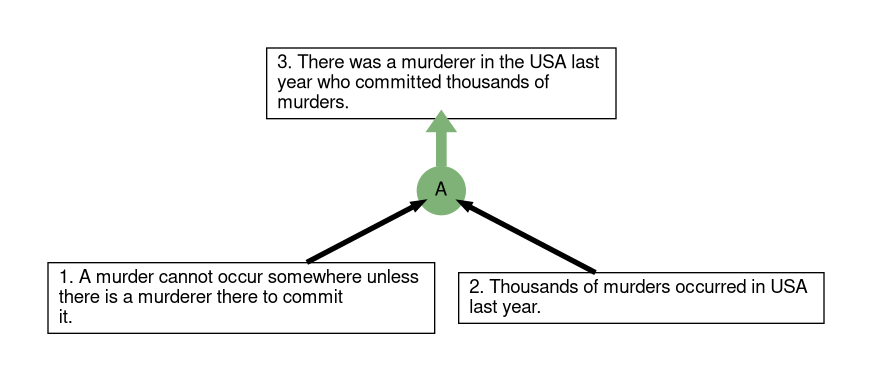
Proposition 1 is clearly true. Proposition 2 is also true. There are in fact tens of thousands of murders in the US on an average year. Moreover, the premises are related to one another such that we could deduce some conclusion from them, but the Inference A is clearly a non sequitur: the premises give us no reason to believe Proposition 3.
From the premises we can conclude that there was at least one murderer in the USA last year. But we can't deduce that there was any single murderer that committed all the murders. The premises don't give us any information about how many of the murders were committed by the same person. For all they say, every murder might have been committed by a different murderer. And, going by our background knowledge of criminology, this is a lot more likely than that there was some single serial killer responsible for all the murders. More likely than either of these alternatives is that there were many murderers, and that some of them committed multiple murders. Any judgment we make about how many murderers there probably were is going to depend on such background knowledge, nothing in the premises suggests one way or another, and the premises certainly don't give us any reason to think that the murders were all committed by any one person.
This argument commits what we can call the single culprit fallacy. Let's describe it more generally. One premise tells us that a phenomenon of a certain sort (e.g. murder) cannot exist without a being of a certain sort (e.g. a murderer) to cause it. The second premise tells us that phenomena of that sort do exist. Then the conclusion says that there is a being of the relevant sort that causes all of the relevant phenomena.
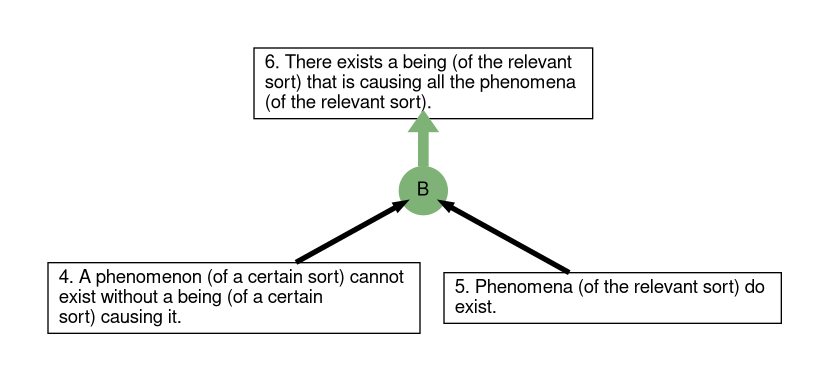
We could conclude from the premises that at least one being of the relevant sort exists, but not that there's a single such being causing all of the relevant phenomena. That's a non sequitur. To reach any conclusion about how many such beings there are, and about which of the phenomena are caused by the same being (and which by other beings of the same type) we'd need more information than is included in these premises.