Aristotelian Syllogisms: Difference between revisions
No edit summary |
No edit summary |
||
| Line 1: | Line 1: | ||
Aristotle went through all possible combinations of two premises and a conclusion that could be made with propositions of the form “All/Some A are/aren’t B” and figured out which were valid deductions. | Aristotle went through all possible combinations of two premises and a conclusion that could be made with propositions of the form “All/Some A are/aren’t B” and figured out which were valid deductions. He found that 14 of them were, and these were later given names by Medieval logicians. We can call these the Aristotelian Syllogisms. (Syllogism is the Greek word that Aristotle used for "deduction"; in English, it has come to refer to an argument with two premises and a conclusion.) | ||
Aristotle also found that all of the 14 valid forms could be restated in terms of four, which he called "First Figure Syllogisms." They are listed below. | |||
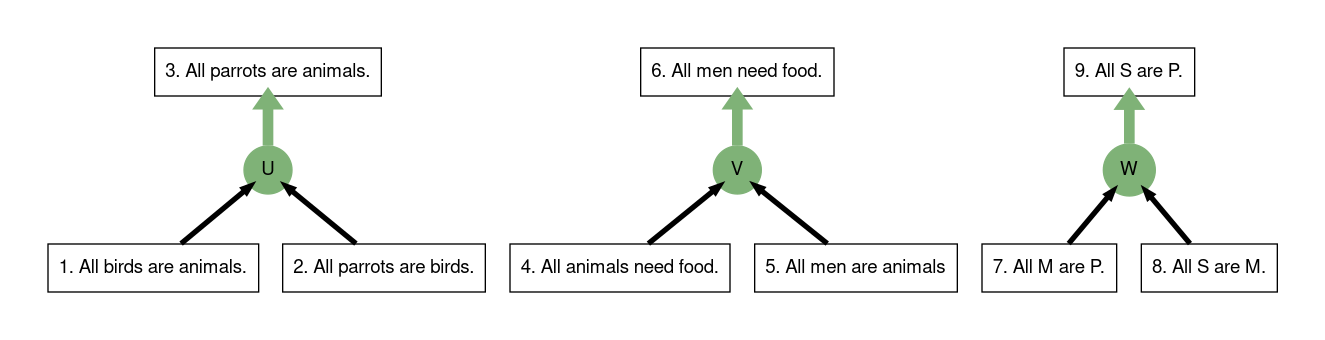
Why, in each of these cases, do the premises necessitate the conclusion? It is because one premise is a universal proposition saying something about everything of a certain sort and the other premise tells us that something else is that sort of thing. The conclusion then applies the universal premise about all things of the sort to the thing that the other premise tells us is a member of that sort. If the universal premise is really true, and the thing in question really belongs to the relevant sort, then the universal premise will, of course, have to apply to that thing. | |||
=First Figure Syllogisms= | =First Figure Syllogisms= | ||
| Line 14: | Line 18: | ||
{{Map|https://app.reasonspace.com/arguments/9ea18ef3-9d6c-4d80-ae4e-7447ea4ee011}} | {{Map|https://app.reasonspace.com/arguments/9ea18ef3-9d6c-4d80-ae4e-7447ea4ee011}} | ||
= | =Second Figure Syllogisms= | ||
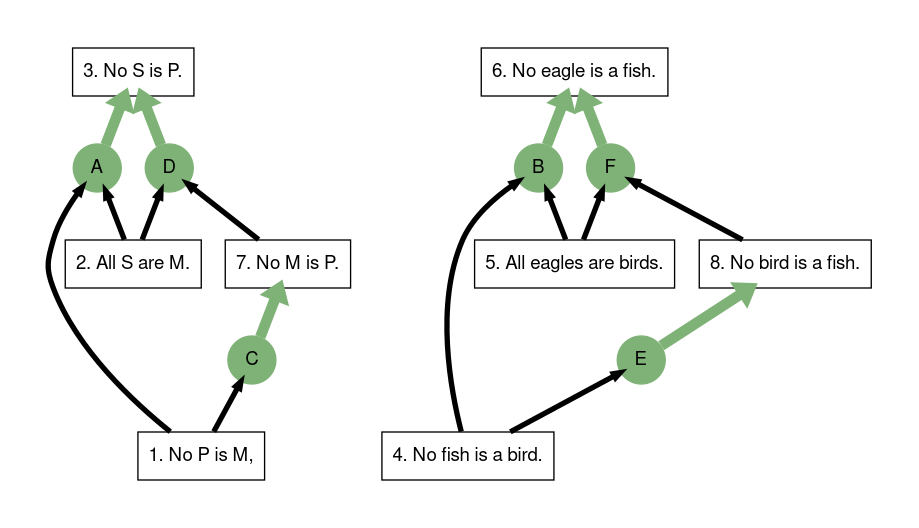
==Cesare== | |||
{{Map|https://app.reasonspace.com/arguments/eb48ef459a414deda929f3b459aa77ea}} | |||
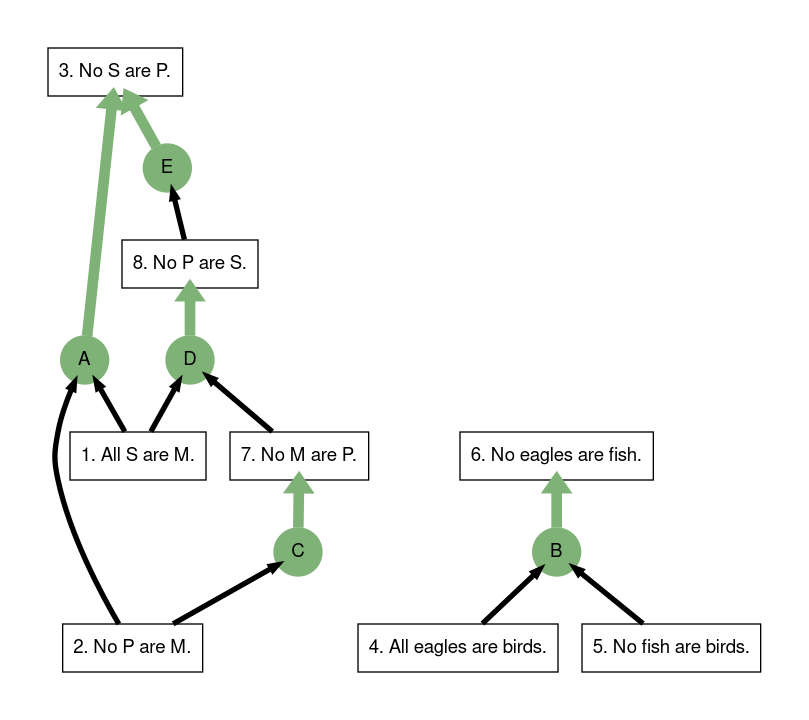
==Camestres== | |||
{{Map|https://app.reasonspace.com/arguments/4bbc209b037d44a181abd05e7a8a8068}} | |||
==Festino== | |||
{{Map|https://app.reasonspace.com/arguments/311388472ad14a90b4017e60af953bd0}} | |||
==Baroco== | |||
{ | {{Map|https://app.reasonspace.com/arguments/0df77d3e4cca468ab0d1e27abd6e1313}} | ||
| | |||
=Third Figure Syllogisms= | |||
Revision as of 16:41, 30 August 2024
Aristotle went through all possible combinations of two premises and a conclusion that could be made with propositions of the form “All/Some A are/aren’t B” and figured out which were valid deductions. He found that 14 of them were, and these were later given names by Medieval logicians. We can call these the Aristotelian Syllogisms. (Syllogism is the Greek word that Aristotle used for "deduction"; in English, it has come to refer to an argument with two premises and a conclusion.)
Aristotle also found that all of the 14 valid forms could be restated in terms of four, which he called "First Figure Syllogisms." They are listed below.
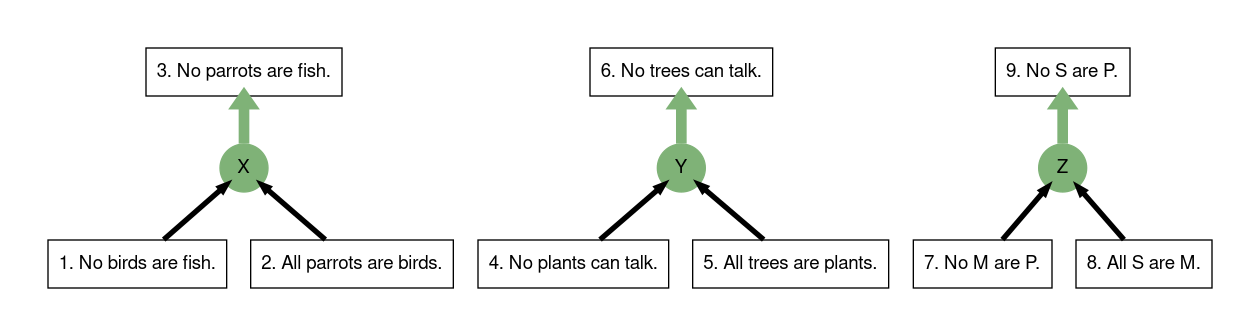
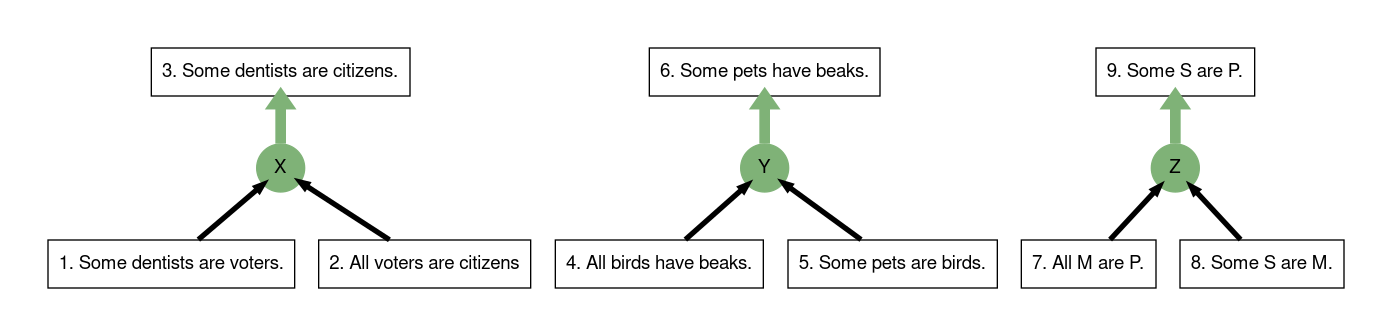
Why, in each of these cases, do the premises necessitate the conclusion? It is because one premise is a universal proposition saying something about everything of a certain sort and the other premise tells us that something else is that sort of thing. The conclusion then applies the universal premise about all things of the sort to the thing that the other premise tells us is a member of that sort. If the universal premise is really true, and the thing in question really belongs to the relevant sort, then the universal premise will, of course, have to apply to that thing.
First Figure Syllogisms
Barbara
Celarent
Darii
Ferio
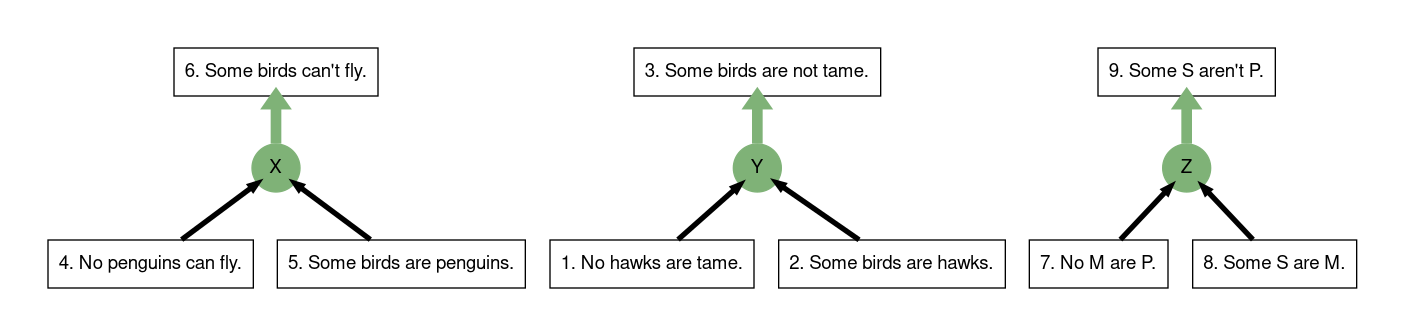
Second Figure Syllogisms
Cesare
Camestres
Festino
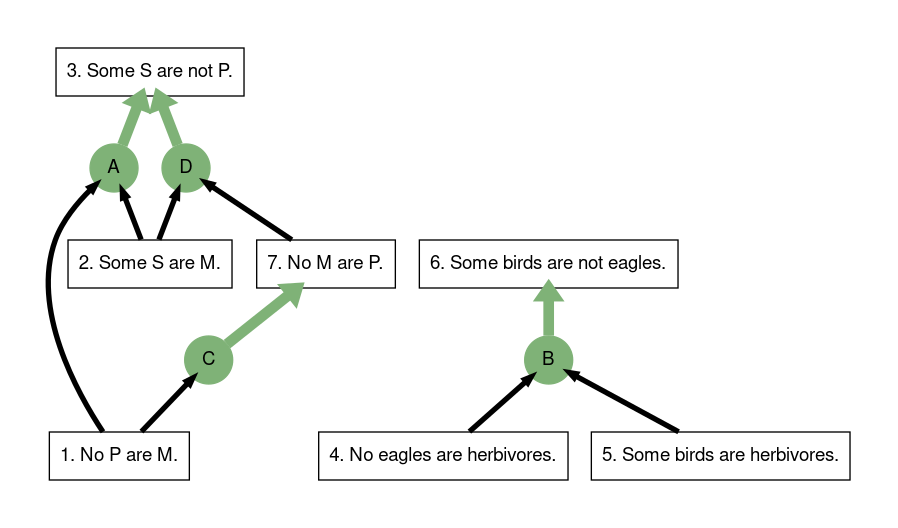
Baroco