Aristotelian Syllogisms: Difference between revisions

From docs.reasonspace.com
Jump to navigation Jump to search
(Created page with "{| class="wikitable" |'''The Barbara Syllogism''' |- |{{Map|https://app.reasonspace.com/arguments/916b58e1-07e7-484c-adf9-2cb8897c1eb7}} |} Let’s focus on the first of these examples. Notice that it is not because of anything special about the subject matter that the premises necessitate the conclusion. If we changed the argument to be about Volkswagens, cars, and Jettas, rather than birds, animals, and parrots, the premises would still necessitate the conclusion. Th...")
 
No edit summary
Line 1: Line 1:
{| class="wikitable"
=First Figure Syllogisms=
|'''The Barbara Syllogism'''
==Barbara==
|-
{{Map|https://app.reasonspace.com/arguments/916b58e1-07e7-484c-adf9-2cb8897c1eb7}}
|{{Map|https://app.reasonspace.com/arguments/916b58e1-07e7-484c-adf9-2cb8897c1eb7}}
|}


==Celarent==
{{Map|https://app.reasonspace.com/arguments/0592ce7f7391434c86d6bb0c940830fd}}


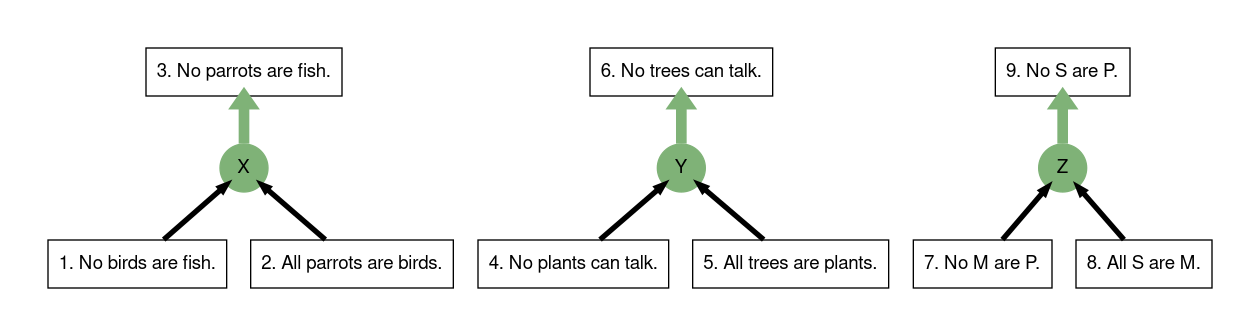
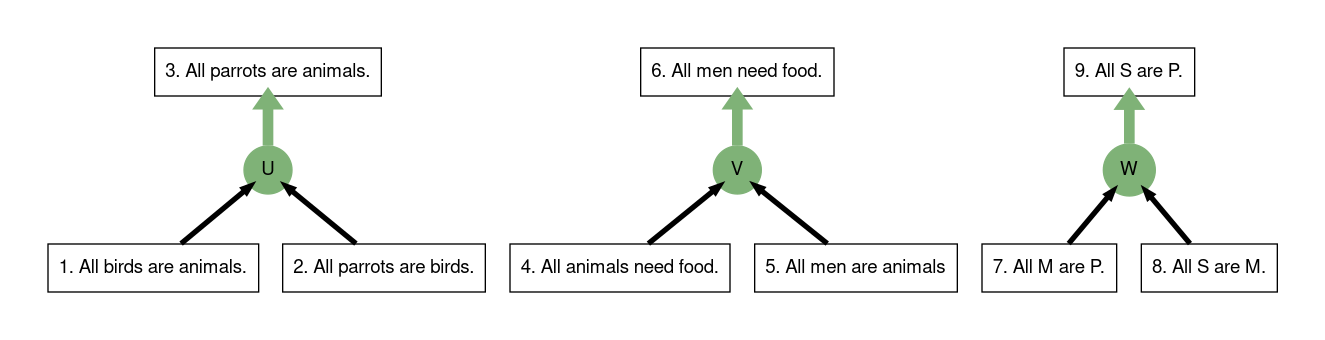
Let’s focus on the first of these examples. Notice that it is not because of anything special about the subject matter that the premises necessitate the conclusion. If we changed the argument to be about Volkswagens, cars, and Jettas, rather than birds, animals, and parrots, the premises would still necessitate the conclusion. The same holds if we changed the argument to make it about musicians, matadors, and marriage counselors. In this last case, both premises would be false, but if they were true (that is, if all musicians were matadors and all matadors, marriage counselors), then the conclusion would have to be true: all musicians would have to be marriage counselors. What makes the deduction work doesn’t have to do with the subject matter of the propositions involved, but with their structure and interrelation. This is called the ''form'' of the argument.
==Darii==
Notice now that the argument immediately to the right of the one we have been considering has the same logical form. (If you don’t see this immediately, try replacing the phrase “need food” with “are things that need food” or “are food-needers”.) In order to focus on the forms of deductive arguments rather than their content, Aristotle introduced the practice of using letters to stand for the subjects and predicates of the propositions, leaving behind only words like “some”, “all”, “no”, “is” and “not” (and their variants). Thus, we can arrive at the symbolic representation, presented in the right above, of the form of the arguments we’ve been discussing.
{{Map|https://app.reasonspace.com/arguments/929a5fec-eb8c-4468-87c6-8a4cb5f82e76}}
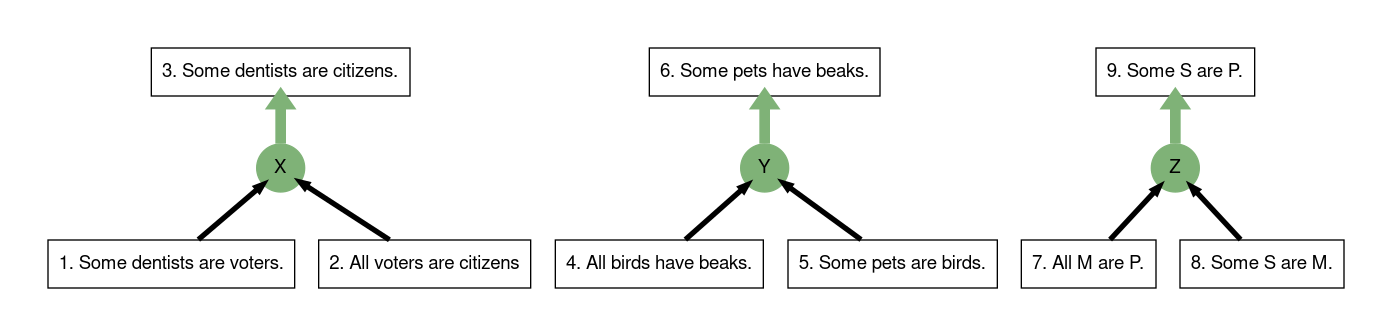
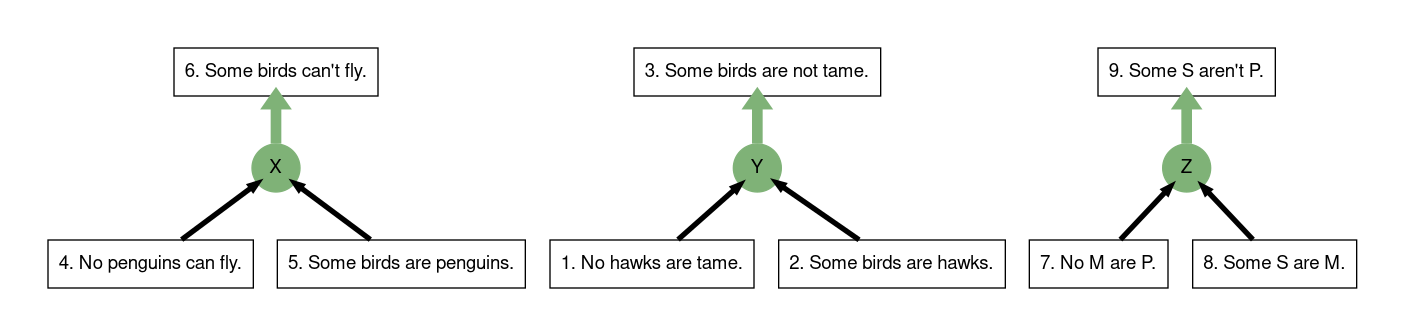
Here are some other forms of deductive arguments. (Again, the arguments next two each other share the same form which is represented symbolically on the right.)


{| class="wikitable"
==Ferio==
| '''The Celarent Syllogism'''
{{Map|https://app.reasonspace.com/arguments/9ea18ef3-9d6c-4d80-ae4e-7447ea4ee011}}
|-
|{{Map|https://app.reasonspace.com/arguments/0592ce7f7391434c86d6bb0c940830fd}}
|}


{| class="wikitable"
=Other=
| '''The Darii Syllogism'''
|-
|{{Map|https://app.reasonspace.com/arguments/929a5fec-eb8c-4468-87c6-8a4cb5f82e76}}
|}
 
{| class="wikitable"
|'''The Ferio Syllogism'''
|-
|{{Map|https://app.reasonspace.com/arguments/9ea18ef3-9d6c-4d80-ae4e-7447ea4ee011}}
|}


[[file:Map19-21.png|thumb|center|500px]]
[[file:Map19-21.png|thumb|center|500px]]

Revision as of 19:27, 29 August 2024

First Figure Syllogisms

Barbara
export?options%5Bembed%5D=true&options%5Bformat%5D=.png

Celarent

export?options%5Bembed%5D=true&options%5Bformat%5D=.png

Darii

export?options%5Bembed%5D=true&options%5Bformat%5D=.png

Ferio

export?options%5Bembed%5D=true&options%5Bformat%5D=.png

Other

Map19-21.png
Map 22-24.png
Map 25-27.png

Aristotle went through all possible combinations of two premises and a conclusion that could be made with propositions of the form “All/Some A are/aren’t B” and figured out which were valid deductions. It turned out that all of the valid forms could be restated in terms of the four that we’ve already looked at. Why, in each of these cases, do the premises necessitate the conclusion? It is because one premise is a universal proposition saying something about everything of a certain sort and the other premise tells us that something else is that sort of thing. The conclusion then applies the universal premise about all things of the sort to the thing that the other premise tells us is a member of that sort. If the universal premise is really true, and the thing in question really belongs to the relevant sort, then the universal premise will, of course, have to apply to that thing.

Aristotle examples.png

Though most deductive arguments involve the application of universal propositions to particular cases, not all do. Some, which were focused on by later Greek and Medieval logicians, involve the application of hypothetical statements to actual cases or the application of statements about alternative possibilities to cases in which some of the alternatives have been ruled out. Here are some examples:

Map 28-29:
export?token=91c26439-f505-4042-a37c-ac44c9114b34&target=active&dpi=100&view=true&format=.png
Map 30-31:
export?token=b0eb2c33-db22-4735-b11a-29e06170402e&target=active&dpi=100&view=true&format=.png